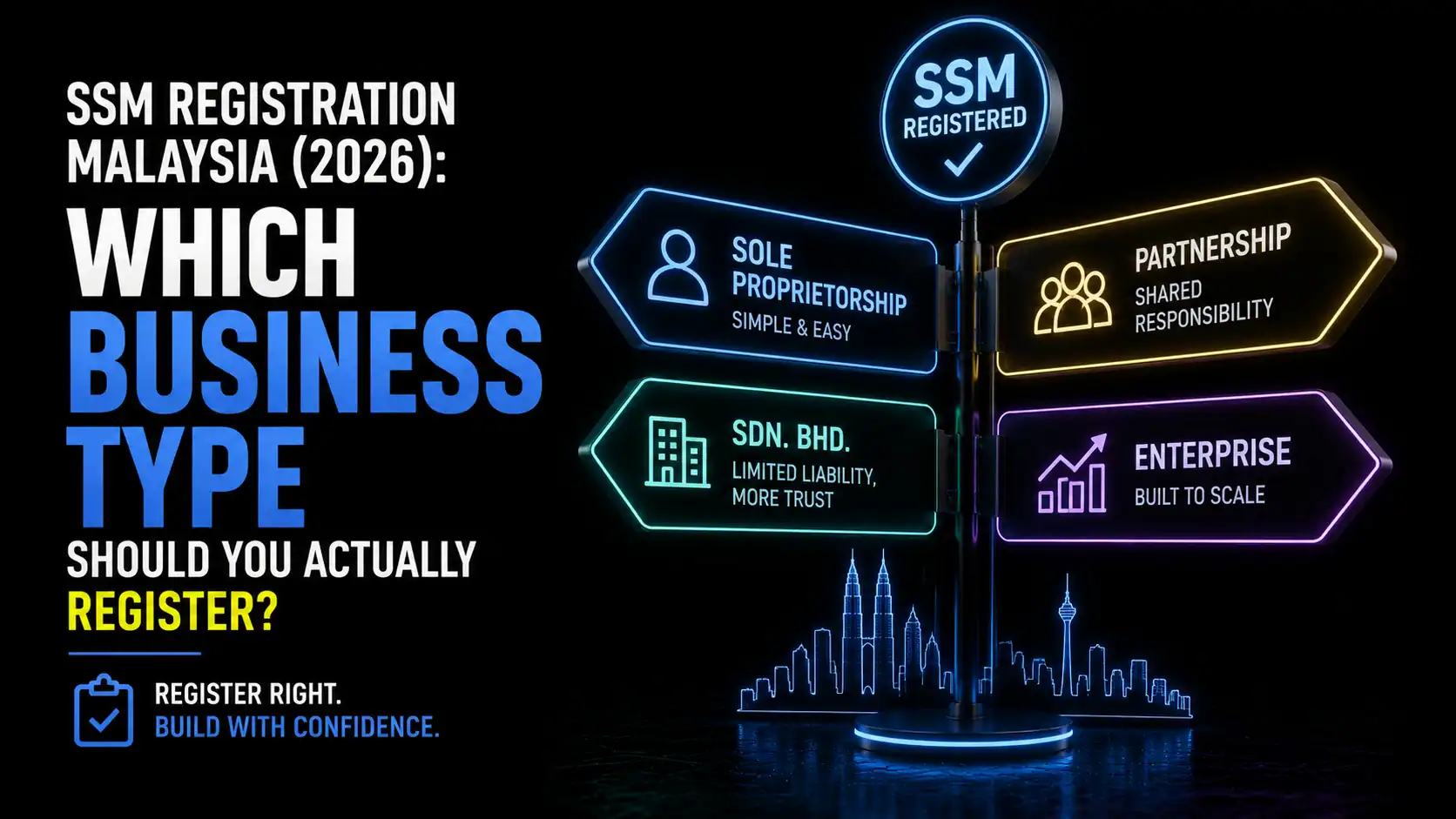
Almost every SSM guide online tells you the same thing: here are the business types — sole proprietorship, partnership, LLP, Sdn Bhd — now go register. That’s the easy part. The part that actually costs people money is the decision nobody helps with: which one should you register, what will it really cost you every year, and when should you switch? Pick wrong and you either expose your personal savings to your business’s debts, or you saddle a side-hustle with thousands of ringgit in compliance fees it never needed.
In 2024 alone, Malaysians registered 343,561 new businesses (sole props and partnerships), 55,595 new companies and 4,017 new LLPs with SSM (Suruhanjaya Syarikat Malaysia). Most of those founders picked their structure blind. This guide is the decision itself — the honest trade-offs, the real costs including the ones agents don’t quote, the tax math on when incorporating actually pays, and the 2026 obligations (e-invoicing, SST, tax) that hit you the moment you register. If you just want the click-by-click registration steps, we have a separate step-by-step guide to registering a business in Malaysia; this one is about choosing correctly before you do.
A quick orientation first. SSM (Suruhanjaya Syarikat Malaysia) is the government body that registers every business and company in the country — you legally cannot operate without registering with it. It runs two separate systems that trip people up: the Registration of Businesses regime for “enterprises” (sole proprietorships and partnerships, done on the ezBIZ portal), and the company/LLP regime for incorporated entities (Sdn Bhd via MyCoID and LLPs via MyLLP). “Enterprise” and “company” are not interchangeable words here — they mean different legal status, different liability, and very different annual costs. That distinction is the heart of the decision, so keep it in mind as you read.
The 60-second answer: which SSM structure fits you?
If you read nothing else, this table gets 90% of people to the right decision. The detail and the costs come after.
| If you are… | Register | Why |
|---|---|---|
| A freelancer, side-income earner or solo micro-trader | Sole Proprietorship | Cheapest and simplest (RM30–60/year), no secretary, no audit — just accept the personal-liability risk while small |
| 2–20 people going in together, low capital | Partnership (or LLP) | Shares risk and profit; LLP if you want liability protection too |
| A professional firm, joint venture, or partners who want protection | LLP | Limited liability without a company secretary or audit — the quiet middle path |
| Serious about scaling, raising money, big clients, or protecting personal assets | Sdn Bhd | Separate legal entity, limited liability, 15% SME tax rate, and the credibility banks and clients expect |
| A foreigner / non-resident | Sdn Bhd (or LLP) | Sole prop and partnership are closed to non-citizens; you must incorporate |
The single biggest mistake is treating this as permanent. It isn’t. The smart path for most people is to start as a sole proprietor to test the business cheaply, then convert to an Sdn Bhd once the profit, risk or credibility demands it. The rest of this guide tells you exactly where those lines are.
The four structures, honestly
Malaysia has two registration regimes: enterprises (sole proprietorship and partnership, under the Registration of Businesses Act 1956, done on SSM’s ezBIZ portal) and bodies corporate (Sdn Bhd under the Companies Act 2016 via MyCoID, and LLP under the LLP Act 2012 via MyLLP). The difference that matters most is liability — whether your business’s debts can reach your personal bank account and house.
| Sole Proprietorship | Partnership | LLP (PLT) | Sdn Bhd | |
|---|---|---|---|---|
| Law / portal | ROB Act 1956 / ezBIZ | ROB Act 1956 / ezBIZ | LLP Act 2012 / MyLLP | Companies Act 2016 / MyCoID |
| Owners | 1 individual | 2–20 partners | 2+ partners (no max) | 1–50 shareholders |
| Liability | Unlimited (personal) | Unlimited (personal) | Limited | Limited |
| Separate legal entity? | No | No | Yes | Yes |
| Company secretary? | No | No | No (needs a compliance officer) | Yes, mandatory |
| Statutory audit? | No | No | No (unless agreed) | Yes, unless exempt |
| Foreigners can own? | No | No | Yes | Yes |
Sole Proprietorship
One owner, cheapest to run, taxed as your personal income. The catch is unlimited liability: legally there is no line between you and the business, so its debts are your debts. It suits freelancers, home businesses and anyone testing an idea. Malaysian citizens or permanent residents aged 18+ only.
Partnership
The same as a sole proprietorship but with 2 to 20 owners sharing capital, profit and — crucially — unlimited liability, including for each other’s business actions. Fine for small, high-trust ventures; risky if you don’t fully trust your partners’ judgement, because you can be liable for their mistakes.
Limited Liability Partnership (LLP / PLT)
The underrated middle option. An LLP is a separate legal entity with limited liability like a company, but with the lighter compliance of an enterprise: no company secretary and no statutory audit required. It needs a compliance officer (a partner or qualified secretary who is a Malaysian resident) and one annual declaration. Popular with professional firms (law, accounting), joint ventures and cost-conscious partners who want protection without the Sdn Bhd overhead.
Sendirian Berhad (Sdn Bhd)
A private limited company: a separate legal person that owns its own assets and debts, so shareholders’ personal assets are protected (with an important caveat we cover below). It can have 1 to 50 shareholders, can raise capital by issuing shares, gets the 15% SME tax rate, and carries the credibility that banks, big clients and investors expect. The price is real compliance: a mandatory company secretary, annual returns, and accounts that may need auditing. This is the structure serious, scaling businesses end up in.
The real costs nobody quotes you
Registration fees are trivially cheap. It’s the ongoing cost that surprises people — especially with an Sdn Bhd. Here are SSM’s official fees, followed by the realistic all-in annual running cost.
Official SSM registration & filing fees
| Item | Fee (RM) |
|---|---|
| Sole prop / partnership — personal name | 30 / year |
| Sole prop / partnership — trade name | 60 / year |
| Each branch | 5 / year |
| Business info print-out / certificate | 10 |
| Sdn Bhd incorporation (MyCoID) | 1,000 |
| Company name reservation (per 30 days) | 50 |
| Sdn Bhd annual return | 150 |
| LLP registration (incl. name) | 500 |
| LLP name reservation | 30 |
| LLP annual declaration | 200 |
(SSM Table of Fees, retrieved July 2026. There is no separate “name approval” charge for a sole prop — the trade-name check is bundled into the RM60.)
The all-in annual running cost (the honest version)
This is what actually matters, and where an Sdn Bhd’s cost lives — not in the RM1,000 to register, but in what you pay every year to keep it compliant.
| Structure | Setup | Realistic ongoing / year | What drives it |
|---|---|---|---|
| Sole prop / partnership | RM30–60 | RM30–60 | Just the renewal — no secretary, no audit |
| LLP | ~RM500 | ~RM200 + light accounting | Annual declaration; a partner can be the compliance officer |
| Sdn Bhd | ~RM1,500–2,500 (incl. secretary setup) | ~RM3,000–10,000+ | Company secretary (RM60–150+/mo), accounting, tax filing, and audit if not exempt |
Malaysian business owners are candid about this online. On the cheap end:
“It’s dirt cheap lah” — sole-proprietor registration, Lowyat forum
And on the Sdn Bhd end, the recurring warnings:
“So many fees to so many people and heavy compliance requirements. Why bother with such an expensive structure?” — Lowyat forum
“yearly ‘maintenance fee’ is around 5k–6k for sdn bhd” — Lowyat forum
“Audit n accounting fee for my sdn bhd is around 10k a year.” — Lowyat forum
Those figures are real ranges, not scare stories: a simple dormant or tiny Sdn Bhd can be kept for a few thousand a year, while an active one with proper audited accounts routinely runs RM5,000–10,000 once you add secretary, accounting, tax agent and audit. The lesson isn’t “avoid Sdn Bhd” — it’s “don’t incorporate a RM2,000-a-month side-hustle,” because the compliance can eat the profit.
What you’re actually paying for with an Sdn Bhd
The reason an Sdn Bhd costs what it does is that it has several separate obligations, each with its own bill. Knowing the parts lets you budget honestly and spot an agent’s “hidden fees” before you sign.
| Cost component | What it’s for | Rough annual RM |
|---|---|---|
| Company secretary | Mandatory statutory role — files returns, keeps registers, ensures compliance | 720–1,800 (more if complex) |
| Accounting / bookkeeping | Preparing your financial statements | 1,000–4,000+ |
| Tax agent / filing | Corporate tax computation and submission to LHDN | 800–2,500 |
| Audit (if not exempt) | Statutory audit of the accounts | 1,500–5,000+ |
| Annual return (SSM) | The RM150 statutory filing | 150 |
A lean, near-dormant company that qualifies for audit exemption might keep this to a few thousand ringgit; an active trading company with a proper audit easily reaches RM5,000–10,000, which is exactly the range owners report. The takeaway isn’t to fear it — it’s to make sure the business generates enough profit and protection value to justify it. Malaysian owners are wary of agents who quote a low headline and pile on extras:
“Many company secretary offer RM1500–RM1600 to open business but when I call to sign up, there are a lot of hidden fee… I need clear guideline to avoid been cheated.” — Lowyat forum
Ask any secretary for the full first-year and ongoing cost in writing — setup, monthly retainer, accounting, tax and audit — before you commit.
Sole prop vs Sdn Bhd: the full scorecard
Cost and tax aside, the two structures differ on things that matter as you grow. Here’s the side-by-side that captures the whole decision, not just the fees.
| Factor | Sole Proprietorship | Sdn Bhd |
|---|---|---|
| Personal asset protection | None — you are the business | Yes (banks may still want a guarantee) |
| Tax | Personal rates (up to 30%) | SME 15% / 17% / 24% |
| Setup + annual cost | RM30–60 | ~RM1,500 setup, RM3,000–10,000+/yr |
| Credibility with big clients / banks | Lower | Higher |
| Raising capital / investors | Very hard | Designed for it (shares) |
| Business continuity | Ends with the owner | Perpetual; transferable / sellable |
| Compliance burden | Minimal | Secretary, audit, annual returns |
| Best stage | Testing, small, low-risk | Scaling, funded, higher-risk |
Read down the columns and the pattern is clear: the sole proprietorship wins on cost and simplicity; the Sdn Bhd wins on protection, tax-at-scale, credibility and growth. Your job is to match the column to where your business actually is — today, not where you hope it’ll be in five years.
The liability reality check
“Limited liability” is the headline reason people incorporate, and it’s genuinely important — but it’s more nuanced than the brochures suggest. With a sole proprietorship or partnership, there is no separation between you and the business:
“The danger of enterprise is you’re personally liable to the debt of the enterprise.” — Lowyat forum
“If they decided to sue you anytime soon, and you’re under enterprise business, they can take your personal wealth as well.” — Lowyat forum
An Sdn Bhd or LLP fixes that in law — the entity is liable, not you personally. But in practice, for a young company, lenders close the gap:
“take loan from bank they will ask director to give personal guarantee” — Lowyat forum
So the real rule is: incorporation protects your personal assets from trade creditors, lawsuits and business failures — which is meaningful — but banks will often still want a personal guarantee on loans, so it’s not a magic shield against everything. If your business carries real risk (stock, staff, contracts, physical premises, anything that can be sued), that protection is worth the compliance cost. If you’re a solo freelancer with almost no liability exposure, it may not be yet.
The tax question: when incorporating actually saves you money
This is the calculation that should drive the decision once you’re profitable, and it’s where most “just stay sole prop” advice quietly costs people money.
A sole proprietor or partner pays tax at personal progressive rates — from 0% up to a top marginal rate of 30% on very high incomes. Your business profit is simply added to your personal income. That’s efficient when profits are modest, because the low bands apply.
An Sdn Bhd that qualifies as an SME pays a flat, low corporate rate on a three-tier scale (LHDN, YA 2025/2026):
| Chargeable income | SME Sdn Bhd tax rate |
|---|---|
| First RM150,000 | 15% |
| RM150,001 – RM600,000 | 17% |
| Above RM600,000 | 24% (standard rate) |
To get the SME rate, the company must be Malaysian-resident with paid-up capital of RM2.5 million or less and gross business income of RM50 million or less. Two disqualifiers to know: it fails if more than 50% is cross-owned with a “related company” over the RM2.5m capital line, and (from YA 2024) if more than 20% is owned by a foreign company or non-citizen — in which case it pays the flat 24%.
The crossover. When your annual profit is small, a sole prop usually wins on tax and cost. As profit climbs into the six figures, the sole prop’s slices start hitting the 24–30% personal bands, while an SME Sdn Bhd pays just 15% on the first RM150,000. That gap is where incorporating starts to pay — but you must net off the ~RM3,000–10,000/year in secretary, accounting and audit fees. As a rule of thumb, once you’re consistently netting well into six figures, the tax saving usually outweighs the compliance cost; below that, the sole prop’s simplicity often wins. Run your own numbers with a tax agent — this is not tax advice, and the right answer depends on how much you draw versus reinvest.
A simple way to think about it. Imagine RM150,000 of profit. An SME Sdn Bhd is taxed at 15% on that first RM150,000 — about RM22,500 — a flat, predictable rate. A sole proprietor pays personal progressive rates on the same RM150,000, and because the upper slices fall into the higher personal bands, the effective bill tends to land higher once profit is at this level, and the top slices of larger profits are taxed at 24–30%. Set against the Sdn Bhd’s ~RM3,000–10,000 of annual compliance, the incorporation “pays for itself” roughly when the tax you save exceeds that compliance cost — which, for most people, is somewhere in the low-to-mid six figures of profit. The other half of the calculation is what you do with the money: profits you keep inside the company to reinvest are only taxed at the corporate rate, whereas a sole prop is taxed personally on everything whether you spend it or not. If you reinvest heavily, that tips the scales toward incorporating earlier.
When to switch from sole prop to Sdn Bhd
Because you can (and most should) start simple and upgrade later, here are the concrete triggers that mean it’s time to incorporate. If two or more apply to you, book the conversation:
Profit is consistently six figures — the tax math now favours the 15% SME rate. You’re taking on real liability — staff, a lease, inventory, big contracts, or anything that could trigger a lawsuit. You need financing — banks and investors lend to companies far more readily than to enterprises. Big clients demand it — corporates and government often won’t deal with a sole prop, a point Malaysian owners make repeatedly:
“If you are dealing with high volume of customer interactions, best is still SDN BHD to have better customer confidence (despite all the fees and fuss).” — Lowyat forum
You’re bringing in partners or raising capital — shares make ownership and investment clean. You want to build something sellable — a company can be transferred or sold; a sole prop dies with its owner. If none of these apply and you’re a lean solo operator, the community’s blunt consensus is worth hearing:
“Unless it’s a requirement from your customers, no need sdn bhd. Waste money and effort to maintain.” — Lowyat forum
The LLP middle path (the option most people miss)
Between the exposed-but-cheap enterprise and the protected-but-pricey Sdn Bhd sits the LLP — and it’s the structure savvy Malaysians quietly recommend when partners want protection on a budget. You get limited liability and a separate legal entity, but you skip the two biggest Sdn Bhd cost centres: no mandatory company secretary and no statutory audit. One partner can act as the compliance officer, and you file a single annual declaration. As one forum user put it:
“Limited partnership can appoint one partner act as compliance officer. Only need submit 2 docs per year to SSM, no need company secretary. Many don’t know.” — Lowyat forum
The trade-offs: LLPs carry less brand familiarity than an Sdn Bhd with some clients and banks, and they’re best suited to professional practices, joint ventures and partner-run businesses rather than companies planning to raise equity from investors. But for two or three founders who want liability protection without RM5,000+/year of compliance, it’s often the smartest structure — and the most overlooked.
What every newly registered business must do in 2026
Registering is step one. The moment you’re trading, a set of obligations kicks in — and several changed in 2025–2026, so old advice will steer you wrong.
Register within 30 days — it’s the law
Under the ROB Act 1956 you must register a business within 30 days of commencing. Trading unregistered is an offence carrying a fine of up to RM50,000 and/or up to 2 years’ imprisonment. It’s also the cheapest box on this whole list to tick, so tick it first.
Open a tax file and understand e-invoicing
Register for an income tax file with LHDN. Then check where you sit on the e-invoicing (MyInvois) rollout — the timeline was revised in December 2025:
| Annual turnover | E-invoicing starts |
|---|---|
| Above RM100m | 1 Aug 2024 |
| RM25m – RM100m | 1 Jan 2025 |
| RM5m – RM25m | 1 Jul 2025 |
| Up to RM5m | 1 Jan 2026 |
| Below RM1,000,000 | Exempt |
The big correction for 2026: the exemption floor was raised to RM1 million turnover (up from the earlier RM150,000), so the smallest businesses are out of scope for now. If you’re between RM1m and RM5m, e-invoicing applies from 1 January 2026. The scramble is real — owners have described the portal experience bluntly:
“I see all the fields that needs to filled up also pening already” — Lowyat forum, on MyInvois
SST, and LVG if you sell online
Sales & Service Tax expanded on 1 July 2025. Service tax is generally 6%, with 8% on selected services, and the scope now reaches areas like leasing, construction, private healthcare, education and beauty; the registration threshold is RM500,000–1,000,000 of taxable turnover depending on the service, so most beginners start outside it. If you import or dropship goods, the 10% Low-Value Goods (LVG) tax applies to imported items priced RM500 or below (since 1 Jan 2024) — build it into your pricing. We cover this in detail in our dropshipping guide and e-commerce guide.
Protect customer data (PDPA)
If you collect customer data — and any online business does — the Personal Data Protection Act applies, and its 2024 amendments (phased in through 2025) raised the maximum penalty to RM1 million, made breach notification and a Data Protection Officer mandatory. Get consent for marketing, and don’t buy or blast lists. More on compliant outreach in our WhatsApp marketing guide.
If you hire staff: EPF, SOCSO and EIS
The day you take on your first employee, a new set of obligations starts — and they apply whether you’re a sole prop or an Sdn Bhd. You must contribute to EPF (KWSP) for retirement savings, SOCSO (PERKESO) for workplace injury and invalidity, and EIS for employment insurance, and you must deduct monthly tax (PCB/MTD) from salaries. Register as an employer with each body before your first payroll run. It’s not onerous, but it’s easy to forget in the excitement of hiring — and back-contributions with penalties are an unpleasant surprise. Budget the employer’s share (roughly 12–13% EPF plus small SOCSO/EIS amounts on top of gross salary) into your hiring cost from the start.
Foreigners: your path is Sdn Bhd or LLP
If you’re not a Malaysian citizen or permanent resident, the enterprise structures (sole prop and partnership) are closed to you — they’re for citizens/PRs only. Your route is a Sdn Bhd (which can be up to 100% foreign-owned in many sectors, though some are capped and at least one director must ordinarily reside in Malaysia) or an LLP (which needs a resident compliance officer). Note the tax point above: foreign ownership over 20% forfeits the 15% SME rate, so the company pays a flat 24%. We have a dedicated walkthrough on registering a company in Malaysia as a foreigner.
How to actually register (the short version)
The structure decided, the mechanics are straightforward — and mostly online:
Sole prop / partnership: register on SSM’s ezBIZ portal (or at an SSM counter), reserve/confirm your trade name, pay RM30–60, and you can be trading within a day. Sdn Bhd: reserve the name and incorporate via MyCoID (most people use a company secretary to file), then appoint that secretary within 30 days. LLP: register on MyLLP and name your compliance officer. Choosing a name that will actually be approved is its own small skill — see our guide to choosing the best company name, and our full step-by-step SSM registration walkthrough for the exact screens and documents.
One realistic warning: ezBIZ can be fiddly, and name rejections happen (English words sometimes must be spelled the Malay way). Have a backup name ready and double-check your business codes before paying.
Common mistakes that cost new business owners
Trading before registering. The 30-day rule is real and the penalty is up to RM50,000 — register first. Incorporating a side-hustle too early. A tiny Sdn Bhd can bleed RM3,000–10,000/year in compliance for no benefit; stay a sole prop until the numbers justify upgrading. Assuming “limited liability” covers everything. Banks still ask directors for personal guarantees on loans. Ignoring the running cost. Founders budget the RM1,000 to incorporate and forget the recurring secretary, accounting and audit bills — ask for the all-in annual figure, not just setup. Falling for “hidden fee” agent quotes. Owners report being quoted a low headline price then hit with extras — get the full scope in writing. Not planning for tax and e-invoicing. Set money aside and know your thresholds from day one. Choosing a structure for status, not fit. “Sdn Bhd” sounds impressive, but the right structure is the one that matches your risk, profit and plans today.
A realistic path: from freelancer to Sdn Bhd
Here’s how the decision plays out for a typical Malaysian founder — call her Mei, a freelance designer. It’s an illustration, not a rule.
Year 1 — test cheaply. Mei registers a sole proprietorship on ezBIZ for RM60 (trade name), opens a business bank account, and starts invoicing clients. Her profit is around RM60,000; taxed at personal rates in the lower bands, and with zero compliance cost, the sole prop is clearly right. She keeps clean records and sets aside money for tax.
Year 2 — growing, and nervous about risk. She lands bigger clients, hires a part-timer, and signs a small studio lease. Now she has liability exposure and a corporate client asking for a company to contract with. Profit is nearing RM130,000. She models the tax: the SME 15% rate would save a meaningful amount versus her personal marginal rate, and it roughly covers the ~RM4,000/year of secretary and accounting fees. Credibility, liability and tax all now point the same way.
Year 3 — incorporate. Mei sets up an Sdn Bhd, appoints a company secretary within 30 days, and moves her contracts across. She checks she qualifies for the SME rate (paid-up capital well under RM2.5m, income under RM50m, Malaysian-owned), registers for e-invoicing ahead of her turnover band, and budgets for annual accounts. The structure now matches the business — and none of it was wasted, because she only paid for compliance once she actually needed the protection and the tax break.
The point: Mei didn’t agonise on day one or over-build. She started cheap, watched the triggers, and upgraded on evidence. That’s the whole decision.
Frequently asked questions
What’s the cheapest way to register a business in Malaysia?
A sole proprietorship on SSM’s ezBIZ portal — RM30/year under your personal name or RM60/year with a trade name. No company secretary, no audit. It’s the standard starting point for freelancers and small traders.
Do I really need to register if I’m just freelancing?
Yes. If you’re carrying on a business, the ROB Act 1956 requires registration within 30 days of starting, and trading unregistered risks a fine of up to RM50,000. It’s cheap and fast, so there’s no upside to skipping it.
Sole proprietorship or Sdn Bhd — which should I choose?
Start as a sole proprietor if you’re small, low-risk and testing the idea. Move to an Sdn Bhd when profit is consistently six figures (for the 15% SME tax rate), when you take on real liability (staff, lease, contracts), when you need financing, or when big clients require it. Don’t incorporate a tiny side-hustle — the compliance can cost more than the tax it saves.
How much does an Sdn Bhd really cost per year?
Incorporation is about RM1,000–2,500 with a secretary’s help. The ongoing cost is the real figure: budget roughly RM3,000–10,000+ a year once you add the mandatory company secretary, accounting, tax filing and (if not audit-exempt) audit. Always ask an agent for the all-in annual cost, not just the setup price.
Does an Sdn Bhd need an audit?
Not always. Under SSM’s 2025 audit-exemption rules, a small private company can be exempt if it meets at least two of three thresholds (for FY2025: turnover and assets each under RM1 million, and 10 or fewer employees), with the thresholds rising in following years. Dormant companies also qualify. You still must prepare and lodge (unaudited) accounts.
What is an LLP and who should use it?
A Limited Liability Partnership gives you a company’s limited liability but with lighter compliance — no mandatory company secretary and no statutory audit, just a compliance officer and an annual declaration. It suits professional firms, joint ventures and partners who want protection without the Sdn Bhd overhead.
Can a foreigner register a business in Malaysia?
Not a sole proprietorship or partnership — those are for citizens and permanent residents only. Foreigners incorporate an Sdn Bhd (often up to 100% foreign-owned, sector depending, with a resident director) or set up an LLP with a resident compliance officer. Note that foreign ownership above 20% means the flat 24% tax rate rather than the SME 15%.
Do I need to charge SST or use e-invoicing as a new business?
Usually not at first. Service tax registration only kicks in above RM500,000–1,000,000 turnover depending on the service, and e-invoicing is currently only mandatory for businesses above RM1 million turnover (with RM1m–5m starting 1 January 2026). Below those, you’re generally exempt for now — but track your turnover and adopt early if you’re scaling.
Can I convert my sole proprietorship into an Sdn Bhd later?
Yes, and many do. There’s no direct “conversion” — you incorporate a new Sdn Bhd and move the business, assets and contracts across. Because it’s straightforward, there’s no need to over-commit on day one; start simple and upgrade when the triggers hit.
I’ve registered — now how do I actually get customers?
This is the real next step, and the one nobody warns you about. A registered business with no visibility earns nothing. You’ll need a website people can find, presence where Malaysians search and shop, and a way to turn attention into enquiries — which is exactly what we help with (see below).
How long does registration take?
A sole proprietorship or partnership can be approved on ezBIZ within a day (sometimes minutes) once your name and details are in order. An Sdn Bhd incorporation via MyCoID is typically done within a few working days, mostly depending on name approval and how quickly your secretary files. Name reservation itself is near-instant if the name is available and compliant.
Do I need a business bank account?
Practically, yes. For an Sdn Bhd it’s essential — the company is a separate legal entity and its money must be separate from yours. Even as a sole proprietor, a dedicated business account keeps your records clean for tax and looks professional to customers. Banks will ask for your SSM registration documents to open one, so register first.
Is a partnership a bad idea?
Not inherently, but go in with eyes open: a conventional partnership carries unlimited liability, and each partner can be held responsible for the others’ business decisions and debts. For most partner ventures that want protection, an LLP is the better modern choice — same shared ownership, but with limited liability and a separate legal entity. Whichever you choose, put a written agreement in place covering profit split, decisions and exit.
A note from the Sterrific team
We’re a Malaysian digital marketing agency, and we rewrote this guide because the usual SSM article stops exactly where the hard part begins. Choosing the right structure, knowing the true annual cost, and timing your move from sole prop to Sdn Bhd are decisions that quietly make or cost you thousands — so that’s what we focused on, with the current fees, tax rates and 2026 rules rather than 2019 numbers. None of this is legal or tax advice; for your specific situation, confirm with a licensed company secretary or tax agent.
Here’s the honest truth about registration, though: an SSM certificate doesn’t bring you a single customer. The businesses that succeed are the ones people can actually find and trust online. That’s our job. We build fast, credible business websites and bring the traffic that fills them through SEO, content and ads. If you’ve just registered — or you’re about to — reach out for a free marketing plan and we’ll show you how to turn a new SSM number into a business customers can find.
Deciding what to build? See our guides to online business ideas in Malaysia, selling online, dropshipping, and making money online. Register the right structure, keep it lean, and put your energy into getting found — that’s how a registration becomes a business.