
Anyone can start a business in Malaysia. Making it legal is the part that trips people up. Every business and company here has to be registered with Suruhanjaya Syarikat Malaysia (SSM) — the Companies Commission of Malaysia — before it can trade, open a business bank account, or sign a contract in the company’s name.
Here’s the thing most guides won’t tell you: a lot of what’s written online about “registering with SSM” is copied from articles that are five or six years old. The process has genuinely changed. So a while back, our team did something different — we actually went down to Menara SSM at KL Sentral, took a number, watched the counters, photographed the self-service kiosks, and walked through the registration ourselves. This guide keeps that real, on-the-ground experience and updates every step to how it works in 2026: fully online via EzBiz and MyCoID, e-KYC verification instead of mandatory counter queues, and the current fee schedule straight from SSM’s own table.
Whether you’re registering a one-person side hustle, a partnership with a friend, or a proper Sdn Bhd, this is the full picture.
What’s changed since we first walked through this
When our team did the original walkthrough, the process leaned heavily on physically going to SSM: you registered your EzBiz account online, but you had to show up at the counter to activate it with a thumbprint, get your trade name approved face-to-face, and queue for company matters. If you’re reading older guides (including the earlier version of this one), that’s the world they describe. Here’s what’s actually different in 2026:
- Identity verification is now online. e-KYC (selfie + IC) and WhatsApp video-call verification have replaced the mandatory counter thumbprint for most people.
- Everything runs on upgraded portals — EzBiz 2.0 and the MySSM mobile app (2025), plus MyCoID for companies.
- The Companies Act 1965 is gone. Sdn Bhd incorporation is governed by the Companies Act 2016 (amended in 2024) and filed through a single SUPERFORM, not stacks of separate forms.
- e-invoicing has arrived as a real obligation for larger businesses (more on that later).
The fees, encouragingly, have barely moved — and the physical office is still exactly where we found it. Now, the details.
Quick answer: what registering with SSM actually costs and takes in 2026
Before we go deep, here’s the short version for people who just want the numbers.
| Business type | Where you register | Cost (2026) | Typical approval time |
|---|---|---|---|
| Sole Proprietorship (personal name) | EzBiz (ezbiz.ssm.com.my) | RM30 / year | Often same day – 1 working day |
| Sole Proprietorship / Partnership (trade name) | EzBiz | RM60 / year (+ RM5 per branch) | 1 working day |
| Limited Liability Partnership (LLP / PLT) | MyLLP portal | RM500 (one-time) | A few working days |
| Sendirian Berhad (Sdn Bhd) | MyCoID (mycoid2016.ssm.com.my) | RM1,010.60 (incl. tax) + RM50 name reservation | 1–3 working days |
Not registering is not a clever shortcut. Under the Registration of Businesses Act 1956, running an unregistered business can carry a fine of up to RM50,000 or imprisonment of up to two years. Registration is cheap; the penalty isn’t.
Why register (beyond avoiding a fine)
The RM50,000 penalty is the stick, but registration is genuinely something you want, not just something you’re forced into. Being registered with SSM is what lets you:
- Open a business bank account and accept payments in your business’s name — most banks and payment gateways won’t onboard you without it.
- Sign contracts and invoice clients as a legitimate entity. Serious B2B customers, marketplaces, and government tenders ask for your SSM number as a basic trust check.
- Apply for financing and grants. SME loans, government grants, and startup schemes almost all require SSM registration as a precondition.
- Claim business expenses properly against tax, and keep your business and personal finances cleanly separated.
- Build credibility. An SSM-registered business simply looks — and is — more trustworthy to customers, suppliers, and partners.
In other words, registration is the key that unlocks nearly everything else a real business needs to do. It’s rarely worth delaying.
Before you begin: what to prepare
You’ll move through the portals much faster if you have these ready before you log in:
- Your MyKad (and your partners’ details, for a partnership) — full name, IC number, and address exactly as printed.
- Three business name options, in order of preference (in case your first choice is rejected).
- Your business address and mailing address.
- Your business activity and the matching MSIC code — SSM’s Malaysia Standard Industrial Classification list has a code for every activity; find yours before you start so you’re not hunting mid-application.
- An FPX-enabled bank account or a credit/debit card for payment.
- A working email and phone number for verification and approval notices.
- For an Sdn Bhd: director and shareholder details, registered office address, share capital, and — lined up in advance — a licensed company secretary you can appoint within 30 days.
First, know your other SSM guides
This is our master guide, but the Sterrific blog has companion articles that go deeper on specific pieces:
- SSM Registration: The Types of Businesses You Can Register
- How to Register a Company in Malaysia as a Foreigner
- Choosing the Best Company Name for Your Business in Malaysia
Step 1: Choose the right business structure
The single most important decision you make before touching any SSM portal is what kind of entity you’re registering. It affects your tax, your personal liability, your paperwork, and how easy it is to raise money or bring in partners later. Get it wrong and you’ll be paying to restructure within a year.
In Malaysia there are two broad families: Enterprises (Sole Proprietorship and Partnership), which are registered under the Registration of Businesses Act 1956, and Companies / Bodies Corporate (Sdn Bhd, Berhad, and LLP), which are separate legal entities. Here’s how they compare.
Sole Proprietorship
A sole proprietorship (pemilikan tunggal) is the simplest and cheapest way to be legal. It’s owned by one Malaysian citizen or permanent resident, and it is not a separate legal entity — legally, you are the business.
- Cheapest and fastest to register (from RM30/year).
- No company secretary, no audit, no annual return filing with SSM.
- Unlimited liability — your personal assets (house, car, savings) are exposed if the business is sued or runs up debt.
- Business profits are taxed as your personal income.
- Only Malaysian citizens and PRs aged 18+ can register one.
Best for: freelancers, online sellers, market traders, and anyone testing an idea before committing.
Partnership
A partnership is essentially a sole proprietorship with 2 to 20 owners. It’s registered the same way, on the same EzBiz portal, and shares the same unlimited-liability downside — except now the liability (and the profit) is shared. A written partnership agreement isn’t required by SSM, but going without one is how friendships end. Put it in writing.
Limited Liability Partnership (LLP / PLT)
The LLP (Perkongsian Liabiliti Terhad, ends in “PLT”) is a hybrid introduced under the Limited Liability Partnerships Act 2012 and updated by the LLP (Amendment) Act 2024. It gives you the flexibility of a partnership with the limited liability of a company — the LLP is its own legal entity, so partners generally aren’t personally liable for the LLP’s debts.
- Registered via the MyLLP portal, not EzBiz.
- Registration fee RM500, plus an annual declaration.
- Requires a compliance officer (a partner or a qualified person resident in Malaysia).
- No statutory audit required, and no minimum capital.
Best for: professional firms (lawyers, accountants, consultants), joint ventures, and partnerships that want liability protection without the full weight of an Sdn Bhd.
Sendirian Berhad (Sdn Bhd)
The Sdn Bhd is a private limited company — the most common structure for serious, growth-minded businesses, governed by the Companies Act 2016 (as amended by the Companies (Amendment) Act 2024). It is a separate legal entity that can own assets, sue and be sued, and continue existing regardless of who owns it.
- Shareholders enjoy limited liability — personal assets are protected.
- Requires at least one director ordinarily resident in Malaysia and at least one shareholder (can be the same person).
- Must appoint a qualified company secretary within 30 days of incorporation.
- Subject to corporate tax, annual returns, and — unless it qualifies for audit exemption — an annual audit.
- The only structure a foreigner can use to fully own a Malaysian company.
Best for: startups raising capital, businesses signing serious contracts, and anyone who wants to protect personal assets and project credibility.
Berhad (Bhd)
A public limited company. Its shares can be offered to the public and it’s typically listed or heading toward listing. Unless you’re building something at that scale, this isn’t your starting point — we mention it for completeness.
Pros and cons at a glance
| Structure | Main advantages | Main trade-offs |
|---|---|---|
| Sole Prop / Partnership (Enterprise) | Cheapest, fastest, minimal compliance, taxed as personal income, easy to convert later | Unlimited personal liability, no continuity, harder to raise funds, higher personal tax at scale |
| LLP (PLT) | Limited liability, no audit, flexible profit-sharing, low compliance | Needs a compliance officer, less familiar to some banks/clients |
| Sdn Bhd | Limited liability, credibility, easier funding, lower effective tax at scale, perpetual existence | Company secretary required, higher cost, annual returns/audit, more admin |
Still unsure which suits you? Our companion guide on the types of businesses you can register with SSM breaks each one down in more detail.
How each structure is taxed (2026)
Tax is often the deciding factor, so it’s worth understanding before you commit — the structure you register with SSM determines how your profits are taxed by LHDN (the Inland Revenue Board).
- Sole Proprietorship & Partnership: Business profit is treated as your personal income and taxed at the individual progressive rates of 0% to 30%. At low profit this is very efficient; once you’re earning well, the top personal rates can bite harder than corporate rates.
- Sdn Bhd: Taxed as a company. A qualifying SME pays a tiered rate — 15% on the first RM150,000 of chargeable income, 17% on RM150,001–RM600,000, and 24% above that. To qualify for SME rates the company must have paid-up capital of RM2.5 million or less and gross business income of RM50 million or less; otherwise it’s a flat 24%.
- LLP (PLT): Taxed like a company (broadly the same SME tiers), with profits taxed at the LLP level rather than passing through to partners personally.
A common pattern for Malaysian founders: start as a sole proprietor while profits are modest, then convert to an Sdn Bhd once profit climbs past roughly RM100,000–RM150,000 a year — the point where the corporate SME rate plus limited liability usually outweighs the extra compliance cost. This is a decision worth running past an accountant with your actual numbers.
A simple way to choose
- Testing an idea, freelancing, or selling online part-time, and you’re Malaysian? → Sole Proprietorship.
- Going in with a partner or two, want it simple and cheap? → Partnership (with a written agreement).
- Professional practice or JV that wants liability protection without heavy admin? → LLP.
- Raising money, signing big contracts, hiring a team, protecting personal assets, or you’re a foreigner? → Sdn Bhd.
Step 2: Pick and check your business name
Once you know your structure, you need a name that’s available. There are two kinds:
- Personal name — your name exactly as printed on your MyKad (e.g. Ruslan bin Mohamad). No name approval needed, and it’s the cheaper option (RM30/year for a sole prop).
- Trade name — a branded business name (e.g. ABS Unggul Enterprise). This needs SSM approval and costs RM60/year.
How to check name availability (free)
You can search existing names for free through SSM’s official channels rather than paying:
- SSM e-Info / e-Search (ssm-einfo.my) — the official search portal.
- MyData SSM — more detailed, but charges a fee per search.
Inside the EzBiz portal itself, you can also run a name check as part of the application.
A real-world warning on trade names
This is where people get stuck. Malaysian founders on the Lowyat forums regularly report trade names being rejected by SSM officers for being too generic, too similar to an existing name, or containing controlled/sensitive words (like “holdings”, “group”, or anything implying a bank or government link). One commonly shared tip: prepare three name options, not one, and avoid overly generic single words. If your first choice bounces, you don’t want to start the whole process over.
Step 3: Register a Sole Proprietorship or Partnership (EzBiz)
This is the path for the vast majority of small businesses and online sellers. The big change since our original walkthrough: you no longer have to queue at an SSM counter to activate your account. Here’s how it works in 2026.
3.1 Create your EzBiz account
Go to ezbiz.ssm.com.my (the upgraded EzBiz 2.0 portal) or download the MySSM app (rolled out in 2025). Click New User Registration and fill in your IC number, name, email, and contact details, then create a username and password and verify via email.
3.2 Verify your identity (e-KYC — the big update)
First-time users complete a one-time identity verification (IDV). In the old days this meant physically going to SSM with your MyKad for a thumbprint. Today you have options:
- e-KYC online — upload a selfie and your IC through the portal.
- WhatsApp video call — book an appointment and verify with an SSM officer over video, no queue.
- Counter thumbprint — still available at any SSM branch if you prefer to do it in person (or if e-KYC fails).
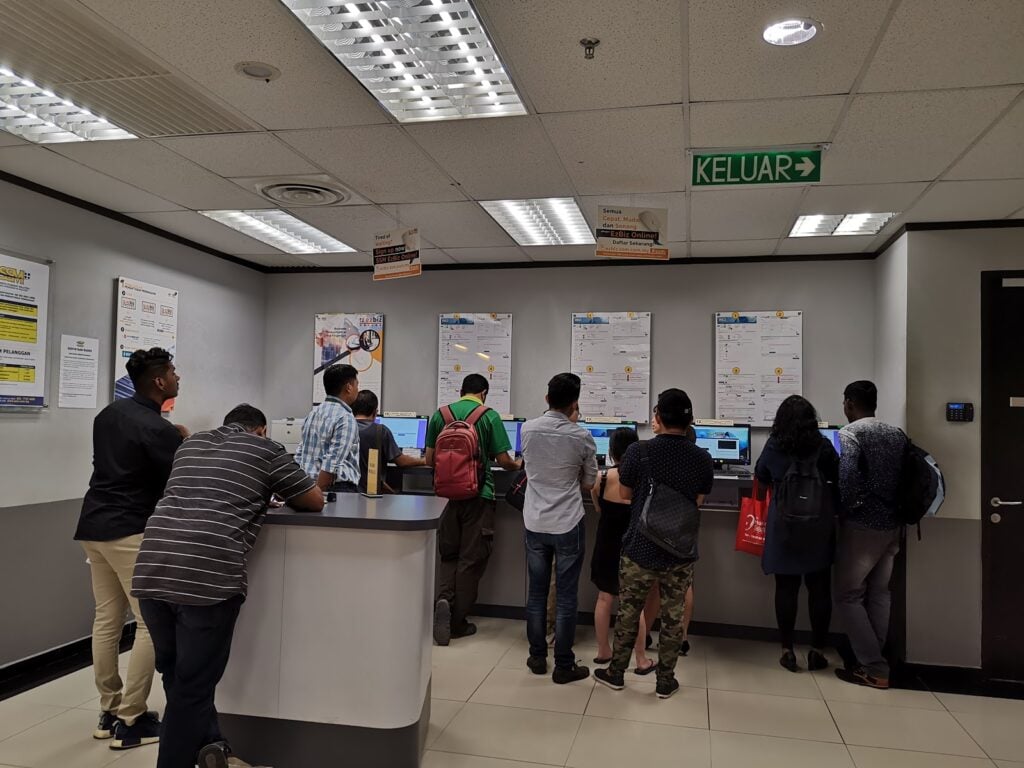
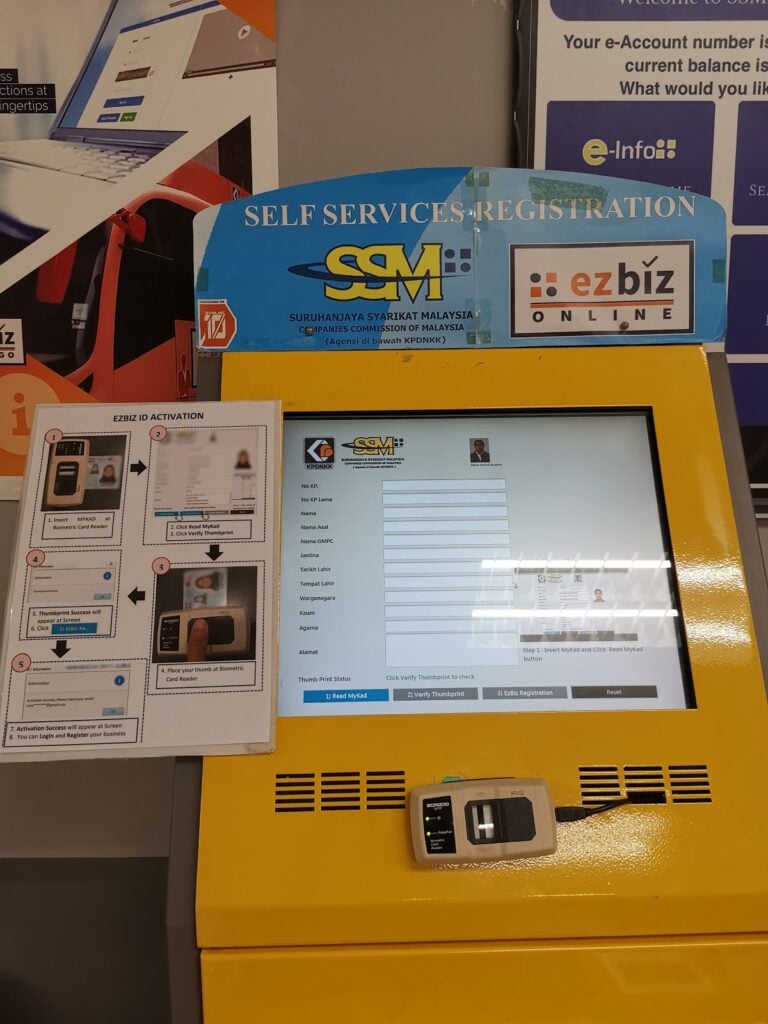
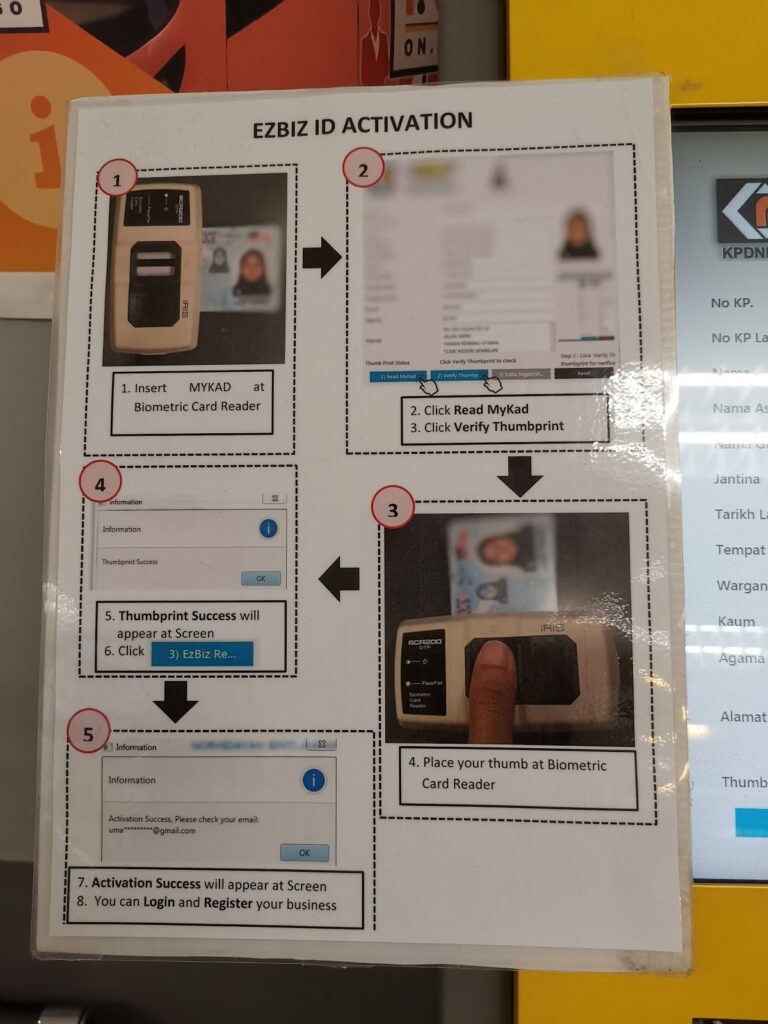
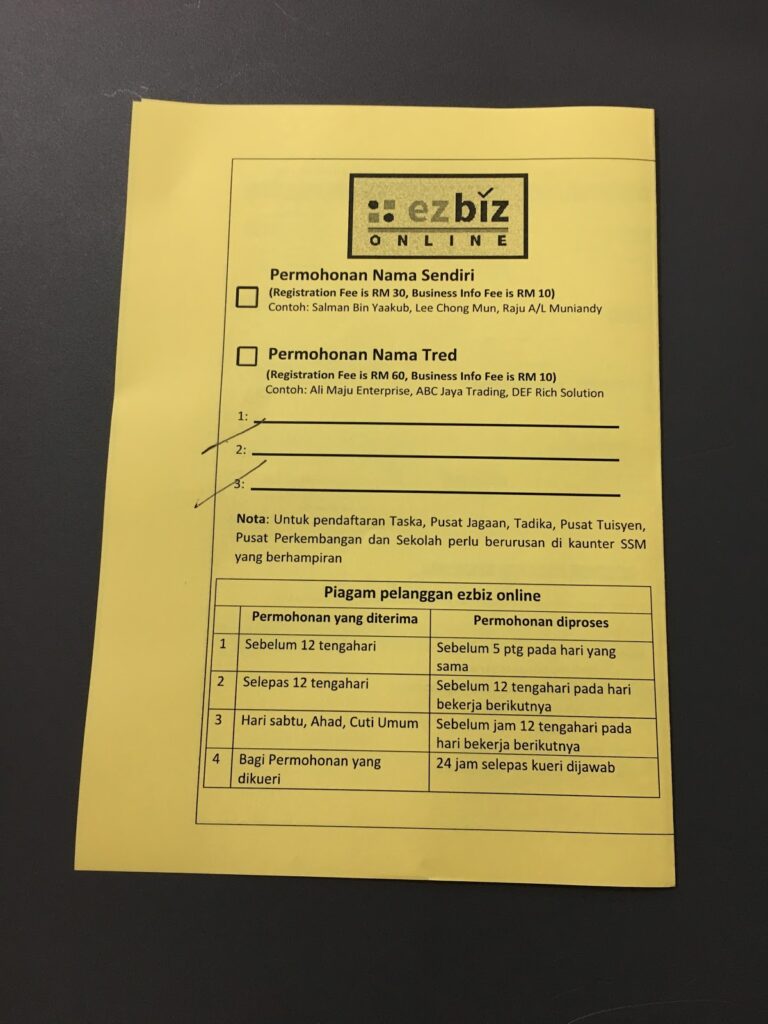
The in-person route still exists, and if you go, the self-service kiosks at Menara SSM let you verify with your thumbprint and MyKad without waiting for a counter officer. But for most people, e-KYC from home is now the faster path.
3.3 Register the business (New Business)
Once verified, log in and go to My Business Services → New Business under New Business Registration. You’ll fill in:
- Main information — name type (personal/trade), business name, business address and mailing address, and whether you’re an online seller.
- Branches — addresses of any branches (RM5/year each).
- Business code (MSIC) — the code describing your business activity. SSM publishes the full MSIC code list on its site; pick the one that best matches what you actually do.
- Owner details — your particulars (and your partner’s, for a partnership).
3.4 Pay
EzBiz accepts FPX online banking and major credit/debit cards (Visa/Mastercard). Current fees, straight from SSM’s official table:
| Item | Fee |
|---|---|
| Registration — Personal Name | RM30 / year |
| Registration — Trade Name | RM60 / year |
| Each branch | RM5 / year |
| Business Information (printout / certificate) | RM10 |
| Business updates (changes) | RM20 |
You can register for up to five years at once (multiply the annual fee accordingly).
3.5 Done — approval
Most sole proprietorship applications are approved within one working day, and error-free personal-name registrations are often same-day (you’ll get an SMS/email). Once approved, buy the Business Information printout (RM10) — that’s the document banks ask for when you open a business account.
Step 4: Register a Sendirian Berhad (Sdn Bhd) with MyCoID
Registering a company is a different portal and a different process from an enterprise. Since the Companies Act 2016, incorporation is done through the MyCoID system using a single consolidated form known as the SUPERFORM — you no longer file the old multi-form paperwork.
4.1 Create and verify a MyCoID account
Register at mycoid2016.ssm.com.my with your details, then verify your account (over the counter or through the available online verification, similar to EzBiz).
4.2 Reserve your company name
Search and reserve your proposed company name through MyCoID. Name reservation costs RM50 and holds the name for 30 days (extendable once for another 30 days). The name must be unique and end in Sdn. Bhd.
4.3 Submit the SUPERFORM (Direct Incorporation)
The SUPERFORM collects everything in one submission:
- Proposed company name (or your reserved name)
- Nature of business (MSIC code)
- Details of directors — at least one director ordinarily resident in Malaysia
- Details of shareholders — at least one shareholder (can be the same as the director)
- Registered office address and share capital
4.4 Pay the incorporation fee
Incorporation costs RM1,000, which comes to RM1,010.60 including tax. SSM typically issues the Notice of Registration / Notice of Incorporation within 1–3 working days once the submission is approved.
4.5 Appoint a company secretary (within 30 days)
This is a legal requirement under the Companies Act 2016: every Sdn Bhd must appoint a qualified, licensed company secretary within 30 days of incorporation. The secretary handles your statutory filings, registers, and annual returns. Most new companies engage a corporate secretarial firm for this — budget an ongoing annual fee on top of the RM1,010.60.
Step 5: Registering a Limited Liability Partnership (LLP)
If you want liability protection without full company overheads, register an LLP through the MyLLP portal. You’ll reserve a name, submit partner and compliance-officer details, and pay the RM500 registration fee. There’s an annual declaration to keep it in good standing, but no audit and no minimum capital. It’s a popular middle ground for professional partnerships.
The real first-year cost of each structure
The SSM fee is only part of the story. What actually matters is your total first-year cost, including the things you can’t skip. Here’s a realistic picture.
| Structure | SSM fee | Other likely first-year costs | Realistic first-year total |
|---|---|---|---|
| Sole Proprietorship | RM30–RM60/yr | Business Info printout (RM10); optional bookkeeping | ~RM40–RM200 |
| Partnership | RM60/yr | Business Info (RM10); partnership agreement (optional legal fee) | ~RM70–RM600 |
| LLP (PLT) | RM500 one-time | Compliance officer / secretarial support; annual declaration | ~RM1,000–RM2,500 |
| Sdn Bhd | RM1,010.60 + RM50 name | Company secretary retainer (~RM60–RM150/mth), accounting, possible audit | ~RM2,500–RM5,000+ |
The Sdn Bhd number surprises people, because the RM1,010.60 you pay SSM is genuinely the small part. The ongoing cost is the company secretary (a legal requirement — expect a monthly or annual retainer from a secretarial firm), plus accounting and tax filing, and an annual audit unless your company qualifies for audit exemption (small dormant/threshold companies). None of this is optional, so factor it in before you incorporate. For many first-time founders, that’s exactly why starting as a sole proprietorship and converting later makes sense.
By contrast, a sole proprietorship can genuinely be up and legal for the price of a nice lunch, with almost no recurring obligation beyond renewal. That low floor is the whole appeal of the enterprise route.
Registering as a foreigner
Foreigners cannot register a sole proprietorship, partnership, or (in the usual case) an LLP — those are reserved for Malaysian citizens and PRs. The route for a non-Malaysian is the Sdn Bhd, which a foreigner can own 100%.
Key points for 2026:
- At least one director ordinarily resident in Malaysia is required — a Malaysian citizen, PR, or an Employment Pass holder with a local residential address. Many foreign founders appoint a resident/nominee director to satisfy this.
- Minimum paid-up capital is technically RM1, but that figure rarely survives contact with a bank or immigration. If you plan to apply for an Employment Pass for yourself, the practical threshold is usually RM250,000–RM500,000 depending on industry.
- Wholesale, retail and trading (WRT) activities need a separate WRT licence, which generally requires RM1 million paid-up capital per outlet for foreign-owned companies.
In practice, most foreign founders don’t file the SUPERFORM themselves — they engage a licensed company secretary or corporate service provider to handle incorporation, the resident-director requirement, and the post-incorporation compliance in one package. With complete documents, the Notice of Registration is still typically issued within 1–3 working days of submission, so the paperwork isn’t the slow part; getting your capital, licences, and (if needed) Employment Pass in order usually is.
Our dedicated guide covers this end to end: How to Register a Company in Malaysia as a Foreigner.
Getting to SSM headquarters (if you go in person)
Even though most of this is now online, some steps — counter IDV, certain company matters, or simply preferring face-to-face help — still bring people to SSM’s KL headquarters. Here’s how to find it, from when our team made the trip.
Menara SSM @ Sentral No. 7, Jalan Stesen Sentral 5 Kuala Lumpur Sentral 50623 Kuala Lumpur


By LRT/train: Get off at KL Sentral. Head toward Chatime, walk past CIMB, take the front entrance, then follow the bridge toward Axiata Arena — Menara SSM is a short walk from there. By car: it’s at KL Sentral (paid parking available). By bus: routes stopping around KL Sentral include 780, 800 and T819.
Operating hours: Monday–Friday, service counters 8.15am–4.15pm (closed weekends and public holidays).
Note: counter locations and floor numbers at SSM are reorganised from time to time — check the directory or ask the information desk on arrival rather than assuming an old floor number.
After you’re registered: your first 30 days
Getting your SSM certificate is the start, not the finish. Here’s what to line up next.
1. Open a business bank account. Take your SSM registration and Business Information printout (RM10 from EzBiz) to the bank. A separate business account keeps your bookkeeping clean and is expected the moment you deal with suppliers or larger customers. Sdn Bhds will also need board resolution documents from the company secretary.
2. Sort out the licences your activity needs. SSM registration is not an operating licence. Depending on what you do, you may also need a local council (PBT) business premise/signboard licence, a WRT licence (wholesale/retail/trade — especially for foreign-owned companies), a food/halal certificate, or a specific industry licence (e.g. education, tourism, financial services). Check before you open the doors.
3. Register your tax file with LHDN. New businesses register for an income tax file. If your annual turnover crosses the SST threshold, you’ll also need to register for Sales & Service Tax. Your accountant or company secretary can handle this.
4. Check whether e-invoicing applies to you. Malaysia is rolling out mandatory e-invoicing through LHDN’s MyInvois system in phases. As of 1 January 2026, businesses with annual turnover below RM1 million are exempt (the threshold was raised from RM500,000), while those between RM1 million and RM5 million entered mandatory e-invoicing from January 2026 with a relaxation period. If you’re a small sole proprietor, you likely have breathing room — but confirm your turnover band, because exemption isn’t automatic.
5. If you’re hiring, register for EPF and SOCSO. The moment you take on employees, you’re responsible for EPF (KWSP), SOCSO (PERKESO), and EIS contributions. Register as an employer before your first payroll.
6. (Sdn Bhd) Appoint your company secretary within 30 days. Worth repeating because it’s a legal deadline, not a suggestion.
Renewing, updating, and closing your business
- Renewal: Enterprise registrations (sole prop/partnership) are valid for 1 to 5 years and must be renewed before they expire — you can renew on EzBiz, and letting it lapse can lead to a compound (fine). Sdn Bhds don’t “renew” but must file annual returns and financial statements each year.
- Updating details: Changing your address, adding a branch, or changing business activity is done through the same portal (a RM20 business update fee applies for enterprises, plus RM5 per branch).
- Closing: If you stop trading, formally terminate the business on EzBiz (enterprise) or go through strike-off/winding-up for an Sdn Bhd. Don’t just walk away — an un-terminated business keeps accruing renewal and filing obligations.
Common mistakes that slow people down
- Only preparing one name. As above — bring three. Trade-name rejections are the #1 delay.
- Picking the wrong structure to “save money”. Registering a sole prop when you needed limited liability means restructuring later. Think one step ahead.
- Forgetting the company secretary deadline. Sdn Bhd owners have 30 days. Missing it is an offence.
- Assuming registration = licensed to operate. Depending on your business, you may still need local council (PBT) licences, a food/halal permit, or an industry licence after SSM registration.
- Letting registration lapse. Enterprise registrations are annual (or up to 5 years). Renew before expiry to avoid compounds.
Frequently asked questions
How much does it cost to register a business with SSM in 2026? A sole proprietorship costs RM30/year (personal name) or RM60/year (trade name). An LLP is RM500. An Sdn Bhd is RM1,010.60 (including tax), plus RM50 to reserve the name.
Can I register a business with SSM fully online? Yes. Sole proprietorships and partnerships are done on the EzBiz portal, and companies on MyCoID. First-time users complete a one-time identity verification, which can now be done online via e-KYC or a WhatsApp video call — a counter visit is optional, not mandatory.
How long does SSM registration take? A sole proprietorship is often approved within one working day (sometimes same day). An Sdn Bhd’s Notice of Incorporation is typically issued within 1–3 working days after the SUPERFORM is approved.
Do I need a company secretary for a sole proprietorship? No. A company secretary is only required for an Sdn Bhd (and must be appointed within 30 days of incorporation). Sole proprietorships and partnerships have no such requirement.
What happens if I don’t register my business? Operating an unregistered business is an offence under the Registration of Businesses Act 1956, punishable by a fine of up to RM50,000 or up to two years’ imprisonment.
Can a foreigner register a business in Malaysia? Not as a sole proprietor or partnership — those are for citizens and PRs. A foreigner can incorporate an Sdn Bhd (and own it fully), provided there is at least one director ordinarily resident in Malaysia.
What’s the difference between EzBiz and MyCoID? EzBiz (ezbiz.ssm.com.my) is for registering businesses — sole proprietorships and partnerships. MyCoID (mycoid2016.ssm.com.my) is for incorporating companies — Sdn Bhd and other bodies corporate. LLPs use the separate MyLLP portal.
Do I need SSM registration to sell on Shopee, Lazada, or Instagram? If you’re running a genuine business and earning income from it, yes — you’re legally required to register, and marketplaces increasingly ask for an SSM number to verify sellers. A sole proprietorship (from RM30/year) is the usual starting point for online sellers.
Should I register a sole proprietorship or an Sdn Bhd? If you’re just starting, testing an idea, or earning modestly, a sole proprietorship is cheaper and simpler. Move to an Sdn Bhd when you want limited liability (to protect personal assets), plan to raise funding or sign larger contracts, or when profit grows enough that the SME corporate tax rate beats personal income tax — often around RM100,000–RM150,000 annual profit. Run the numbers with an accountant.
How long is my SSM registration valid? Enterprise (sole prop/partnership) registrations are valid for the number of years you paid for — between 1 and 5 years — and must be renewed before they expire. An Sdn Bhd exists indefinitely once incorporated, but must file annual returns and (unless exempt) audited accounts every year.
Can I register while overseas? For identity verification, SSM now offers online e-KYC and WhatsApp video-call verification, which makes it far easier to complete registration without being physically present. That said, sole proprietorships and partnerships remain limited to Malaysian citizens and PRs; foreigners register an Sdn Bhd.
You’re registered — now get found
Registering with SSM makes your business legal. It doesn’t make it visible. Every new business today needs an online presence — a proper website and a way for customers to find you on Google.
That’s what we do. Sterrific helps Malaysian businesses launch with professional web design and get discovered through SEO. Just registered your company? Talk to us about getting it online — it’s the natural next step after SSM.
And if you’re still deciding what to build, our guides on starting an online business in Malaysia, online business opportunities, and e-commerce in Malaysia are a good next read.