Search Google Malaysia for “chicken rendang recipe.”
The #1 result is published from the United States. #2 is run from the United Kingdom. #3 is an Indian food blog. The first Malaysian-owned website appears at position nine — a personal blog with a Domain Rating of zero, holding the line alone.
Malaysia cannot rank for its own rendang.
That search sent us down a question nobody in Malaysian marketing seems to have measured: when Malaysians Google something — in English or in Bahasa — whose websites actually answer?
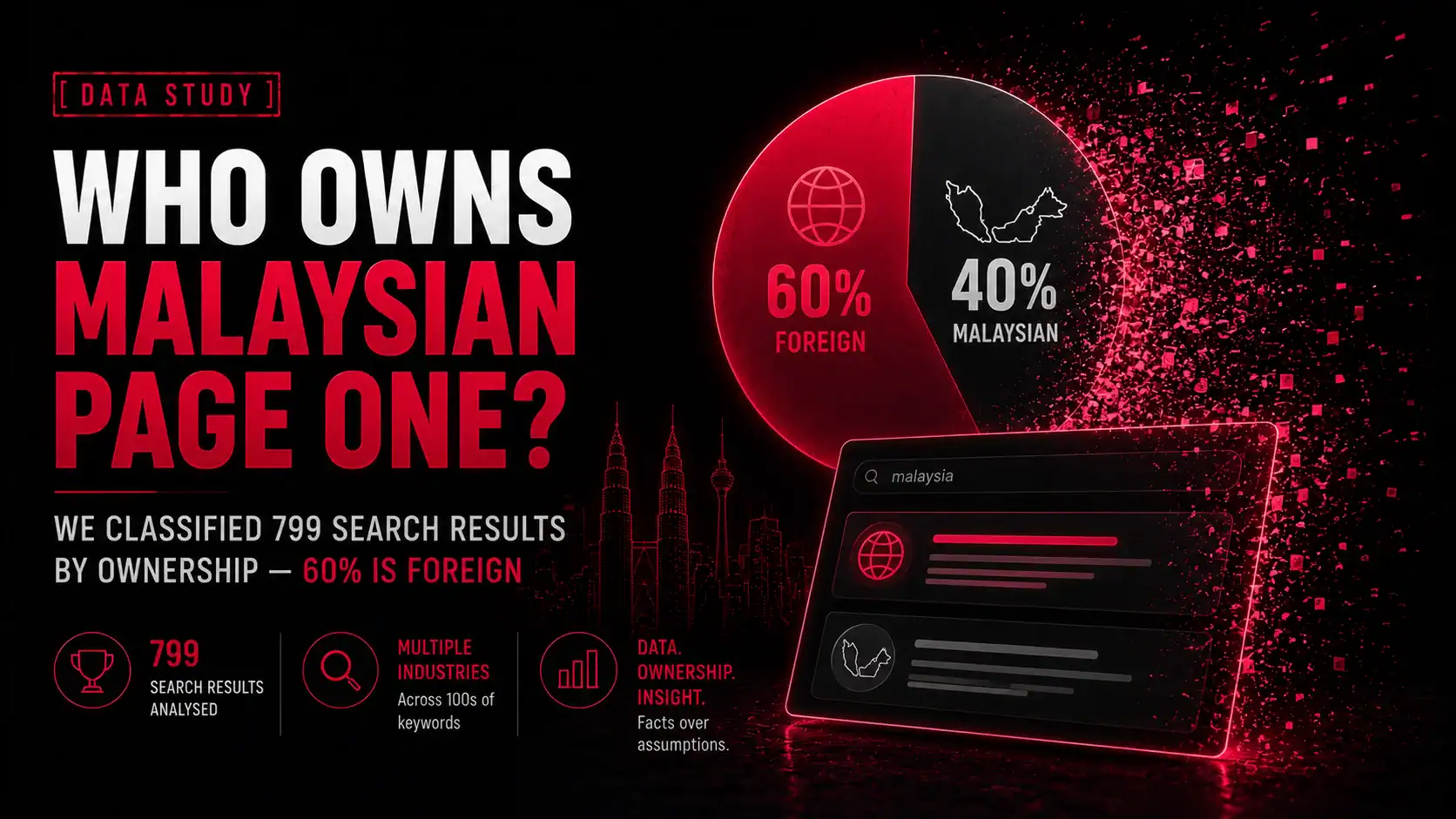
So we classified 799 page-one results across 104 Malaysian SERPs — commercial, informational, and four fresh verticals (education, jobs, food, B2B software) — by a single, strict criterion: who owns the site. Not where it’s hosted, not whether it has a .my domain or a Kuala Lumpur sales office. Ownership.
The answer: 60.1% of Malaysian page-one results are foreign-owned. Foreign-owned sites hold 22 of the 33 organic #1 positions in the study. In some verticals, the local share is close to a rounding error.
This is not a grievance piece, and it’s written for a specific reader: the Malaysian business owner or marketing decision-maker deciding where next year’s visibility budget goes. (SEOs and journalists: the dataset, classification script and sensitivity math are all here for you too.) The same data shows exactly where Malaysian sites still win, the one query pattern that halves the foreign share, and a twist about Bahasa Melayu that says more about the future of local content than any statistic we’ve published. And it ends with a verdict, not a shrug — because an entire industry has been optimising for “page one” without asking who page one belongs to, and the answer changes what you should do about it.
Methodology
We classified every organic result in three datasets — 799 results across 104 Malaysian SERPs, all pulled in June 2026, country set to Malaysia:
- Commercial queries (455 results, 60 SERPs): the product-search dataset from our marketplace study — electronics, fashion, home, automotive, in English and BM.
- Informational queries (188 results, 24 SERPs): the how-to and price-guide dataset from our content anatomy study — business compliance, finance, health, home services.
- New pull (156 results, 20 SERPs): four previously uncovered verticals — education & study, jobs & careers, food & recipes, B2B software — validated and pulled fresh for this study.
Every result was classified by ultimate ownership into five buckets: Malaysian-owned (private), Malaysian government, purely foreign (no Malaysian localisation), foreign-owned, Malaysia-localised (a foreign company’s MY site or subsidiary — samsung.com/my, jobstreet under SEEK, British Council Malaysia), and global platforms (Facebook, YouTube, Reddit, Instagram, TikTok, Pinterest, LinkedIn, Wikipedia).
The ownership rule is strict by design, and we disclose its sharp edges: a Malaysian-born blogger publishing from the US classifies as foreign; JobStreet classifies as foreign (SEEK, Australia); conversely, Gleneagles and Pantai hospitals classify as Malaysian (IHH Healthcare, Malaysian-listed), and Lowyat.net counts as a Malaysian platform. Every judgment call is documented in the classification script that ships with this article — audit ours, or re-run it with your own rules. The headline number is always reported alongside its three-layer decomposition, so nobody has to take “foreign” on faith.
Finding 1: Three In Five Results Belong To Someone Else

Across all 799 results:
Owner | Share |
Foreign-owned, total | 60.1% |
— purely foreign sites | 18.0% |
— foreign-owned, MY-localised | 28.7% |
— global platforms | 13.4% |
Malaysian-owned (private) | 35.4% |
Malaysian government | 4.5% |
Read the decomposition before reacting to the headline, because each layer is a different phenomenon.
The localised-foreign 28.7% is the layer hiding in plain sight: sites that look Malaysian, sell to Malaysians, often employ Malaysians — and remit ownership elsewhere. Shopee and Lazada’s .com.my domains. malaysia.indeed.com. IKEA’s and Samsung’s /my/ trees. Watsons (AS Watson, Hong Kong). It’s the biggest single layer of the foreign share, and almost nobody mentally files these sites as foreign.
The platform 13.4% is Facebook, YouTube, Reddit, TikTok, Instagram and Pinterest ranking as search results — and as we’ll see in Finding 6, what’s on those results complicates the story.
The purely foreign 18.0% is the layer most people imagine when they hear “foreign websites”: Wikipedia, Harvard’s career pages, US recipe blogs, global SaaS companies — sites with no Malaysian presence whatsoever, answering Malaysian searches anyway.
And the #1 positions skew harder than the average: foreign-owned sites hold 22 of the 33 true organic #1s in this study — 67%. Malaysian private sites hold seven. The government holds four.
The three datasets also rank themselves in a telling order. Commercial product queries are the most foreign segment (64.4% — marketplaces, global brands, platforms). The fresh verticals run 67.3%. But informational queries — the how-to and price-guide searches — come in at 43.6%, the only segment where foreign ownership falls below half. Two things hold that line: the Malaysian government’s 16% share of informational page one (SSM, LHDN, KWSP answering their own territory), and the small local businesses our content study profiled — clinics, contractors, accounting firms publishing their own trade. Where Malaysia answers its own questions, Malaysia keeps the page.
Malaysian marketers fight for page one. The data says most of page one was never theirs to begin with.
Finding 2: Food Is 94.6% Foreign. Including The Rendang.
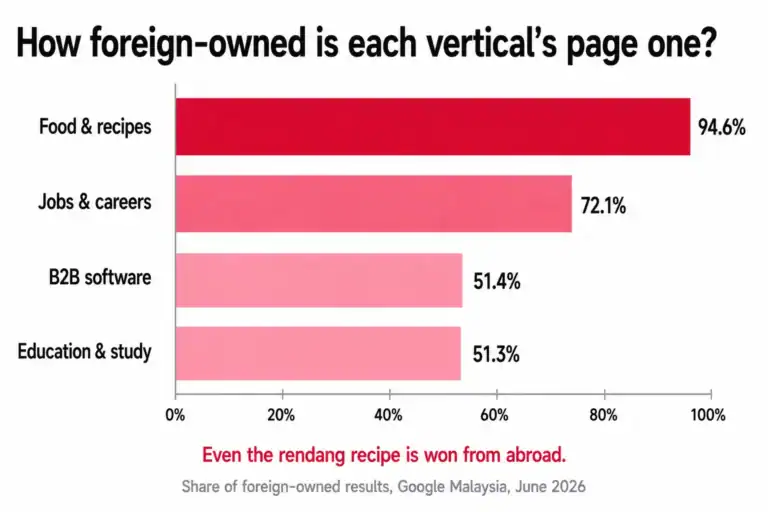
The new-pull verticals, ranked by foreign-owned share:
Vertical | Foreign-owned share |
Food & recipes | 94.6% |
Jobs & careers | 72.1% |
B2B software | 51.4% |
Education & study | 51.3% |
Food deserves its own paragraph, because it isn’t pancakes dragging the number up. “Banana cake recipe”: ten results, zero Malaysian. “Sambal recipe”: one Malaysian-owned site on the page (El Mundo Eats, a Malaysia-based blog), surrounded by Singapore, Indonesia, US, and UK publishers. And “chicken rendang recipe” — the dish that inspires UNESCO-level national pride — is won by a US-based blog, a UK-based one and an Indian one, with the sole Malaysian-owned site sitting at #9 with a Domain Rating of zero.

This mirrors what our domain study found in travel, where 81% of page one was non-local. The pattern generalises: on any topic where the query doesn’t pin itself to Malaysia, the global English content industry — two decades of food blogs, career sites and SaaS publishers — simply outweighs the local one. Not because Google is biased. Because they published and we didn’t.
The country that argues about rendang on Twitter never built the page that ranks for it.
Education and tech read more hopefully — roughly half the page stays Malaysian wherever the query implies Malaysia. Local universities (UM, UKM, MMU, Taylor’s) and Malaysian edu-platforms (EasyUni, StudyMalaysia, Afterschool, EduAdvisor) hold real ground, and the B2B software SERPs are carried by a genuinely strong local product scene: Bukku, SQL, AutoCount, EasyStore, SiteGiant, Billplz.
But education also contains the study’s most overlooked occupier class: other countries’ governments. Search “study in australia” from Malaysia, and position two is studyaustralia.gov.au — the Australian government’s recruitment site — with Australia’s Department of Home Affairs visa pages a few slots below. Foreign-university Malaysian campuses (Monash, Nottingham) occupy further slots as localised-foreign entries. None of this is sinister; it’s nations and institutions competing professionally for Malaysian students and Malaysian fees, with content infrastructure built for exactly that job. The point is the asymmetry: foreign governments treat Malaysian page one as a market worth publishing for. Most Malaysian businesses still treat it as a place to buy ads.
Finding 3: The Jobs SERP Is Foreign Pipes End-to-End
Jobs & careers measured 72.1% foreign-owned — but the texture matters more than the number, because this is the vertical where the localised-foreign layer (41.9 points of it) does the occupying.
Walk “part time job,” 6,600 searches a month: malaysia.indeed.com (US) at #2, FastJobs (Singapore) at #3, my.jobstreet.com at #4. “Remote jobs malaysia”: Indeed #1, JobStreet #2, LinkedIn #3. “Internship malaysia” is the rare bright spot — TalentCorp’s MySIP, a Malaysian government initiative, takes #1, with Bank Negara’s internship page at #3.
And yes, JobStreet counts as foreign in this study. That isn’t a provocation; it’s the public record — SEEK, the Australian employment group, has owned JobStreet since 2014. The brand most Malaysians would name as “our local job site” is, by ownership, part of the foreign 60.1%. We classified it that way because the alternative — classifying by vibes — is how a country ends up not noticing a decade-old change of ownership in its employment infrastructure.
The one sub-vertical Malaysians swept: “salary calculator malaysia” is a 10-for-10 near-local page — payroll.my, Fincrew, four independent DR-0 calculator sites, PayrollPanda. Where the query is Malaysian-specific and the answer requires Malaysian tax tables (PCB, EPF, SOCSO), the global content industry has nothing to offer, and local builders own everything.
The pattern of Findings 2 and 3 in one sentence: foreign sites win wherever generic knowledge suffices, and vanish wherever Malaysian specifics are the product.
Finding 4: The Moat Isn’t Language. It’s The Anchor.

Split the 641 English-query results by whether the query carries a Malaysian anchor — the word “malaysia,” or an unmistakably Malaysian entity (sdn bhd, SSM, EPF, SST, ASB, takaful):
- English, Malaysian-anchored: 45.4% foreign-owned (Malaysian sites: 45.4%, government: 9.1% — locals collectively hold the majority)
- English, global-topic: 73.8% foreign-owned (Malaysian sites: 25.9%)
One word in the query swings ownership of the page by nearly thirty points. “Accounting software” belongs to the world; “accounting software malaysia” belongs — barely, but genuinely — to Bukku, SQL, AutoCount and the LHDN’s approved-vendor list. “Resume” belongs to Harvard and Indeed; “salary calculator malaysia” belongs to five Malaysian developers.
This reframes the standard advice about “going after big English keywords.” For a Malaysian site, the unanchored English SERP is an away game against the accumulated content industry of the entire Anglosphere — Wikipedia, Ivy League career centres, twenty-year-old recipe empires. The anchored SERP is a home game where Malaysian specifics are the price of entry.
Every unanchored English keyword in your content plan is a land war in someone else’s country. The anchored ones are the only home soil on the map.
Finding 5: Bahasa Melayu — Local Voices On Rented Land
Here’s the result that broke our own hypothesis. We expected BM queries to be the moat — the place foreign ownership collapses. The measurement:
- English queries: 59.3% foreign-owned
- Bahasa Melayu queries: 63.3% foreign-owned
Higher—until you decompose it: of BM’s 63.3 points, 27.2 are platforms — nearly triple the platform share on English queries (10.0). Pure foreign sites on BM queries are actually lower than English (16.5 vs 18.4), because a Kansas food blogger does not write “harga tayar” content. What fills BM page one instead of foreign publishers is Facebook seller pages, TikTok walkthroughs, YouTube tutorials and Facebook groups — made by Malaysians, hosted by California.
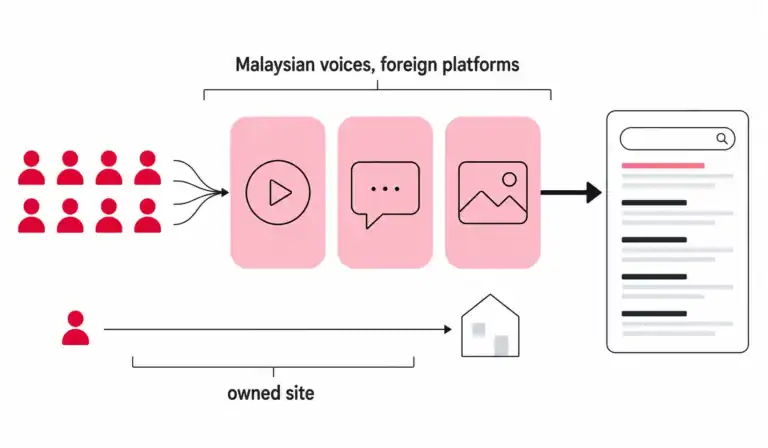
So the BM moat is real — against foreign publishers. What it doesn’t hold against is the quiet migration of Malaysian publishing itself off Malaysian-owned websites and onto foreign platforms. The kedai selling katil queen answers the query from a Facebook video, not from its own domain. The wiring contractor’s knowledge lives on TikTok. By traffic, that works today. By ownership, every one of those rankings is an asset on someone else’s balance sheet, subject to someone else’s algorithm, monetised by someone else’s ads.
Our BM vs English study showed Malay keywords are the easiest, cheapest ranking opportunities in the country. This study adds the uncomfortable corollary: the people best positioned to take them are giving the rankings away to the platforms they post on.
Malaysia’s most defensible search territory is being homesteaded — by Malaysians — in other people’s names.
Finding 6: The Top Occupiers Aren’t Who You’d Guess
Rank every foreign-owned domain in the study by how many page-one results it holds:

# | Domain | Results | What it is |
1 | facebook.com | 33 | Platform |
2 | youtube.com | 23 | Platform |
3 | reddit.com | 19 | Platform |
4 | shopee.com.my | 18 | Localised marketplace (SG/Sea) |
5 | ikea.com | 17 | Localised brand (SE) |
6 | tiktok.com | 11 | Platform |
7 | lazada.com.my | 8 | Localised marketplace (Alibaba) |
8 | pinterest.com | 7 | Platform |
9 | wikipedia.org | 6 | Pure foreign |
9 | jobstreet.com | 6 | Localised job board (SEEK, AU) |
9 | instagram.com | 6 | Platform |
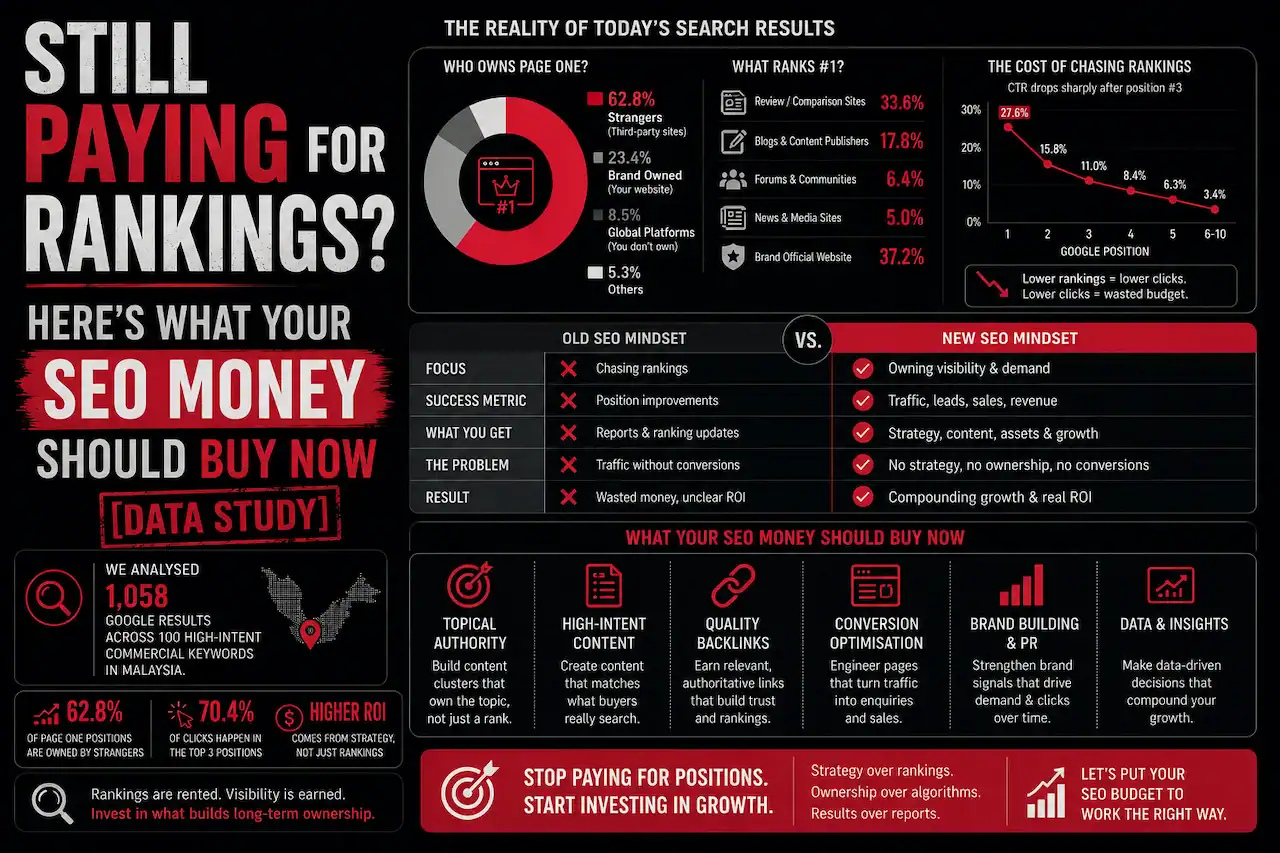
Six of the top eleven are platforms. The “foreign invasion” of Malaysian search, at its largest scale, isn’t foreign media or foreign brands out-publishing Malaysia — it’s the world’s social platforms becoming search results, carrying a mix of foreign and Malaysian content with them. (Our marketplace study measured the same force from a different angle: UGC and social at 16% of commercial page one, 2.5× the marketplaces.)
The brands and marketplaces are real but smaller than the discourse suggests — Shopee’s 18 results across 104 SERPs are consistent with the 6.4% we measured before. The quiet giants on Malaysian page one wear blue, red and black-and-white logos, and none of them is in e-commerce.
Finding 7: Where Malaysia Wins — The Map Of Held Ground
For balance and for strategy, here is where Malaysian ownership holds or dominates in this data:
- Government answers: informational queries are the most Malaysian segment in the study (43.6% foreign — the only segment under half), held down by MY-gov’s 16% share. SSM, LHDN, KWSP and Customs own their territory outright.
- Malaysian-specific tools: salary calculators, PCB calculators — local sweeps, including multiple DR-0 sites at the top.
- Malaysian-anchored B2B: accounting/POS/payroll software “…malaysia” queries — Bukku, SQL, AutoCount, EasyStore, SiteGiant, Billplz holding majority ground against Xero and Airwallex.
- Local trades and clinics: as shown in our content anatomy study — dental clinics on braces prices, air-con specialists, battery shops and accounting firms publishing their own trade remain the most reliable Malaysian winners anywhere on the map.
- Education: public and private universities plus Malaysian edu-platforms (EasyUni, StudyMalaysia, Afterschool, EduAdvisor) hold near-parity.
The held ground shares one property: Malaysian specificity is load-bearing. Tax tables, statutory rates, local prices, local institutions. Nowhere on the map does Malaysia hold ground on generic knowledge — and everywhere Malaysian specifics matter, even DR-0 sites beat the global giants.
The Final Take: What You Should Actually Do With A 60% Foreign Page One
A measurement without a verdict is trivia. Here’s the verdict, and then the playbook.
The verdict: stop treating “page one” as one battlefield. The single most important structure in these 799 results is the home/away split — Malaysian-anchored queries where locals hold the majority and the entry price is Malaysian specifics, versus global-topic queries where you’re facing the accumulated content industry of the entire English-speaking world. Most Malaysian marketing plans don’t make this distinction. After this data, yours should — because it decides which channel each keyword belongs to, and which fights are worth having at all.
If you own or market a Malaysian business — the Monday playbook
- Split your keyword list with the anchor filter. One column: queries with a Malaysian anchor (“…malaysia”, sdn bhd, EPF, your city, your statutory terms). The other: global-topic queries. The first column is home soil, at 45% foreign and falling wherever Malaysian specifics matter. The second is away territory at 74%. Every strategic decision below flows from this split — it takes one afternoon.
- Win on home soil with SEO; rent away games with ads. On anchored queries, your Malaysian specifics — ringgit prices, PCB tables, local process, your own trade knowledge — are an advantage Harvard and Wikipedia structurally cannot copy, and even DR-0 sites in this study win with them. That’s where organic investment compounds. On unanchored queries you genuinely need (“crm software”, “running shoes”), don’t out-publish the Anglosphere — buy the placement. Paid search and shopping exist precisely so you can appear on pages you’ll never own. Same keywords, two different tools; the anchor tells you which.
- Repatriate your publishing. If your knowledge currently lives on Facebook, TikTok and YouTube — like the 27% of BM page one that’s Malaysian voices on rented land — adopt the dual-publish rule: your own domain first, platforms second, every time. Keep the reach; stop donating the asset. The platforms are for distribution. They were never meant to be the address.
- Claim your anchored queries this year, not “eventually.” The compounding-occupation clock is the quiet deadline in this data: every year an anchored query stays unanswered by a Malaysian-owned site, the incumbent adds links, library and history, and the buy-back price rises. The anchored queries still open in your category are the cheapest they will ever be. That sentence will be true again next year — at a higher price.
- Measure ownership, not just rankings. Add one column to your SEO report: of the page-one results in your category, how many are on domains you (or any Malaysian competitor) own? Track it quarterly. Rankings tell you whether you’re visible. Ownership tells you whether the visibility is building your asset or someone else’s.
If you’re an SEO or content specialist
The anchor split is the client-conversation tool this study hands you: it turns “should we target this keyword?” from opinion into a structural question, and it gives you the honest answer for the away games — recommend paid there, and be the consultant who said so. The classification script ships with the article; running it on a client’s category is a one-afternoon audit that no proposal template currently includes.
The one-sentence version
Own the queries that name your country, rent the ones that don’t, and publish on land you hold — because the 60% wasn’t taken from Malaysia. It was left unclaimed.
Run This Yourself
The full classification table (799 rows, with origin labels) and the classification script — including every documented judgment call — are available on request; reach out, and we’ll send the pack to anyone who asks.
To audit or extend: pull your own keyword set’s top 10 (any tool that exports URLs works), run each domain through the script’s ownership classifier — or amend our rules where you disagree (move JobStreet back to “local,” reclassify diaspora bloggers, treat localised subsidiaries as Malaysian) and watch how far the headline moves. The sensitivity math, shown rather than asserted: treat the localised-foreign layer as local (the most generous defensible re-rule) and the foreign share is still 31.4% — pure foreign plus platforms. Treat platforms as neutral territory instead, and the foreign share becomes 46.7%. Move JobStreet, FastJobs and the foreign-campus universities back to “local”, and the needle barely registers — together they’re under two points. Under every reclassification we could defend, between a third and two-thirds of Malaysian page one belongs to someone else. Under the ownership rule, it’s 60.1%. The story survives the methodology arguments; only the adjective changes.
Limitations (Read These Before Quoting)
- Ownership is a judgment-laden rule. We classified by ultimate ownership and documented every contested call: JobStreet = foreign (SEEK), Gleneagles/Pantai = Malaysian (IHH), Malaysian-born bloggers publishing from abroad = foreign, Lowyat = Malaysian platform. Reasonable people can re-rule individual cases; the script makes that a five-minute exercise.
- Platforms carry mixed content. A Facebook.com result is foreign-owned infrastructure, but the page may be a Malaysian seller. Finding 5 addresses this directly; the headline figure counts the pipe, not the speaker, and says so.
- Basket scope. 104 SERPs across roughly ten verticals, single snapshot (June 2026). Verticals were chosen for business relevance, not as a census of Malaysian search.
- English and BM only. Mandarin and Tamil SERPs are unmeasured here; our Mandarin study suggests the foreign share there may run higher (Taiwanese and Chinese banks answering Malaysian banking queries).
- Ownership ≠ value judgment. Localized foreign companies employ Malaysians and serve them well; foreign blogs rank because they published useful content. The study measures structure, not merit.
FAQ
Is this saying Google is biased against Malaysian sites?
No. The same Google hands locals 10-for-10 sweeps on salary calculators and majority ground on anchored B2B queries. The 60.1% reflects two decades of publishing volume, not algorithmic preference. Where Malaysians published specifics, Malaysians rank.
Why count Shopee and JobStreet as foreign when they operate here?
Because the study’s question is ownership, and blurring it is how ownership changes go unnoticed. The decomposition is always published alongside the headline — readers who prefer an “operates locally” rule can subtract the 28.7% localized layer themselves and still face a 31.4% foreign share of pure-foreign-plus-platforms.
Does the platform share mean Malaysians should stop posting on Facebook and TikTok?
No — it means the platform post shouldn’t be the only home the content has. Reach is rented; the domain is owned. Publish on both, in that order of priority.
What's the single most actionable number in here?
45.4% vs 73.8% — the anchor effect. If your content targets English queries, the presence or absence of a Malaysian anchor in the query roughly decides whether you’re playing at home or away. Audit your keyword list with that one filter, and you’ll find the away games your budget has been quietly subsidising.
Will you repeat this measurement?
That’s the plan — the classification script makes the re-run cheap, and the interesting question is the direction of travel: whether Malaysian page one becomes more Malaysian, or less.
One last frame before the byline, because it’s the one that should outlast the statistics. Every click on the foreign 60% accrues somewhere else — the ad revenue, the retargeting audiences, the first-party data, the brand equity of being the answer. The 60.1% isn’t just a visibility figure; it’s a map of where the compounding interest of Malaysian attention gets deposited.
Page one is a ledger of who bothered to publish. Sixty percent of Malaysia's ledger is in other people's handwriting — and the pen is not expensive.
This study was produced by the research team at Sterrific, a digital marketing agency in Petaling Jaya, Malaysia. Dataset and classification script available on request.