You hired a designer. They built you a beautiful website. One page, smooth scroll, all five of your services in tidy little sections with matching icons.
It went live. Everyone admired it. And then it did almost nothing.
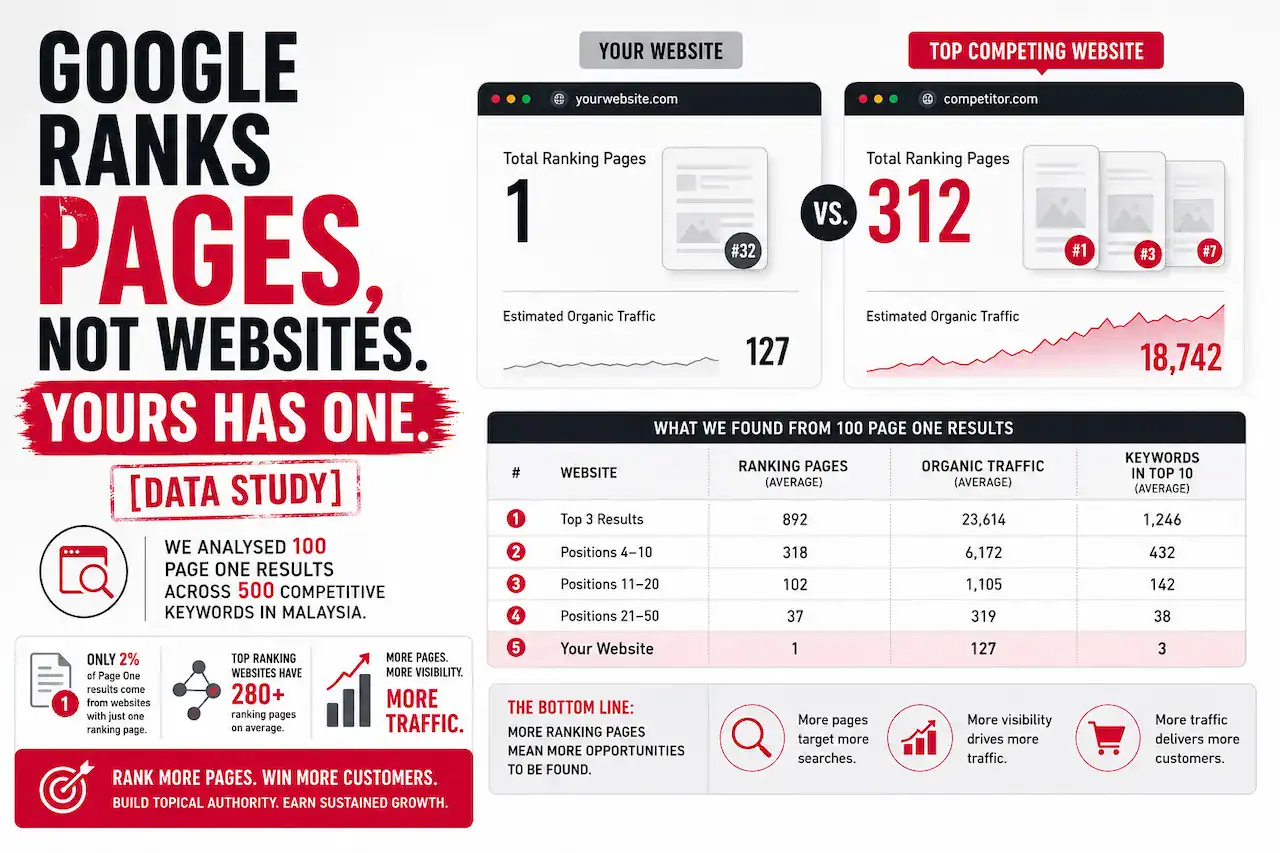
Here’s the part nobody told you: Google does not rank websites. It ranks pages. Every time someone searches, Google reaches into its index, pulls out individual pages, and lines them up. Your gorgeous one-pager enters that contest with a single bullet — one URL, asked to be the best answer for “divorce lawyer,” “corporate lawyer,” “will writing,” “conveyancing” and “employment dispute” all at once.
It will win none of them. Not because it’s ugly — because it’s one page competing against opponents who built one page for each.
This study is for the Malaysian business owner who paid for a website that doesn’t bring leads, and for anyone about to commission one. We pulled the data three ways: we measured how many separate searches your services actually generate, we classified what kinds of pages win those searches across 39 results on real Malaysian SERPs, and we dissected three Malaysian sites that rank to see where their traffic truly comes from.
The findings are blunt. Across five Malaysian service searches, the number of combined “all our services” pages that ranked was zero. And the sites that win earn 60% to 93% of their traffic from pages that are not the homepage. The one-page website isn’t a minor disadvantage. It’s a structural decision to forfeit most of the searches your business depends on — made, usually, by someone whose job ended the day the site looked good.
Key Findings (TL;DR)
- Google ranks pages, not sites. One page can realistically own one primary search intent. Your services generate many — so a one-page site competes for one search and concedes the rest.
- Your services are searched separately. Across 6 verticals, we found legal splitting into 11 distinct sub-service searches (15,240/month combined), medical into 8 (10,270/month), and B2B into 11. Each has its own volume, its own difficulty, its own results page.
- Combined service pages ranked 0 out of 39. On five Malaysian service SERPs, not one “our services” mega-page appeared. 59% of the ranking results were a dedicated service page or a whole domain devoted to that one service.
- You don’t need authority — you need the page. Eleven of the ranking dedicated pages sit at Domain Rating 10 or below — DR-0 divorce firms and DR-0 dental clinics outranking general practices with far stronger sites, purely on relevance.
- The homepage is the smallest part of a winning site. WenJie & Co earns 7.1% of its top-page traffic from the homepage; the other 92.9% comes from practice-area pages, guides and calculators. Shinjiru and ServiceAircond: 60–62% off homepage.
- Winners build a page per service — and often per sub-service. Shinjiru holds #1 for “wordpress hosting,” “social media management”, and “ecommerce website builder” on three separate sub-service pages, not one “services” page.
Methodology
Three Malaysian datasets, one question: does website structure decide who ranks for service searches?
Dataset 1 — demand fragmentation (45 keywords, 6 verticals). For legal, medical/dental, home services, B2B services, finance and education, we mapped the distinct sub-services people search for and pulled volume and difficulty for each. Most rows are reused from our keyword-value and zero-volume studies (already paid for); the rest are a fresh June 2026 pull. The question this answers: when a business says “we offer five services,” how many separate searches does that actually represent?
Dataset 2 — SERP proof (39 organic results across 5 service SERPs). We pulled the live top 10 for “divorce lawyer malaysia,” “klinik gigi,” “aircond service,” “web design malaysia” and “will writing malaysia,” then classified every organic result by page type: dedicated service page, whole-domain-one-service, article/guide, calculator, portfolio, directory, government, or social. The question: what kind of page does Google actually reward for a service query?
Dataset 3 — winner anatomy (3 Malaysian sites). For one law firm (WenJie & Co), one trade business (ServiceAircond.my) and one multi-service agency (Shinjiru), we pulled their top pages by Malaysian organic traffic. The question: when a Malaysian business ranks well, where does its traffic actually live — the homepage, or everywhere else?
All SERP and site data were pulled live on 12 June 2026 via Ahrefs, Malaysia database. Page-type classification uses Ahrefs’ AI page-type labels plus manual review. The full datasets and analysis script are available on request — reach out and we’ll send the pack.
One scope note stated plainly: this study measures structure — how a site is divided into pages — not visual design quality, which matters enormously for conversion and is a different discipline doing a different job. We come back to that in the balance section.
Finding 1: Your Five Services Are Not One Search. They’re Eleven.
Start with the assumption baked into every one-page design: that “our services” is a single thing a single page can present. The search data says it is not.

Take a law firm. To its designer, that’s one client with one “Services” section. To Google, it’s this:
Legal sub-service | Monthly searches | Difficulty |
lawyer / peguam | 4,800 + 4,800 | 47 / 7 |
hibah | 3,100 | 0 |
company secretary malaysia | 800 | 9 |
wasiat | 700 | 0 |
will writing malaysia | 400 | 0 |
immigration lawyer malaysia | 250 | 0 |
divorce lawyer malaysia | 150 | 0 |
employment lawyer malaysia | 100 | 0 |
conveyancing / peguam syarie | 80 + 60 | – |
Eleven distinct searches. 15,240 a month, combined. Six of them at Difficulty 0. Each is a different person with a different problem typing a different phrase — and Google has a different results page waiting for each one. The pattern repeats across every vertical we measured: medical splits into 8 separately searched services (10,270/month — klinik gigi, dentist, klinik pakar kulit, braces, scaling, implants…), B2B into 11, finance into 5 worth 34,900 a month between them.
As our keyword-value study showed, each of these separate searches also carries its own commercial value, so combining them on one page does not just reduce visibility; it forfeits multiple revenue opportunities.
A one-page website walks into this with a single URL and says: be the best answer for all eleven. It can’t. A page optimised for everything is optimised for nothing — it has one title tag, one H1, one primary topic, and Google reads it as weakly about many things rather than strongly about one. The merge that looked so clean in the design mockup is, in search terms, a decision to compete for one of your eleven markets and abandon the other ten.
Every service you fold into a shared page is a market you’ve agreed not to show up for.
Finding 2: Combined Service Pages Ranked Zero Out Of 39
This is the finding that should end the debate in any boardroom.
We took five Malaysian service searches and classified all 39 organic results by page type. Here’s what Google actually rewards:

What ranked | Count | Share |
Dedicated service page | 13 | 33.3% |
Whole domain = one service | 10 | 25.6% |
Article/guide | 4 | 10.3% |
Government | ||
Social | 4 | 10.3% |
Directory | 3 | 7.7% |
Portfolio | 1 | 2.6% |
Combined “all our services” page | 0 | 0.0% |
Fifty-nine percent of everything that ranked was a dedicated service page or an entire domain built around that single service. The number of combined multi-service pages that ranked was zero. Not one. Across fifty-nine percent winning on dedication and zero percent winning on the merge, the SERP is telling you, in the plainest language a dataset can speak, what it wants.
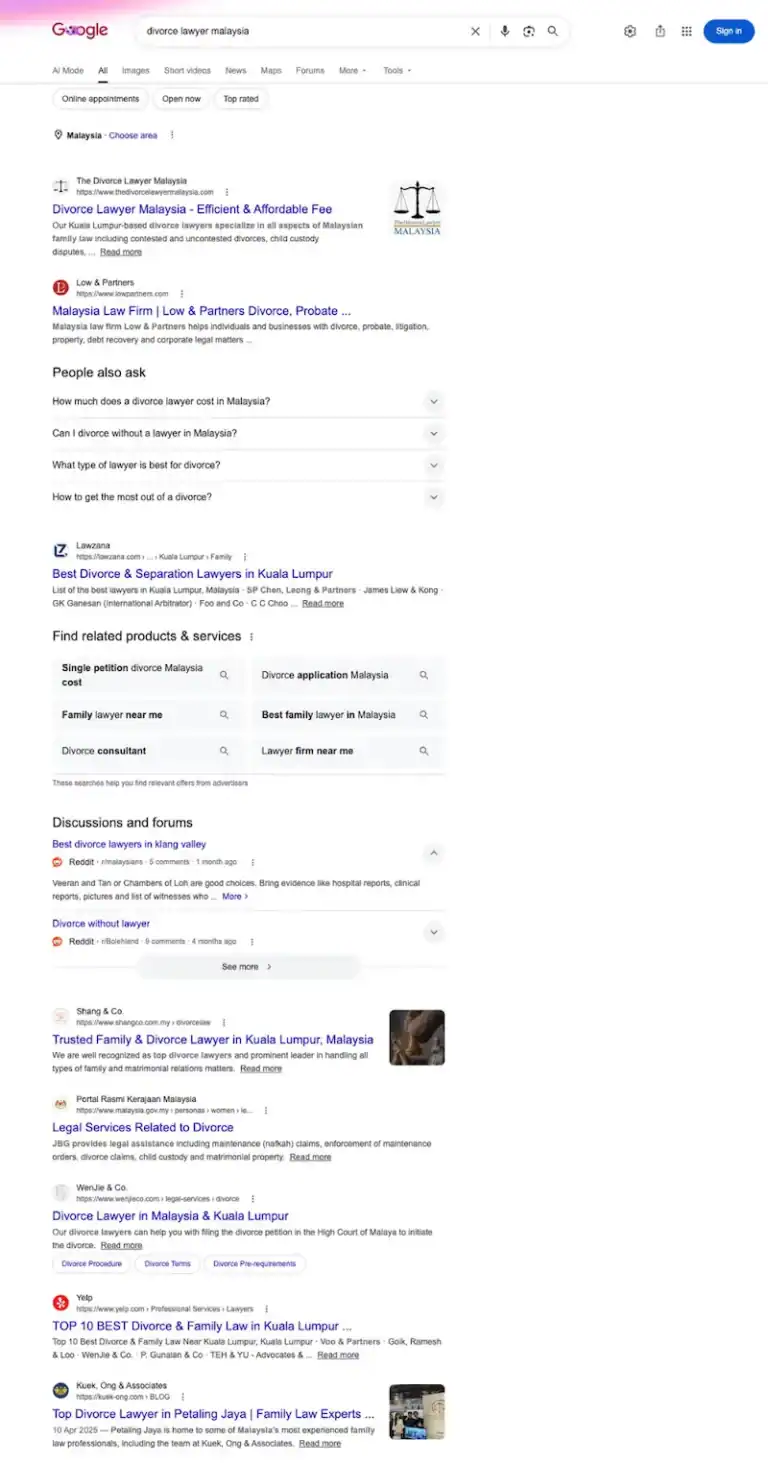
Look at who’s winning “divorce lawyer malaysia”: thedivorcelawyermalaysia.com (an entire domain about one thing), wenjieco.com/legal-services/divorce (a dedicated page in a structured firm site), shangco.com.my/divorcelaw, kuek-ong.com’s dedicated divorce page. Every winner has the page. The general-practice firm with one “Our Services” page listing twenty practice areas is nowhere — it’s the structural equivalent of the one-page site, and it loses the same way.
And here is the detail that removes the last excuse, the one about needing a big established website to compete:
Eleven of the dedicated pages winning these SERPs sit at Domain Rating 10 or below.
thedivorcelawyermalaysia.com at DR 0, ranking #3. shangco at DR 2. kuek-ong at DR 1. Four dental clinics at DR 0 ranking on page one of “klinik gigi.” coolairservis at DR 10, drair at DR 6. These are sites with almost no link authority whatsoever, outranking far stronger domains — because they have the one thing the strong domains’ combined pages don’t: a page that is unambiguously, entirely about the thing being searched. Our page-one anatomy study found the same species of winner; here it is again, decided by structure.
You don’t need a powerful website to beat your competitors for a service. You need a page that is about that service. They usually don’t have one.
Finding 3: What This Looks Like From Google’s Side Of The Screen
Step out of the marketing seat and into the searcher’s, because that’s whose experience Google is actually optimising for — and it explains every number above.
You have a contract dispute. You search “employment lawyer kuala lumpur.” You click the first result and land on a law firm’s single page where employment law is section seven of eleven, sandwiched between conveyancing and probate, three scrolls down, sharing the page with criminal defence and family law. You skim, you don’t find a paragraph that’s actually about your problem, and you hit back within seconds.
That back-click is data. Google sees you return to the results and pick a different link — a firm whose entire page is about employment disputes, that opens by naming your exact situation. You stay. You read. You call.
Google has now learned something concrete: for “employment lawyer,” the dedicated page satisfied the searcher, and the combined page didn’t. Multiply that by thousands of searchers, and the ranking order you see in Finding 2 is simply the accumulated record of which page type keeps making Malaysians stop searching. Relevance isn’t an abstraction Google rewards out of principle — it’s measured behaviour. The combined page loses because real people leave it.

This is why the merge fails on two fronts at once. It fails at ranking — one page can’t be strongly relevant to eleven different queries. And it fails at conversion — even on the rare visit, a person looking for one specific service has to hunt through four others to find themselves, and many won’t bother. The dedicated page wins the click and the customer: it ranks because it’s relevant, and it converts because the visitor sees their exact problem named in the first line.
A one-page site for a multi-service business is, from Google’s side of the screen, a page that makes searchers leave. That is the single behaviour the entire ranking system is built to detect and demote.
Your designer optimised the page for the three seconds a human admires it. Google optimises for whether that human found what they came for. Those are not on the same page.
Finding 4: The Homepage Is The Smallest Part Of A Site That Works
If pages are what rank, then a winning site should look like a collection of ranking pages, with the homepage as just one of them. That’s exactly what the anatomy data shows.

We pulled the top pages of three Malaysian sites that rank well, and asked: how much of the traffic is the homepage, and how much is everything else?
WenJie & Co (law firm): top pages earn ~7,047 visits/month. The homepage accounts for just 500 visits (7.1%). The other 92.9% comes from a legal-fee calculator (1,697/month), a power-of-attorney guide (745), a divorce-procedure guide that ranks separately in English, Malay and Chinese (684 + 446 + 270), a letter-of-demand page, an employment-law page, and a tenancy guide. A firm that built one page would have built the page earning 7% and skipped the 93%.
ServiceAircond.my (trade business, DR 23): ~9,610 visits/month across its top pages; the homepage is 37.8%, and the other 62.2% is guides — best portable aircond, how often to service, why your compressor stopped — each ranking, several duplicated in Malay because the BM versions rank too.
Shinjiru (multi-service agency): ~15,209 visits/month; homepage 39.3%. The rest is one page per service and per sub-service — `/web-design/website-design-malaysia/` (2,793), `/seo-malaysia/` (2,058), `/web-design/web-builder-malaysia/` holding #1, `/web-hosting/wordpress-web-hosting/` holding #1, `/social-media-management/` holding #1. Nine service and sub-service pages, three of them ranking first for their own keyword.
Read those three numbers together — homepage at 7%, 38%, 39% — and the conclusion is unavoidable. The homepage is never where the traffic is. It’s the lobby; the service pages are the rooms people actually searched to reach. A one-page website is a building that is all lobby — beautiful, and empty of the rooms anyone came for.
Note especially Shinjiru’s sub-service pages, because that’s the move the next section is built on: they didn’t stop at “web design.” They built “web design,” then “ecommerce website builder” and “web builder” underneath it — and the sub-pages rank #1 where the parent ranks #3. Depth wins the searches breadth can’t reach.
The page your designer was proudest of is the one earning you the least. The traffic was always going to live in the pages they didn’t build.
What This Data Does NOT Say
The honest fences, because this study argues for structure — not against design, and not for endless pages:
- It does not say one-page websites never work. They’re correct for specific jobs: a single-product launch, a campaign landing page tied to an ad, an event, a personal brand, a business with genuinely one service and one search intent. The failure is the multi-service business on one page — the case this study measured.
- It does not say design doesn’t matter. Design quality decides whether a visitor trusts you and converts once they arrive; it does essential work. The argument here is that design and structure are two different jobs — making the page beautiful and making the right pages exist — and that a site needs both. A stunning one-pager and an ugly ten-pager are both half-built.
- It does not say “more pages = better.” Ten thin, near-empty pages are worse than one good one — our zero-value-page concerns are real. The rule isn’t “split everything”; it’s “one page per genuine, separately-searched service,” which the demand data in Finding 1 tells you exactly how to find.
- It does not say structure alone ranks you. Structure makes you eligible. The page still needs real content, and the domain still needs authority earned over time. Structure is the prerequisite that the merge throws away before the race even starts.
The Strategy: Build A Site Google Can Actually Rank
A measurement without a blueprint is just bad news. Here’s the structure the data prescribes — the same architecture every winning site in this study converged on, laid out so you can hand it to whoever builds your next site.
Step 1 — The structure map: think in a hierarchy, not a page
A site that ranks is shaped like a tree, not a poster:
- Brand hub (homepage): who you are, the trust signals, links down to every service. It ranks for your name — and as the anatomy showed, that’s a small slice, which is fine. That’s its job.
- One page per service: the core layer. Five real services = five pages, each owning one search intent. This is the layer the one-page site deletes entirely.
- Sub-service pages beneath the services that need them: where a service splits further (Shinjiru’s “web design” → “ecommerce builder”; a law firm’s “family law” → “divorce” → “child custody”), each sub-service that has its own search demand earns its own page. This is how DR-0 specialists outrank giants: depth.
- Location pages where you serve distinct areas and people search geographically (“aircond service [town]” — ServiceAircond’s area pages rank).
- Guides, calculators and tools that catch the research-stage searches: WenJie’s fee calculator alone pulls 1,697 visits/month, more than three of its practice pages combined. These feed the whole site authority and catch buyers before they’re ready to choose. Even low-volume opportunities are often worth building when they reflect genuine demand, as shown in our zero-volume study.

Step 2 — The anatomy of one service page
A service page that ranks and converts isn’t a paragraph and a contact button. The winners include, in roughly this order:
- What the service covers — the scope, in plain language, naming the exact problem the searcher has (this is what wins the click-and-stay).
- Why it matters / when you need it — the stakes, the consequences of getting it wrong, the trigger situations.
- The keyword worked in naturally — the page’s one primary search term in the title, H1, and opening line; close variants and the BM/Chinese phrasing where relevant (Finding 1’s fragmentation lives here).
- Process / what working with you looks like — steps, timeline, what to expect.
- Case study or example — a real outcome, even anonymised; proof beats adjectives.
- Portfolio/evidence — relevant work, results, credentials specific to this service.
- Why you — differentiation that’s about this service, not generic “we’re passionate.”
- FAQ — the real questions people ask about this service (these often win their own searches and feed AI Overviews).
- One clear CTA — the single next step.

Step 3 — The language layer
Finding 1 showed “peguam” (4,800, KD 7) and “lawyer” (4,800, KD 47) are the same demand at a seventh of the difficulty; WenJie ranks for divorce procedure in three languages on three URLs. This mirrors both our BM vs English study and our Mandarin study, which found that native-language search behaviour consistently uncovers demand that translated English pages miss. Where your customers search in Malay or Chinese, those are separate pages or separate sections, researched natively — never a Google-translated copy of the English page. The structure that wins isn’t just one page per service; in Malaysia, it’s often one page per service per language.
Step 4 — The migration path (if you already have a one-page site)

You don’t rebuild from scratch, and you don’t lose what you have. The sequence:
- List your services and pull the demand (Finding 1’s method — the Run-It-Yourself section has the steps). Rank them by monthly searches.
- Split highest-demand first. Carve each service out of the one-pager into its own full page, built to the Step 2 anatomy, starting with the service that has the most search volume — fastest return.
- Keep the homepage as the hub, linking down to each new service page; the merged sections become summaries that link to the full pages.
- Preserve link equity: if old URLs change, 301-redirect them so nothing you’ve earned is lost.
- Add sub-service and guide pages over the following weeks, demand-ordered. A realistic cadence is one or two proper pages a fortnight — a 90-day path from one page to a ranking structure, not a frozen six-month rebuild.
Step 5 — Brief your designer (or hire one who thinks past launch)
When you commission the site, the brief is structural, not just visual: “one page per service, sub-pages for [list], BM versions for [list], here are the target searches per page.” A designer whose job ends at launch will build you a beautiful poster. The site needs someone whose thinking starts at “what does each page need to rank for” — which is exactly the seam where search strategy and design meet, and exactly why the two shouldn’t be commissioned as separate, sequential jobs.
What To Take From This Article
If you read nothing else, take these five:
- Google ranks pages, not websites. Every service you want to be found for needs its own page. This is not an SEO nicety; it’s the mechanism.
- Count your searches, not your services. Five services are often ten or fifteen separate searches (Finding 1). Each separately searched intent that matters to your revenue deserves a page.
- Zero combined pages ranked. A “list everything on one page” site competes for one search and forfeits the rest — and DR-0 specialists with the right page will beat your stronger site every time.
- The homepage was never going to carry you. Winners earn 60–93% of their traffic off the homepage. A one-page site is all lobby, no rooms.
- Design and structure are different jobs — make sure both get done. A beautiful one-pager is half a website. Brief for structure, build for ranking, then make it beautiful.
The Final Take: A Website Is A System Of Pages, Not A Single Beautiful One
The verdict, plainly: a multi-service business on a one-page website has made a structural decision to be invisible for most of what it sells — and no amount of design polish reverses it, because the problem isn’t how the page looks, it’s that the other pages don’t exist. Google ranks pages; you gave it one; it can rank you for one thing at most. The fix isn’t more marketing budget on a broken structure — it’s the structure itself.
If you’re a business owner
- Audit honestly this week. Open your site. Count the pages a search engine could rank for a specific service. If the answer is “one” or “the homepage,” you’ve found why the leads aren’t coming.
- Count your real searches using Finding 1’s method — list your services, pull the volume for each (and their BM/Chinese phrasings). That list is your page plan.
- Split the highest-demand services first if you’re migrating, full-anatomy pages, 301 the old URLs, hub-and-spoke structure. One or two real pages a fortnight.
- Commission structure, not just design. Your brief names the pages and the searches each must win — before anyone picks a colour.
- Treat guides and calculators as front doors, not afterthoughts — they out-earned core pages in our anatomy data and catch buyers early.
If you’re choosing who builds it
The uncomfortable but data-backed implication: a pure web-design shop whose engagement ends at launch optimises for the handover, not the leads — the site looks finished the day it’s least able to rank. The build should be led by whoever owns the search outcome, so structure, content depth and language layers are designed in from the wireframe, not retrofitted after the site quietly underperforms for a year. Design is essential, and the site must be beautiful — but beauty is the finish on the structure, not a substitute for it. That’s the difference between traditional web design and structure-led web design.
The one-sentence version
Google ranks pages, not websites — so a one-page site for a multi-service business is a decision to be found for one thing and invisible for everything else, and the only fix is to build the pages the searches are actually looking for.
Run This Yourself
The three datasets (45 fragmentation keywords, 39 classified SERP results, 3 site anatomies) and the analysis script are available on request — reach out and we’ll send the pack.
The audit for your own business, one afternoon:
- List every service and sub-service you offer. Be granular — “family law” is really divorce, custody, maintenance, adoption.
- Pull monthly search volume for each (and the Malay/Chinese phrasing) in any keyword tool. This is your fragmentation map — and your page plan, ranked by demand.
- Search your top 3 service terms and classify the top 10: dedicated pages or combined? You’ll see the Finding-2 pattern in your own market within minutes.
- Count your own rankable pages against that list. The gap between searches-that-matter and pages-that-exist is your forfeited market — in pages and what a ranking is worth in ringgit.
Limitations (Read These Before Quoting)
- 5 SERPs / 39 results is an illustrative cross-section, not a census — chosen across legal, medical, home services and B2B for contrast; single snapshot, 12 June 2026. The 0/39 combined-page result is stark and consistent, but treat it as strong directional evidence, not a universal constant.
- 3 site anatomies are case studies, not a sample — they were selected as clear ranking winners to show where traffic lives; they illustrate the pattern rather than prove its prevalence.
- Page-type classification involves judgment — “dedicated service page” vs “whole-domain-one-service” vs “guide” are our calls using Ahrefs’ AI labels plus review; the full classified table ships in the pack for audit.
- Structure is necessary, not sufficient. These winners also have real content and earned authority. This study isolates structure’s role; it does not claim structure alone ranks a page.
- Traffic and volume figures are Ahrefs estimates subject to the usual sampling caveats (see our zero-volume study); the relative shares — homepage vs rest — are robust even where absolute numbers carry error.
- “Combined pages ranked zero” describes these five SERPs. It is a measured result here, not a law of nature; your vertical may differ, which is why the Run-It-Yourself check matters.
FAQ
My business genuinely has one service. Is a one-page site fine for me?
Often yes — if your service maps to essentially one search intent, a single well-built page (or a small site) is reasonable. The failure mode this study measures is the multi-service business on one page. Even then, check Finding 1’s method: “one service” frequently fragments into several searches once you look.
Won't lots of service pages look empty or thin?
Only if you build them thin — and thin pages are their own problem. Each service page should be a complete answer (the Step 2 anatomy: scope, stakes, process, proof, FAQ). If you can’t fill a page about a service, that’s a signal the demand or your offering is too small to warrant a separate page — fold it back. Structure follows real demand, not page-count targets.
We're a startup with no domain authority. Is this pointless until we're bigger?
The opposite — this is your cheapest path in. Eleven dedicated pages in our data rank at DR 10 or below; four DR-0 dental clinics rank on page one. Relevance via structure is exactly how small sites beat big ones before they have authority. Waiting until you’re “bigger” forfeits the years when this is easiest.
Our designer says one page is better for user experience / it's a modern style.
Single-page design is a legitimate style for the right job (a product launch, a portfolio). For a multi-service business, it trades findability for scroll-smoothness — and the data shows the cost. The reconciliation is structured underneath, good design on top: a multi-page site can be every bit as beautiful, and it can actually be found.
Should the Malay and Chinese versions be separate pages?
Where you have real demand in those languages, yes — separate pages or clearly separate sections, researched natively (never translated), because the search terms and phrasings differ. WenJie ranks for divorce procedure on three language URLs simultaneously; that’s three markets one English page would have missed.
We already rank okay for our brand name. Isn't that enough?
Ranking for your own name means people who already know you can find you — that’s the homepage’s 7–39%. It does nothing for the majority who are searching for the service, not the company. Those searches go to whoever built the dedicated page, and right now that isn’t you.
Want to see exactly which searches your current site is forfeiting? Send us your website and service list, and we’ll run a structure audit covering every service you offer, the searches it generates, whether you have a page that can rank for each, and the page-by-page priorities for an effective SEO programme. Drop us a line to start your website structure audit.