
“What’s a ranking actually worth?”
Every Malaysian business owner has asked it — usually right before approving or killing a marketing budget — and every answer they’ve gotten was a feeling. “Visibility.” “Brand presence.” “Long-term value.”
Here’s a number instead
RM22,000
The #1 organic position for “personal loan” in Malaysia is worth approximately RM22,000 a month. Not in mystique — in arithmetic. That’s what the same clicks would cost if you bought them at the price advertisers are paying right now, in a live auction, for that exact keyword.
- Google Ads is many things, but above all, it is a price discovery machine.
Thousands of Malaysian businesses bidding real ringgit, every day, on what a click in each category is worth to them. Most of the market only ever reads those prices to set ad budgets. We read them the other way — as a valuation of every organic position on the page.
This study is written for two readers
The business owner
Deciding how to split a budget between ads and SEO
The marketer
Who has to defend that split with numbers
We priced 60 Malaysian commercial keywords
in English, Bahasa Melayu and Chinese — pulling live volume, cost-per-click and ranking difficulty for each, then computed what one organic #1 is worth per month in ringgit, and where the gap between a keyword’s price and its difficulty is so wide it amounts to mispricing.
- The short version
Malaysia’s keyword market has the pricing errors of any young market. A Chinese-language loan click costs triple the English one while its SERP sits nearly undefended. A dental keyword worth RM1,200 a month has a difficulty score of zero.
The cheapest clicks in the country are hiding in BM — and the most expensive belong, with no irony spared, to the agencies selling search itself.
Key Findings (TL;DR)
One organic #1 in Malaysia is worth up to RM22,028/month in equivalent ad spend ("personal loan").
Across our 60-keyword map: "pinjaman peribadi" RM5,874, "car insurance" RM5,685, "aircond service" RM2,881, "seo services malaysia" RM1,802, "klinik gigi" RM1,235.
The most mispriced keyword in the study is 贷款 (loan, Chinese): RM4,005/month of click value sitting at Keyword Difficulty 3
A $3.00 click, triple the English price, with the organic page barely defended.
A BM click averages $0.27 against the English $0.73 — 37% of the price
at lower average difficulty. And BM had zero empty auctions: advertisers already know what Malaysian SEO plans keep missing.
"Lawyer" and "peguam" are searched exactly as often
4,800 times a month each. One is Difficulty 47. The other is Difficulty 7.
Five commercial legal and medical keywords carry search volume, and no recorded ads at all
empty auctions in verticals everyone assumes are expensive.
B2B services are Malaysia's dearest clicks ($1.46 average)
topped by "seo services malaysia" at $1.80 and "payroll services malaysia" at $3.50 with a difficulty of zero.
Methodology
And the honest model behind the RM figures
60 commercial-intent keywords
Pulled live on 12 June 2026 from the Ahrefs Malaysia database with three values each: monthly search volume, cost-per-click (USD, as paid by actual advertisers), and Keyword Difficulty (0–100).
The basket spans seven verticals — finance, B2B & agency services, medical & aesthetic, legal, property, home services, education — across English, Bahasa Melayu and Chinese, including nine matched triplets (the same commercial intent expressed natively in all three languages; BM and CN terms researched natively, never translated).
The RM model
Monthly value of organic #1 =
volume × 25% CTR × CPC × RM4.45/USD
Three assumptions, all disclosed
1. CTR at #1 is ~25% — deliberately conservative
Figures scale linearly: read them at ×0.8 if you prefer 20% or ×1.2 at 30%. The model is robust across the band.
2. Advertiser CPC is treated as market value of a click
This understates organic value if anything, since advertisers only bid what a click is worth to them after margin.
3. USD→MYR at 4.45
EDITOR: click-verify the current rate before publish and adjust the constant in the script — every RM figure regenerates automatically.
Finding 1
The RM Table — What One Ranking Pays Per Month

The fifteen most valuable organic positions in the basket, priced at advertiser rates:
| Keyword | Lang | Volume | CPC | KD | Value of #1 /mo |
| personal loan | EN | 22,000 | $0.90 | 57 | RM22,028 |
| credit card | EN | 16,000 | $0.35 | 64 | RM6,230 |
| pinjaman peribadi | BM | 6,600 | $0.80 | 18 | RM5,874 |
| car insurance | EN | 7,300 | $0.70 | 49 | RM5,685 |
| 贷款 (loan) | CN | 1,200 | $3.00 | 3 | RM4,005 |
| aircond service | EN | 3,700 | $0.70 | 3 | RM2,881 |
| insurans kereta | BM | 7,200 | $0.35 | 17 | RM2,804 |
| seo services malaysia | EN | 900 | $1.80 | 36 | RM1,802 |
| web design malaysia | EN | 1,000 | $1.20 | 27 | RM1,335 |
| digital marketing agency malaysia | EN | 1,000 | $1.20 | 61 | RM1,335 |
| klinik gigi | BM | 3,700 | $0.30 | 0 | RM1,235 |
| hair transplant malaysia | EN | 900 | $1.10 | 12 | RM1,101 |
| social media agency malaysia | EN | 1,100 | $0.90 | 27 | RM1,101 |
| lawyer | EN | 4,800 | $0.20 | 47 | RM1,068 |
| erp system malaysia | EN | 500 | $1.70 | 1 | RM946 |
Three ways to read this table
in ascending order of usefulness
As a curiosity
Rankings have prices. Nice.
As a budget defence
If your business holds — or could hold — one of these positions, the table is the line item your next marketing review has been missing. An air conditioning company at #1 for its head term is banking RM2,881 a month from clicks its competitors are buying at retail. Over a year, that single position is a RM34,000 asset — against an acquisition cost (the SEO work) that is mostly one-off.
As a portfolio
No business lives on one keyword. A clinic ranking #1 across "klinik gigi" plus four mid-volume treatment terms is sitting on RM2,000–3,000 of monthly click value; an agency holding the B2B cluster, RM5,000+. The audit in the Final Take turns your own keyword list into this table — and for most Malaysian SMEs, it's the first time their organic presence has ever had a ringgit denomination.
As a rent-or-buy decision
The table also prices the alternative you're already living with. Take the aircond row. Buying those clicks at auction — which is what not ranking means, if you want the traffic at all — runs RM2,881 a month, every month, forever: roughly RM103,700 over three years, with nothing owned at the end of it.
The organic position costs a build and a defence — real money, mostly once — and then pays the same RM2,881 in perpetuity at a marginal cost near zero.
Neither answer is wrong; cash-flow businesses rent, balance-sheet businesses buy. But until both numbers sit in the same row, the rent has a way of never being counted — because it leaves the account as “ad spend,” a category nobody compares to anything.
Your rankings have been earning a salary this whole time. Nobody ever printed the payslip.
Finding 2
The Arbitrage Index — Malaysia’s Mispriced Keywords
Value is one axis. Cost of capture is the other. Divide the monthly RM value by the Keyword Difficulty, and you get the arbitrage index — how much monthly value each point of ranking effort buys. This is the table for deciding where to fight:

| Keyword | RM/mo | KD | Index (RM per KD point) |
| 贷款 (loan, CN) | RM4,005 | 3 | 1,335 |
| klinik gigi (BM) | RM1,235 | 0 | 1,235 |
| aircond service (EN) | RM2,881 | 3 | 960 |
| erp system malaysia (EN) | RM946 | 1 | 946 |
| payroll services malaysia (EN) | RM584 | 0 | 584 |
| personal loan (EN) | RM22,028 | 57 | 386 |
| pinjaman peribadi (BM) | RM5,874 | 18 | 326 |
| insurans kereta (BM) | RM2,804 | 17 | 165 |
| dentist (EN) | RM801 | 5 | 160 |
| company incorporation malaysia (EN) | RM134 | 0 | 134 |
What the table reveals
Look at the top five
A Chinese loan keyword, a BM dental keyword, an English trade service, and two B2B software terms — none of them is the kind of keyword Malaysian SEO proposals are built around, because proposals chase volume and the index chases value-per-fight.
- The details are worth a circle in red: KD 0
klinik gigi, payroll services and company incorporation sit at Keyword Difficulty zero. Twelve hundred ringgit a month, five hundred eighty, a hundred thirty — unguarded.
KD 0 doesn’t mean no competitors exist; it means the pages’ rankings have effectively no earned links defending them, which our page-one anatomy study showed is exactly the condition under which a real business publishing its own trade walks in.
These aren’t keywords you win after a campaign. They’re keywords somebody wins by showing up properly once.
Two rows that missed the top table carry lessons the table can’t
The sleeper: klinik pakar kulit
2,400 monthly searches for a skin specialist, a 20-cent click, KD 15 — prices out at RM534/month of click value in a category where one converted patient covers a year of it.
It’s the kind of keyword this index exists to surface: too small for a volume-chasing proposal, too valuable per fight to ignore.
And the inverse lesson: rumah lelong
Pulls 1,300 searches a month — more than half the basket — at a one-cent click: RM14/month of value, because the auction-property marketplaces absorbed that intent so completely no advertiser bothers bidding.
Volume is not value. The auction is the market’s opinion of the keyword; the volume is only its noise level.
A regulatory note on the table-topper
贷款’s $3.00 click is the licensed-moneylending and personal-financing ad market — among the most compliance-sensitive advertising categories in Malaysia. The arbitrage is real, and the data reports it; entering that market is a licensing question before it’s a marketing one.Malaysian marketing budgets are auctioned by volume. Value per fight is barely measured — which is why the best-priced keywords in the country are still sitting on the table.
Finding 3
The Language Price Map — The BM Click Costs A Third
Average the recorded CPCs by language and Malaysia’s three search markets price themselves:

Language | Avg CPC | Avg KD | Empty Auctions |
English | $0.73 | 18 | 5 of 34 |
Bahasa Melayu | $0.27 | 12 | 0 of 16 |
Chinese | $0.65 | 9 | 4 of 10 |
The BM click costs 37% of the English click — for the same Malaysians, often the same intent, at lower average difficulty. Our BM vs English study established the volume and difficulty halves of this; this is the missing money panel: the paid market has already re-priced Malay intent at a discount, the organic market still hasn’t arbitraged.
And note the column nobody expects: BM recorded zero empty auctions. Every single BM commercial keyword in this basket has consistent advertisers — local businesses, bidding in a market they understand — while English and Chinese both carry gaps. Read that plainly: *the advertisers already know.* Malaysian SMEs buying BM clicks at 27 cents have quietly out-priced the strategy decks still telling everyone Malaysian search happens in English.
Chinese is the strange one — bimodal. Finance burns white-hot ($3.00 loans, with 信用卡 carrying real volume) while service categories barely register an auction at all (装修 — renovation — trades at four cents; 冷气维修 has no recorded ads). The Chinese-Malaysian market doesn’t have a click price so much as two separate economies: one where lenders fight for every impression, and one where nobody official has shown up since our Mandarin study first mapped the third SERP.
English is where Malaysian marketing budgets compete. BM is where Malaysian customers got 63% cheaper. The gap between those sentences is the most actionable line in this study.
Finding 4
The Triplets — Same Customer, Three Prices
Nine intents, expressed natively in all three languages, priced side by side. Three of them deserve their own frames:

The language triplets
Three separate economies with separate price levels
- personal loan
$0.90
- pinjaman peribadi
$0.80
- 贷款
$3.00
The Chinese-speaking borrower’s click costs 3.3× the English one — concentrated demand, fewer pages competing for it, and an advertiser pool (licensed lenders) that has done the maths.
Language segments in Malaysia are separate economies with separate price levels — not translations of one market.
The dentist triplet — the open door
- dentist
2,400 searches | KD 5
- klinik gigi
3,700 searches | KD 0
- 牙医
80 searches | KD 0
The BM term out-volumes the English one and sits unguarded. Every dental clinic budget meeting in the Klang Valley should have this row taped to the wall.
The remaining triplets repeat the pattern with local texture
BM matches or beats English volume in 5 of 9 intents, never at greater difficulty
Chinese volume is thin outside finance, but its difficulty floor is effectively zero everywhere it exists
Two CN service terms returned no auction at all — the third SERP isn't just under-published, it's under-monetised
You don't have one keyword market. You have three; they price the same customer differently, and your plan has probably only ever shopped in the expensive one.
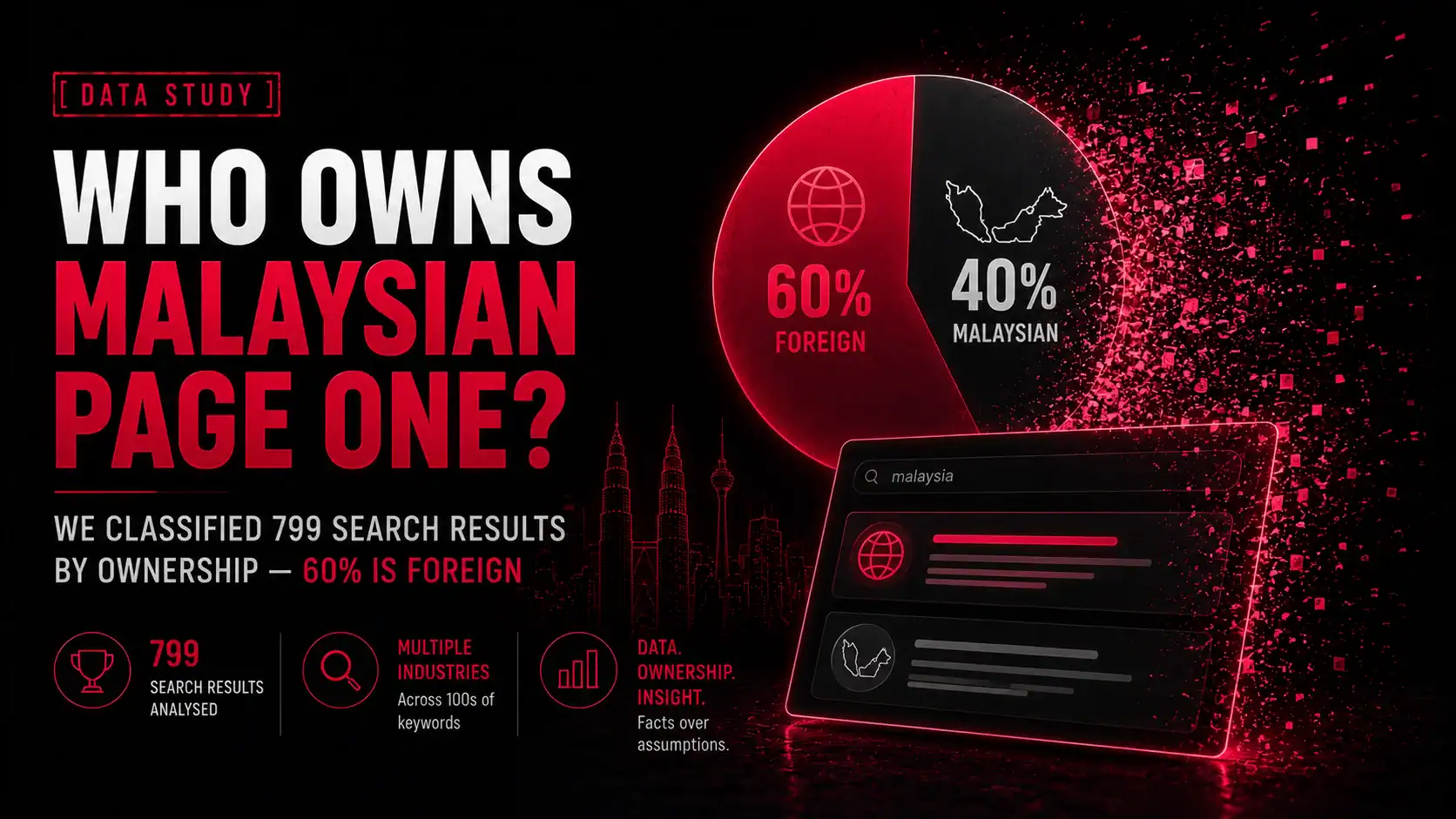
The same home-versus-away pricing effect appears in our ownership study, where local ownership consistently influences who captures commercial visibility.
Finding 5
The Empty Auctions — Volume With No Bidders
Five keywords in this basket carry real commercial search volume and no recorded ad auction at all:
Keyword | Volume/mo | KD |
immigration lawyer malaysia | 250 | 0 |
divorce lawyer malaysia | 150 | 0 |
employment lawyer malaysia | 100 | 0 |
补习中心 (tuition centre) | 100 | 13 |
fertility clinic malaysia | 40 | 37 |

Sit with the legal rows. Two hundred and fifty Malaysians a month search for an immigration lawyer, and nobody is consistently advertising to them. Same for divorce, same for employment law — and the organic difficulty on all three is zero. The vertical everyone “knows” is expensive (because American legal CPCs are legendary) turns out, in Malaysia, to be a market where the buyers never showed up — likely some mix of Bar advertising conservatism, small-practice marketing habits, and the assumption that clients come by referral.
Whatever the cause, the consequence is a genuine two-channel gift: paid clicks at floor prices for whichever firm enters the auction first, and organic positions undefended behind them. This is the purest cross-channel finding in the study — an SEM opportunity and an SEO opportunity stacked on the same keywords, in a category with four-figure client values.
The pattern says something bigger about reading CPC data: a null isn’t “no market.” It’s a market before its first real bidder — and Malaysian search still has whole commercial neighbourhoods like this.
Somewhere in this table is a law firm's entire next decade of clients, currently being awarded to whoever Google can find.
Finding 6
The Vertical League — And Who Pays The Most For A Click In Malaysia
Average the recorded CPCs by vertical:

Vertical | Avg CPC |
B2B & agency services | $1.46 |
Finance | $0.77 |
Medical & aesthetic | $0.45 |
Home services | $0.41 |
Legal | $0.31 |
Education | $0.25 |
Property | $0.15 |
The league’s top is its own punchline: the most expensive clicks in Malaysia belong to the companies that sell clicks. “Seo services malaysia” trades at $1.80, “digital marketing agency” and “web design” at $1.20, “payroll services” at $3.50 — B2B services out-price even finance. There’s a clean reason and a useful one. Clean: B2B deal values are large and recurring, so a lead is worth bidding hard for. Useful: the people with the best visibility data in the country — agencies — bid the most aggressively of anyone for visibility. Watch what the experts pay, not what they post.
The league’s bottom is just as instructive. Property’s $0.15 average isn’t low demand — “rumah lelong” pulls 1,300 searches a month — it’s that the marketplaces (iProperty, PropertyGuru, Mudah) absorbed the transactional intent so completely that the per-click auction never developed heat. Cheap clicks aren’t always an opportunity; sometimes they’re the market telling you a platform already owns the buyer. Our marketplace study mapped who; this table prices what that ownership did to the auction.
And medical at $0.45 average hides the study’s quiet monster: hair transplant at $1.10, aesthetic clinics at $0.90, pico laser at $0.60 — the aesthetic economy bids like B2B because a single converted patient is worth thousands. Pair those CPCs with their difficulty scores (12, 35, 0) and the aesthetic cluster is arguably the most under-fought high-value territory in the country after the CN loan market.
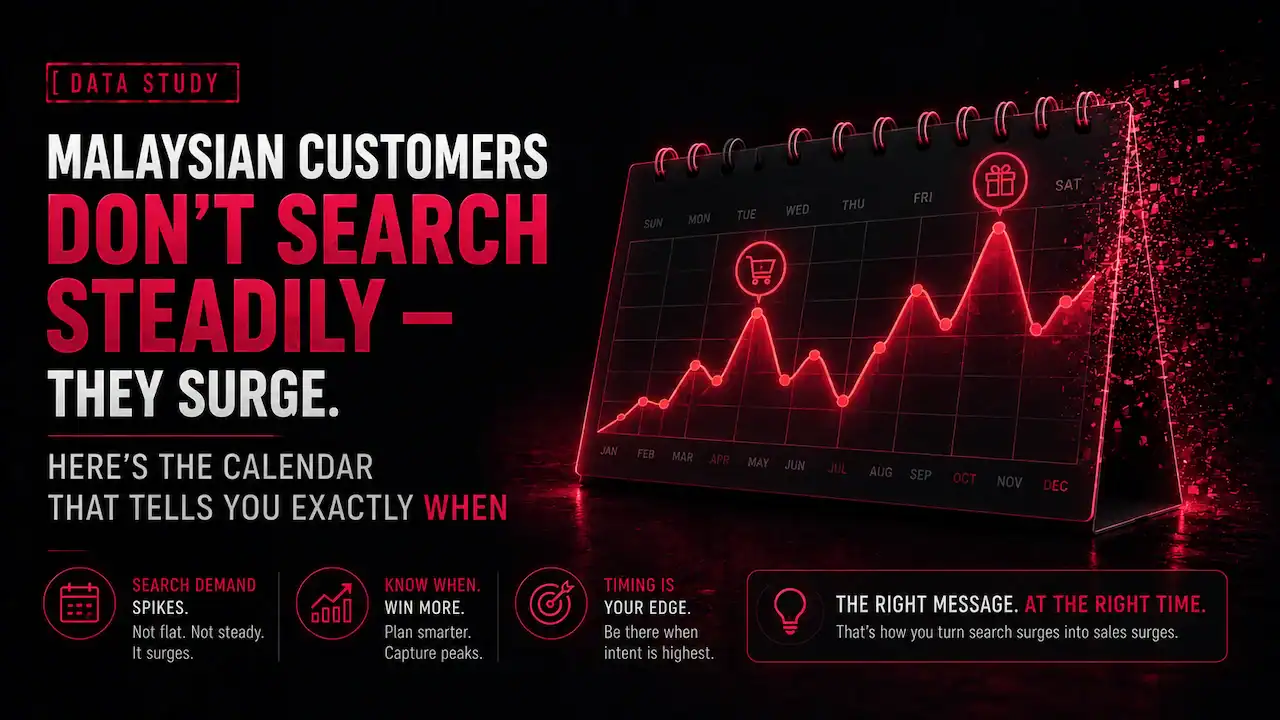
One last property of these prices: they breathe. Every figure in this study is June’s weather, and Malaysian auctions have seasons — our search calendar mapped the Q4 pile-up where retail, festive and year-end budgets collide in the same auctions, and finance terms surge into tax season. The strategic consequence cuts in organic’s favour twice: ad rent is highest exactly when the clicks are worth most, while a ranking’s cost doesn’t move in November. The asset pays its biggest dividend in precisely the months the rent peaks — so if your category’s season is predictable (and in Malaysia it almost always is), the build needs to finish before the surge, not be budgeted during it.
Every vertical's CPC is its self-assessment of what a customer is worth. Malaysia's most honest market researchers turn out to be its advertisers.
What This Data Does NOT Say
It does not say a ranking is free money.
The RM figures are gross click value at market rates — capturing them costs content, links, time and maintenance. The honest comparison is asset purchase vs rent: ads bill monthly forever; a ranking is paid for mostly once and then defended. Both are legitimate; the table prices the choice, it doesn't make it.
It does not say CPC equals profit.
Advertisers bid on their own conversion economics. A $3.00 click is only "worth" $3.00 if your business converts as the bidders' do.
It does not say to abandon expensive keywords.
"Personal loan" at KD 57 is still worth RM22k a month — the index reframes sequencing, not worth. High-KD, high-value terms are where ads earn their keep, while organic compounds (the same two-surface logic our marketplace study landed on).
It does not say the model is gospel.
25% CTR is an assumption, stated and adjustable; Ahrefs CPCs lag live auctions; single snapshot, June 2026. The script ships so you can re-run it on your own numbers and your own rate.
The Final Take: Price Every Keyword Before You Fight For It
The verdict in plain words: Malaysian search has a published price list, and almost nobody on the organic side has ever read it. Advertisers priced every click; difficulty scores priced every fight; and the moment you put those two numbers side by side, “should we do SEO or ads?” stops being a philosophy debate and becomes arithmetic — keyword by keyword, in ringgit.
If you’re a business owner — the budget-split algorithm
Run this on your top 15–20 commercial keywords (one afternoon; the Run This Yourself section has the steps):

Price each keyword
volume × 25% × CPC × current RM rate = monthly value of #1. No CPC recorded? Flag it — that's a Finding-5 empty auction, and you may be able to buy those clicks at floor prices today while you build.
Index each keyword
value ÷ difficulty. Sort descending.
Split into three buckets
- RANK (index high, KD under ~20): your klinik-gigi-class keywords — high value per fight, doors open. Organic investment here compounds fastest; every month you delay, you're paying the table's rent in lost equivalent spend.
- BUY (value high, KD 40+): your personal-loan-class keywords. Rent them with ads now — the value justifies the CPC — while organic work climbs in the background. Re-run the index quarterly; keywords migrate buckets as your domain strengthens.
- BOTH (the language twins): wherever your category has a BM or CN sibling at a fraction of the difficulty — and Finding 4 says it usually does — run the cheap-language organic play and keep the English term on paid. Same customer, two doors, priced separately; use both prices.
Put the RM column in your monthly report
"We rank #1 for these eight terms" is trivia. "Our rankings replaced RM6,400/month of ad spend this quarter" is a board sentence. The valuation also tells you what defending a position is worth when a competitor starts climbing — and what losing one quietly cost you last year.
- If you're an SEO or media specialist
This model is your proposal weapon and your honesty test in one. Price the client’s target list in RM before scoping; let the index pick the battles; recommend ads without flinching where the index says rent (the consultant who says “buy this one, rank that one” with numbers attached wins against every single-channel pitch in the room).
And quote retainers against the asset value being built — “RM4,100/month of click value captured to date” is a renewal conversation that runs itself.
Every Malaysian keyword already has a price tag written by the advertisers who know it best — so rank the cheap fights, rent the expensive ones, shop in all three languages, and never again spend a marketing ringgit on a keyword nobody priced first.
Run This Yourself
The 60-keyword dataset and the pricing script are available on request — reach out and we’ll send the pack; change one constant and every RM figure recalculates at your preferred CTR and exchange rate.
The DIY version for your own list: export your target keywords with volume, CPC and difficulty from any major tool; in a spreadsheet, compute value = volume × 0.25 × CPC × RM rate, and index = value ÷ difficulty (floor difficulty at 1). Sort by index. The top of that sort is your organic shortlist; the high-value/high-KD tail is your ads list; the blank-CPC rows are your empty auctions. Check the BM and CN siblings of every English term before you finalise anything — natively phrased, never translated.
Limitations (Read These Before Quoting)
The model's assumptions are the model
25% CTR for #1, advertiser CPC as value, USD-MYR at 4.45. Decision-grade estimates, not accounting.
Ahrefs CPC is a trailing average
Current bids move seasonally and differ from tomorrow's rates.
60 keywords is a map, not a census
Verticals chosen for relevance and contrast. Your category needs your own data pull.
Chinese sample is thin
10 keywords, 4 without auctions. Pattern is clear; averages are directional.
KD measures link-based difficulty only
Underweights SERP features and UGC occupation. A KD-0 keyword can still be hard.
贷款 pricing reflects regulated lending market
Participation is compliance question first. Reported as data, not recommendation.
FAQ
Why use advertiser CPC to value organic clicks — aren't paid and organic clicks different?
They differ in trust and intent mix, usually in organic’s favour — which makes CPC a conservative floor, not an inflated ceiling. The bidders setting those prices convert those clicks profitably; that’s the most market-tested valuation available.
Our keyword's CPC is blank in every tool. Worthless?
Opposite — read Finding 5. Volume plus an empty auction means demand with no incumbent buyer: the cheapest paid entry you’ll ever get, and usually a soft organic page behind it. Blank is a signal, not a void.
Should we drop our expensive English keywords for the BM twins?
Add, don’t swap. The twins are separate doors to overlapping customers — the BM door is cheaper to open organically, and its clicks are 63% discounted on paid. The English term keeps its value; the arbitrage is funding both for the price you thought one cost.
KD 0 can't really mean 'no competition,' can it?
It means no meaningful link moat — the strongest single predictor we have, but not the whole page. Check what actually ranks (a KD-0 page full of marketplaces or forums is a different fight, per our other studies). KD 0 plus normal-business results is as open as doors get.
How often should we re-price?
Quarterly for the index (difficulty and your own domain both move), and before every annual budget. CPCs spike on Malaysia’s retail calendar — pricing a keyword in November tells you about November.
Want your keyword list priced without the afternoon? Send us your top 20 terms (or just your category), and we’ll return the full valuation — RM value per position, the arbitrage index, the BM and CN siblings you’re not targeting, and the rank/buy/both split — across organic and paid.
If you’d like help deciding which keywords to rank organically and which to target with Google Ads, explore our Google Ads services or SEO services, or drop us a line for a keyword portfolio valuation.