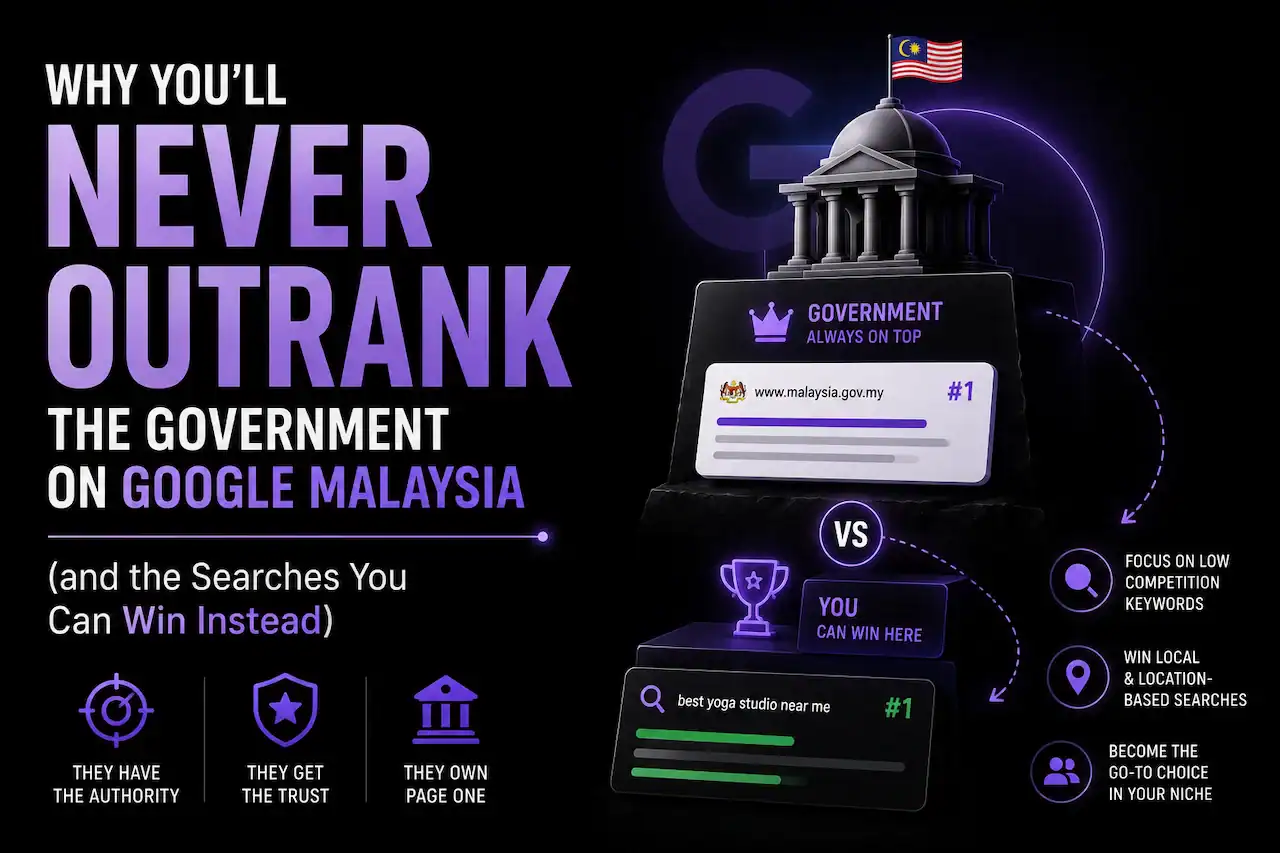
By Steve Chan, Director, Sterrific Sdn Bhd (Petaling Jaya). SEO analysis by Alfi Rahman, SEO Lead. Published 25 July 2026. This is an original study: we analysed live Malaysian page-one results (Ahrefs, country = Malaysia, 11 July 2026) for the country’s most-searched government terms to see exactly where a business can and cannot rank. It is SEO and marketing analysis, not legal or tax advice.
TL;DR
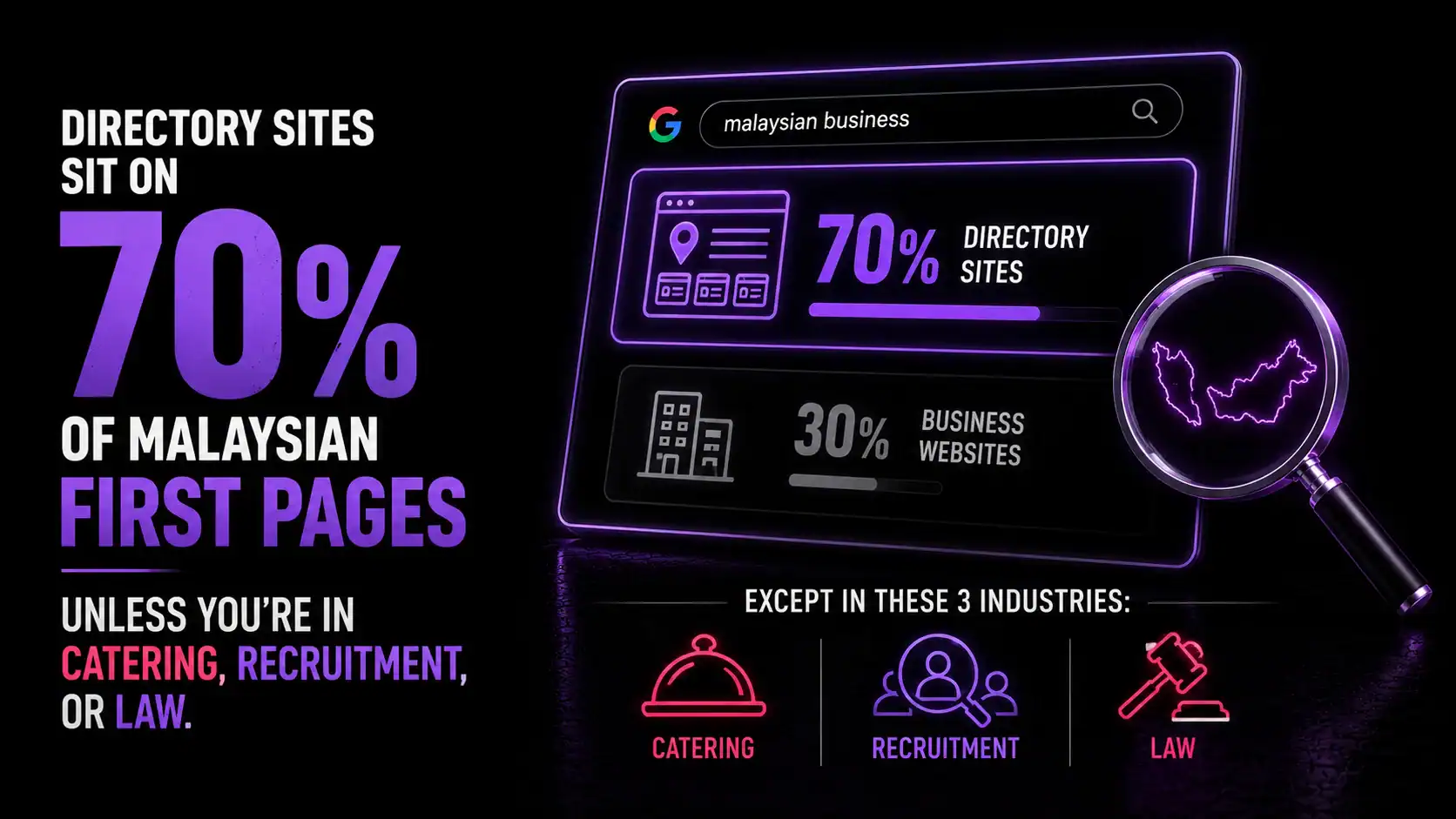
- Government sites are the biggest force on Malaysian page one. The most-searched terms in the country are government ones, KWSP (451,000/mo), LHDN (163,000), EPF (121,000), PERKESO (113,000), SSM (104,000), SOCSO (86,000), MyEG (66,000), AKPK (56,000), JPJ (51,000). For these, a business page is not getting to number one.
- But there are two very different kinds of government search. The head terms are mostly navigational, people typing “kwsp” to log in, not to buy anything. Chasing those is a trap even if you could win them.
- The real money is in the advice layer around them. On “income tax malaysia” the agency owns the top, but PwC (DR 91), HSBC (DR 83), Maybank2u (DR 75) and RinggitPlus (DR 66) all rank on the same page with guides. The door is open.
- Some “government” SERPs aren’t owned by the government at all. On “road tax,” the top result is a private calculator (oto.my, DR 33), followed by MyEG and a stack of insurers, PolicyStreet (DR 26), Pos Malaysia, TNG Digital. A DR-5 site ranks on page one.
- This decides where you spend. Stop paying to fight KWSP and LHDN for terms you cannot win and would not benefit from. Redirect that budget to the “how, which, should I” questions the agencies answer badly.
- Winning the advice layer is an E-E-A-T job. Named expert authors, genuinely useful tools and calculators, honest comparisons, and Bahasa content. The full method and a per-industry map are below.
Why this matters to your business
If you have ever run Google Ads or paid for SEO in Malaysia and felt like you were shouting into a wall, this article explains a big part of why. In a lot of industries, the search terms that look most attractive, the high-volume, obviously-relevant ones, are quietly owned by a government agency. A tax firm eyeing “LHDN” or “income tax,” a company secretary chasing “SSM registration,” an HR software vendor after “EPF” or “SOCSO,” a car dealer or insurance agent targeting “road tax” or “JPJ”, all of them are lining up against a .gov.my domain that Google trusts more than it will ever trust a commercial site.
Here is the thing almost nobody tells you: that is not a failure of your SEO, and it is not always a battle worth fighting. Some of those terms are genuinely unwinnable. Some of them you would not want even if you won them. And right next to them sits a layer of searches that is wide open, higher-intent, and far more valuable to a business, if you know how to spot it.
We pulled the live data to map exactly where that counter’s territory ends and yours begins. Everything below is first-party SERP analysis from Ahrefs (country = Malaysia, 11 July 2026). Where a number is demand or difficulty, it is Ahrefs’ figure; where we describe who ranks, it is the live top-10 on the day we pulled it. Full methodology and limitations are at the end.
1. The government is the biggest publisher on Malaysian page one
Start with the raw demand. When you line up the most-searched queries in Malaysia, an astonishing share of the very top are government services, not brands, not products, government touchpoints that nearly every working adult has to use.
| Government term | Searches / month (Ahrefs, MY) | What it is |
|---|---|---|
| kwsp | 451,000 | EPF / retirement savings (login) |
| lhdn | 163,000 | Inland Revenue (tax) |
| epf | 121,000 | EPF (English) |
| perkeso | 113,000 | Social security (BM) |
| ssm | 104,000 | Companies Commission |
| socso | 86,000 | Social security (English) |
| myeg | 66,000 | e-Government services concessionaire |
| akpk | 56,000 | Credit counselling & debt management |
| jpj | 51,000 | Road transport department |
| bantuan str | 36,000 | Government cash aid |

To put that in perspective: “kwsp” alone, at 451,000 searches a month, out-pulls almost every commercial term in the country. There is no consumer brand in Malaysia that a small or mid-sized business could realistically target with that kind of volume behind it. And it is not a fluke, the pattern repeats all the way down: retirement, tax, social security, company registration, road transport, cash aid. These are the rails the whole economy runs on, and Google sends people straight to the source.
Why does the government win these so completely? Three reasons stack on top of each other:
Trust and authority. Google’s quality systems lean hard on Experience, Expertise, Authoritativeness and Trust, and for anything touching money, law, or civic life (what Google calls “Your Money or Your Life” topics), it wants the most authoritative possible source. For “what is the income tax rate,” nothing is more authoritative than the Inland Revenue Board itself. The agency is not just a good result, it is definitionally the correct one.
Exact-match intent. When someone types “kwsp” or “myeg,” they are almost always trying to reach that specific portal, usually to log in. Google knows this, so it fills the page with the official site and its own apps. There is no room for an interpretation, and no reason for Google to offer one.
Links and longevity. These domains have been accumulating authority for two decades and are linked to by every bank, newspaper and blog in the country. hasil.gov.my and kwsp.gov.my sit at Domain Rating 79 and 73 respectively, and they are referenced constantly. You are not out-linking them.
What this means: for the pure head terms, the game is over before it starts. But, and this is the whole point of the article, the head term is rarely where the value is.
2. Two kinds of government search, and one of them is a trap
The single most useful idea in this study is that “government searches” are not one thing. They split cleanly into two groups, and telling them apart is what separates wasted budget from won customers.
Navigational terms (the fortress)
“kwsp,” “myeg,” “perkeso,” “semak saman,” “e filing lhdn.” The searcher wants to reach a specific portal, usually to log in or transact. Google shows the official site and nothing else. Unwinnable, and worthless to you even if you won.
Advice & decision terms (the open door)
“how to file income tax,” “which business type should I register,” “how much EPF should I have,” “is road tax cheaper online.” The searcher wants help deciding or doing something. The agency answers thinly, or not at all. Winnable, and full of buyers.
The navigational terms are a trap for a simple reason: even in the impossible event you out-ranked KWSP for “kwsp,” the traffic would be worthless to you. Those people are trying to log into their retirement account, not hire an accountant or buy insurance. High volume, zero commercial intent, and locked anyway. It is the worst keyword in the world to chase.
The advice layer is the opposite. Lower volume per term, but the searcher has a real question and often a wallet open behind it, and crucially, the government does a mediocre job of answering. Agencies publish dense, official, jargon-heavy pages designed to be correct, not helpful. That gap between “technically accurate” and “actually useful” is the entire opportunity, and it is exactly what a good business can fill.
The rest of this article is about proving that split with data, then showing you where the open doors are and how to walk through them.

3. The data: five government SERPs dissected
We pulled the live top-10 for five representative government queries. The pattern that emerges is not “government always wins”, it is far more useful than that. It ranges from a total lockout to a SERP the government barely shows up on.
| Query (demand) | Who owns page one | Verdict |
|---|---|---|
| kwsp (451k) | 100% KWSP: its login portals, member/employer i-Akaun, plus KWSP’s own Facebook, YouTube and app-store listings | Total fortress, no independent result at all |
| income tax malaysia (16k, CPC RM20) | hasil.gov.my #1–2 and MyTax, but PwC (DR 91), HSBC (DR 83), Maybank2u (DR 75), a KWSP guide and RinggitPlus (DR 66) all rank | Agency owns the top, advice layer wide open |
| ssm registration (2.6k, KD 71, CPC RM25) | SSM.gov.my (DR 75) and official portals (mydata-ssm DR 51, ssm-einfo DR 56), plus a private service, ssm4u.com.my (DR 39) | Mostly official, but a private operator breaks in |
| road tax (6k, CPC RM20) | oto.my calculator (DR 33) at #1, MyEG (DR 59), then insurers, PolicyStreet (DR 26), TNG Digital, Pos Malaysia (DR 75), and otofacts (DR 5) | Government barely present, private sites own it |
| akpk (56k) | AKPK’s own site and government debt-help pages dominate the distress term | Fortress on the brand, advice layer open around it |
Read those five rows and you have the whole strategy. Let’s take the two extremes, because they are the most instructive.
“kwsp” is the fortress in its purest form. Every single result on page one is KWSP: the member login (an estimated 347,000 visits), the employer login (971,000), the Malay homepage, i-Saraan, e-KYC, even KWSP’s Facebook and Google Play app listing. There is no crack. There is no blog, no bank, no comparison site. And notice the intent, these are logins. People are not researching retirement here; they are trying to get into their account. If you sold EPF-adjacent services, this SERP would be useless to you even if you somehow appeared on it.
“road tax” is the surprise, the government hardly owns it. The number-one result is not JPJ, it is a private road-tax calculator, oto.my, at Domain Rating 33. Behind it sit MyEG (the renewal concessionaire) and then a wall of insurance players: PolicyStreet (DR 26), TNG Digital, Pos Malaysia (DR 75), even otofacts.com at Domain Rating 5. The actual government pages (malaysia.gov.my, mot.gov.my) are stranded at positions three and four with a fraction of the traffic. Why? Because the intent behind “road tax” is commercial and practical, calculate it, renew it, insure the car, and the private sector answers that far better than a ministry page does. A DR-5 site ranking on page one for a term with an RM20 cost-per-click is proof that authority is not destiny when the intent is right.

The middle rows prove the same point from the other side. “income tax malaysia” is a genuinely mixed SERP: LHDN’s hasil.gov.my holds the top two spots, but a global accounting brand (PwC, DR 91), two banks and a fintech comparison site (RinggitPlus) all earn a place with better, friendlier guides. And “ssm registration,” one of the hardest terms in our set at keyword difficulty 71, still lets a private company-secretary service (ssm4u.com.my, DR 39) onto page one by being genuinely useful around the registration process. The agencies set the floor; helpful operators still find a way in.


4. Why you shouldn’t even want the head terms
It is worth dwelling on this, because a lot of wasted marketing money comes from wanting the wrong keyword. Even in a fantasy where you could rank first for “kwsp” or “lhdn,” you should not want to. Here is the reasoning, in the plain terms a business owner cares about.
Who is searching? Someone who needs to log in, check a balance, file a return, or pay a fine. They have a specific administrative task and a specific destination in mind.
What do they want? To reach the official portal as fast as possible. Any result that is not the government is friction, an obstacle between them and their account.
When are they searching? At the moment of transaction, not the moment of decision. The decision, if there ever was one, already happened.
Where does it lead? Straight to the agency. Even a curious click on your result bounces the instant they realise you are not KWSP.
Why does this kill the keyword commercially? Because there is no product to sell to a person mid-login. The traffic converts at essentially zero. You would be buying, or earning, the most expensive irrelevant clicks in the country.
Compare that to the advice layer. “How to file income tax in Malaysia” is searched by someone who is unsure, possibly anxious, and open to help, exactly the person an accountant, a tax-software company, or a bank wants to reach. That is why Maybank2u, HSBC and RinggitPlus invest in ranking there and ignore the login terms entirely. They understand that the valuable searcher is the confused one, not the one who already knows where they are going.
5. Where the door is open, by industry
This is the part to bring to your next marketing meeting. For each government-shadowed industry, the head term is lost, but a specific advice layer is winnable. Here is the map, with real examples across very different businesses so you can find yours.
Tax & accounting (shadowed by LHDN / hasil.gov.my)
What this means for you: you will never own “lhdn” or “e filing lhdn,” and you would not want to, those are login terms. But “income tax malaysia” (16,000/mo, RM20 CPC) already ranks PwC, HSBC, Maybank and RinggitPlus alongside the agency. The winnable questions: which reliefs can I claim, how do I file for the first time, sole proprietor vs Sdn Bhd tax, what happens if I file late, do I need an accountant. Those carry real buying intent from exactly the SMEs and individuals an accounting firm wants.
Company registration (shadowed by SSM)
What this means for you: “ssm registration” is difficulty 71 and dominated by official portals, yet a private service (ssm4u.com.my, DR 39) still ranks by being useful. The open ground for company secretaries and incorporation services is the decision layer: enterprise vs Sdn Bhd, how much it really costs, what a company secretary actually does, what you must do after registering (tax file, EPF, bank account). SSM tells you the rules; it never tells you which choice is right for your situation.
Motoring & car insurance (shadowed by JPJ / MyEG)
What this means for you: this is the best news in the study. On “road tax,” the government barely ranks, private calculators and insurers own the page, and a DR-5 site made it. If you are an insurance agent, motor trader or workshop, the calculators, renewal guides, and “how much is road tax for my car” comparisons are genuinely winnable, and they feed directly into a car-insurance sale.
HR, payroll & benefits (shadowed by EPF/KWSP, SOCSO/PERKESO)
What this means for you: “kwsp,” “epf,” “socso” and “perkeso” are pure login fortresses. But an HR-software vendor or payroll outsourcer can own the employer-side questions the agencies bury: how to calculate EPF and SOCSO contributions, employer registration steps, statutory deadlines, what counts as wages. These are searched by business owners, your actual buyers, not employees checking a balance.
Debt & personal finance (shadowed by AKPK)
What this means for you: AKPK owns the distress term outright, and you should not compete with a free government counselling agency on its own name. But “AKPK vs debt consolidation loan,” “will AKPK affect my credit,” and “how to get out of debt in Malaysia” are advice questions a licensed lender or financial planner can answer with more practical depth than the agency does. (We went deep on this dynamic in the finance study linked below.)
Immigration & travel (shadowed by Immigration Dept)
What this means for you: “passport renewal malaysia” (9,900/mo) is an official-process term, but the surrounding questions, documents needed, how long it takes, renewing from overseas, appointment tips, are thinly served and useful for travel agencies, relocation services and visa consultants.

6. How to find your own winnable government-adjacent searches
You do not need our exact list, you need a repeatable way to find the open doors in your own industry. Here is the checklist we use.
- Name the agency that shadows you. Which .gov.my body owns your topic? Tax = LHDN (hasil.gov.my); companies = SSM; retirement/EPF = KWSP; social security = PERKESO/SOCSO; motoring = JPJ; debt = AKPK. That is your “counter.”
- List the head terms and cross them off. The agency’s brand name, its portal names, its login and e-service terms (“e filing,” “semak,” “myeg”). These are the fortress. Do not target them, do not bid on them.
- Harvest the questions around them. For each topic, collect the “how, which, should I, how much, what happens if, do I need” variants. Use Google autocomplete, the “People also ask” box, and Ahrefs’ matching-terms and questions reports (country = my). These reveal the decision layer.
- Check the live SERP for each. If page one already shows banks, blogs, comparison sites or tools alongside (or instead of) the agency, the door is open, that is your target. If it is 100% government and login portals, skip it.
- Filter for commercial intent. Keep the questions a paying customer asks on the way to buying (“do I need an accountant to file,” “which business type for tax,” “cheapest way to renew road tax”). Drop the pure-admin ones a customer can self-serve with no help.
- Prioritise by winnability × value. Favour terms where the ranking sites are beatable (mixed DR, thin content) and the searcher is close to spending. Build there first.

7. The playbook: how to actually win the advice layer
Finding the open door is half the job. Winning it is the other half, and because these are money/tax/legal topics, Google holds them to a high trust bar. Here is what actually works.
- Put a real, credentialed expert on the page. A named author with genuine qualifications (a chartered accountant, a licensed company secretary, a financial planner), an author bio page, and author schema. On government-shadowed YMYL topics, anonymous “Admin” content does not clear the bar. This is the single highest-leverage move.
- Be more useful than the agency, not more official. You will never out-authority LHDN, so do not try. Out-help them: plain language, worked examples with real ringgit figures, step-by-step walkthroughs, screenshots, and the honest context the agency omits (“here’s when you actually need us, and when you don’t”).
- Build the tool the government won’t. The road-tax SERP is owned by calculators. A genuinely good calculator, checklist, or comparison tool earns links, ranks, and converts, because it does something an official PDF never will. Interactive utility is a moat.
- Answer in Bahasa Malaysia too. Many of these terms are searched in Malay (“perkeso,” “cukai pendapatan,” “bantuan”), and the credible, licensed Malay-language answer is often missing. That field is far less contested than its English twin.
- Structure it to be quoted. Lead each page with a direct answer, then the detail, and add clear headings, FAQs and structured data. That is how you earn the featured snippet and, increasingly, the AI Overview citation, sitting right alongside the government link.
- Interlink to your money page. Every helpful guide should route the ready-to-act reader to the relevant service, the accountant, the insurance quote, the incorporation package, with a natural, non-pushy segue.
A quick checklist to take away
- □ Identified the agency that shadows your topic
- □ Crossed off the login/portal head terms
- □ Built a target list of “how / which / should I” questions with buying intent
- □ Verified each SERP actually lets non-government sites rank
- □ Assigned a named, credentialed author
- □ Added a genuinely useful tool, calculator or checklist
- □ Published a Bahasa version where demand is in Malay
- □ Linked each guide to the relevant service page

Not sure which searches your business can actually win?
We map the government-owned dead-ends and the winnable advice-layer queries in your industry, then build the credentialed, genuinely useful content that ranks and converts.
Or see how we work on our digital marketing services page.
The Final Take
The government is the quiet giant of Malaysian search. KWSP, LHDN, SSM, PERKESO and the rest own the highest-volume terms in the country, and no amount of SEO will move them, nor should you try. But the lesson of this study is not “give up.” It is “aim better.”
Once you separate the navigational fortress (worthless to you even if you won it) from the advice layer (winnable, and full of buyers), the whole picture flips from discouraging to full of opportunity. The road-tax SERP, owned by a DR-33 calculator and a stack of insurers with the government stranded at position three, is the proof: when the intent is a decision rather than a login, authority stops being destiny and usefulness takes over. That is ground a focused Malaysian business can absolutely take.
The frustration is real, on Lowyat and r/malaysia, wrestling with MyTax e-filing or a MyEG renewal is a perennial complaint (a directional signal, not a statistic). Every one of those frustrations is a question the agency answered officially but not helpfully, and every one is a door. Walk through the ones your customers are standing at, with a named expert, a genuinely useful tool, and an honest answer, and you win the decision that happens just before the government counter. That is the whole game.
Methodology
- What we measured. Keyword demand and difficulty for 20 government and government-adjacent terms, and live top-10 SERPs for five representative queries (“kwsp,” “income tax malaysia,” “ssm registration,” “road tax,” and the AKPK debt cluster), pulled from Ahrefs (Keywords Explorer + SERP overview, country = Malaysia) on 11 July 2026.
- How we classified. Each ranking result was tagged government / official-portal versus private (brand, bank, comparison site, tool, forum), and each query tagged navigational versus advice/decision intent. This is a composition analysis of who currently occupies page one, not a ranked league table.
- Figures. Volumes, difficulty (KD), CPC and Domain Rating (DR, 0–100) are Ahrefs’ metrics. Traffic estimates are Ahrefs’ per-URL estimates on the pull date.
Limitations
- A SERP snapshot is a moment in time. Results reflect 11 July 2026 and move; five queries are a deliberate cross-section, not the whole of government search. Directional, not definitive.
- Intent labels are judgement calls. “Navigational” vs “advice” is our reading of searcher intent, informed by the SERP, not a Google-published label.
- Not tax, legal or compliance advice. Government processes and figures change; verify anything actionable with the relevant agency.
- Community signal is illustrative. Forum sentiment is anecdotal and hedged, never treated as data.
Sources
- Ahrefs Keywords Explorer & SERP Overview (country = Malaysia, 11 July 2026), our own pulls.
- Lembaga Hasil Dalam Negeri (LHDN), hasil.gov.my
- Kumpulan Wang Simpanan Pekerja (KWSP/EPF), kwsp.gov.my
- Suruhanjaya Syarikat Malaysia (SSM), ssm.com.my
- MyGov, malaysia.gov.my
Relevant articles
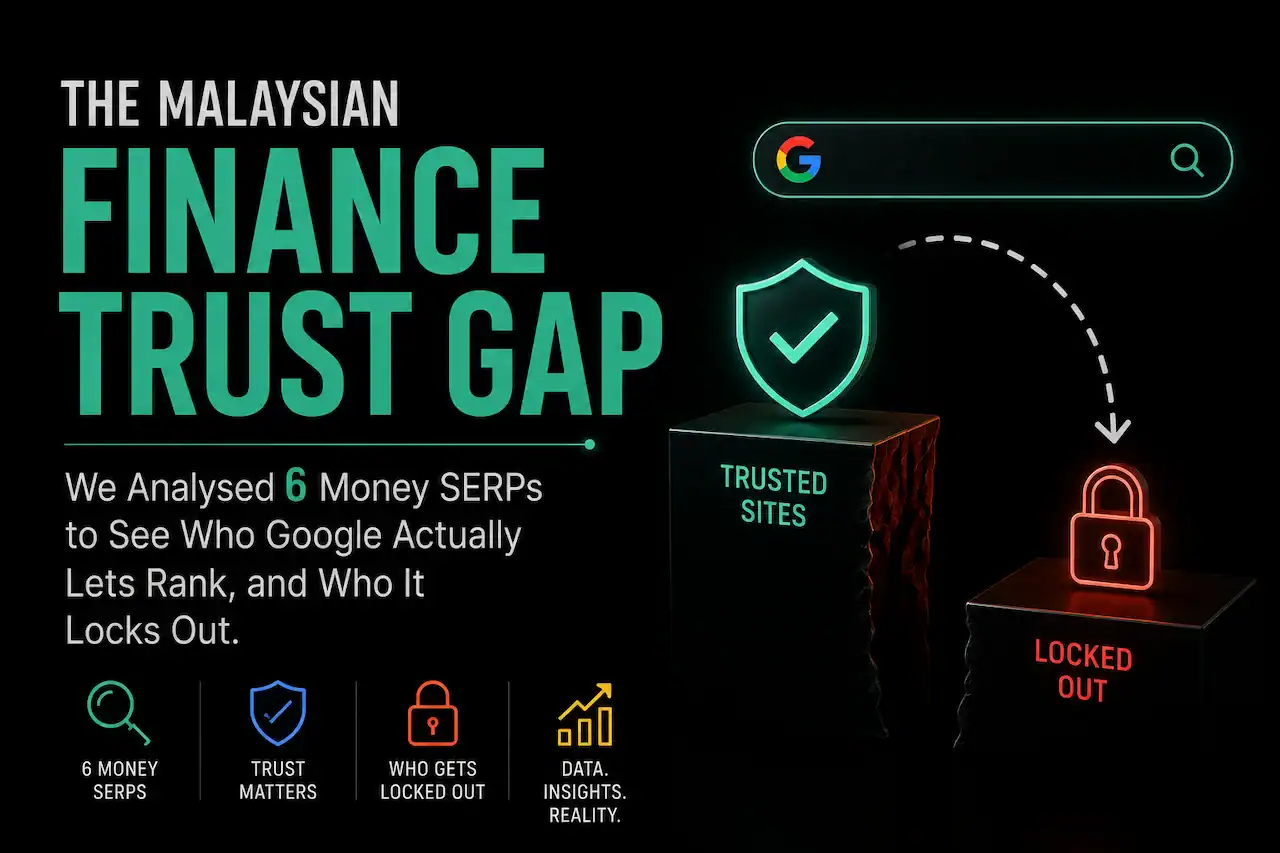
- The Malaysian Finance Trust Gap
- The May 2026 Google Update Reshuffled Malaysian Page One
- Do Shopee and Lazada Really Own Google Malaysia?
- Your Customers Search in Malay. Your Website Speaks English
Steve Chan is the Director of Sterrific Sdn Bhd, a full-service digital agency in Petaling Jaya, and has led Malaysian search and digital-marketing campaigns for over a decade. SEO analysis by Alfi Rahman (SEO Lead, Sterrific). This study is based on Sterrific’s own live-market SERP analysis.
FAQ
Can a business ever outrank a government website in Malaysia?
For the pure head terms (a brand name like “kwsp,” or a login/portal term), effectively no, and you would not benefit if you did. For the advice and decision questions around those topics, yes: banks, comparison sites and even DR-5 tools already rank on government-shadowed SERPs.
Why does Google rank government sites so highly here?
Three reasons stack up: they are the most authoritative source for money/legal/civic (YMYL) topics, the search intent is usually to reach that exact portal, and the domains have two decades of links and authority (hasil.gov.my is DR 79, kwsp.gov.my DR 73).
Should I bid on government keywords in Google Ads?
Generally no for navigational terms, the clicks are people trying to log in or reach an official service, and they convert at essentially zero. Put that budget on advice/decision keywords with real commercial intent instead.
What is the difference between a navigational and an advice keyword?
A navigational keyword (“myeg,” “e filing lhdn”) means the searcher wants a specific portal, usually to transact. An advice keyword (“how to file income tax,” “which business type to register”) means they want help deciding or doing something, that is the winnable, valuable layer.
Which government-shadowed industries have the most open opportunity?
Motoring and car insurance (the “road tax” SERP is owned by private calculators and insurers, not JPJ), tax and accounting (the “income tax” guide layer ranks PwC, HSBC and banks), and company registration (a private service already ranks for “ssm registration”).
How do I find winnable government-adjacent keywords for my industry?
Name the agency that shadows you, cross off its login/portal head terms, harvest the “how/which/should I” questions around your topic, check each live SERP to confirm non-government sites can rank, filter for commercial intent, then prioritise by winnability and value. Full checklist is in section 6.
Is the “road tax” result really not owned by the government?
Correct, on our 11 July 2026 pull, the number-one result was a private calculator (oto.my, DR 33), followed by MyEG and several insurers, with the actual government pages down at positions three and four. Practical, commercial intent lets private sites win it.
Do I need to write in Bahasa Malaysia?
Often yes. Many government topics are searched in Malay (“perkeso,” “cukai pendapatan,” “bantuan”), and the credible Malay-language answer is frequently missing, making it less contested than the English version.
What actually helps a page rank on these YMYL topics?
A named, credentialed author (accountant, licensed company secretary, financial planner) with author schema; genuinely useful content and tools that beat the agency on helpfulness; a Bahasa version where relevant; and clear structure so you can earn snippets and AI-Overview citations.
Isn’t competing near government content risky or restricted?
No, publishing genuinely helpful guidance around a public topic is normal and encouraged, as long as you are accurate, transparent about who you are, and do not impersonate an official body. This article is marketing analysis, not legal advice; verify processes with the relevant agency.