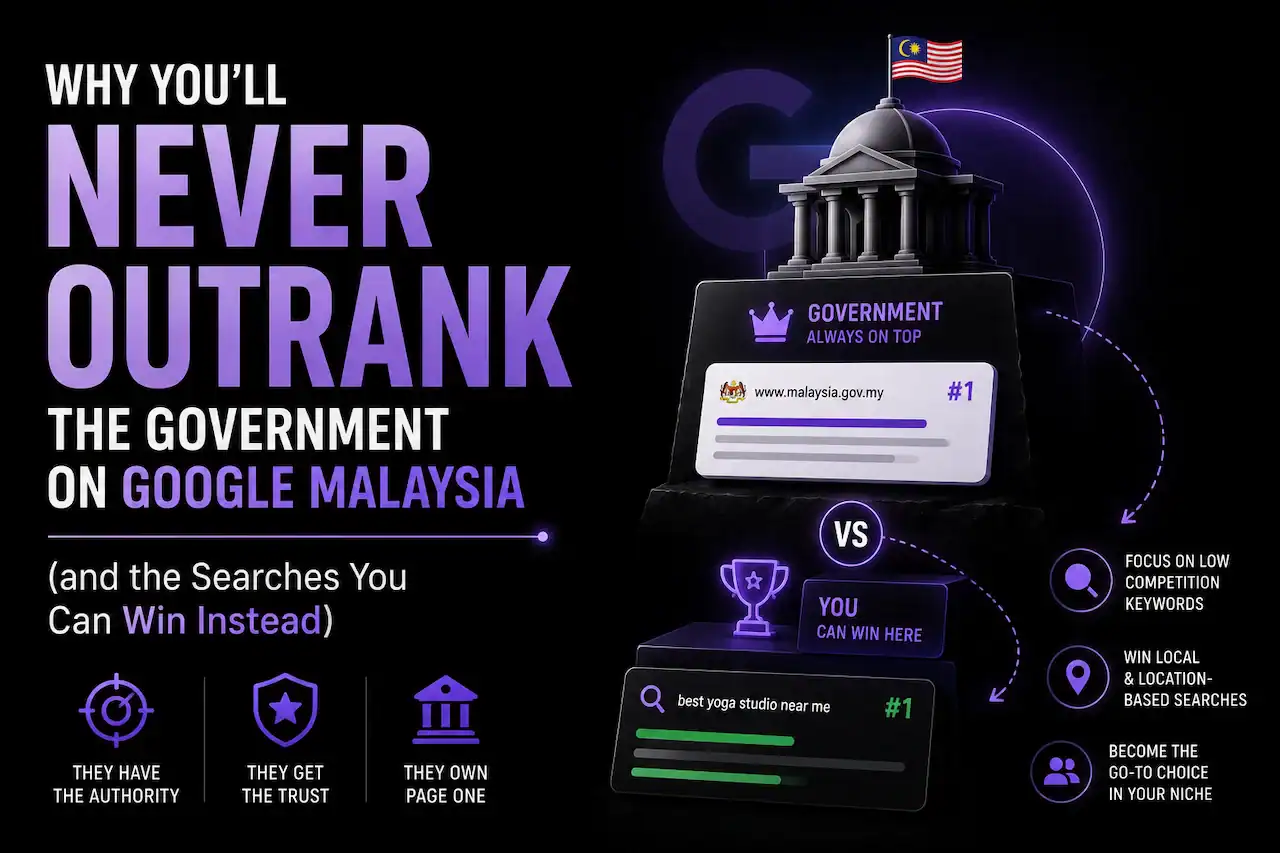

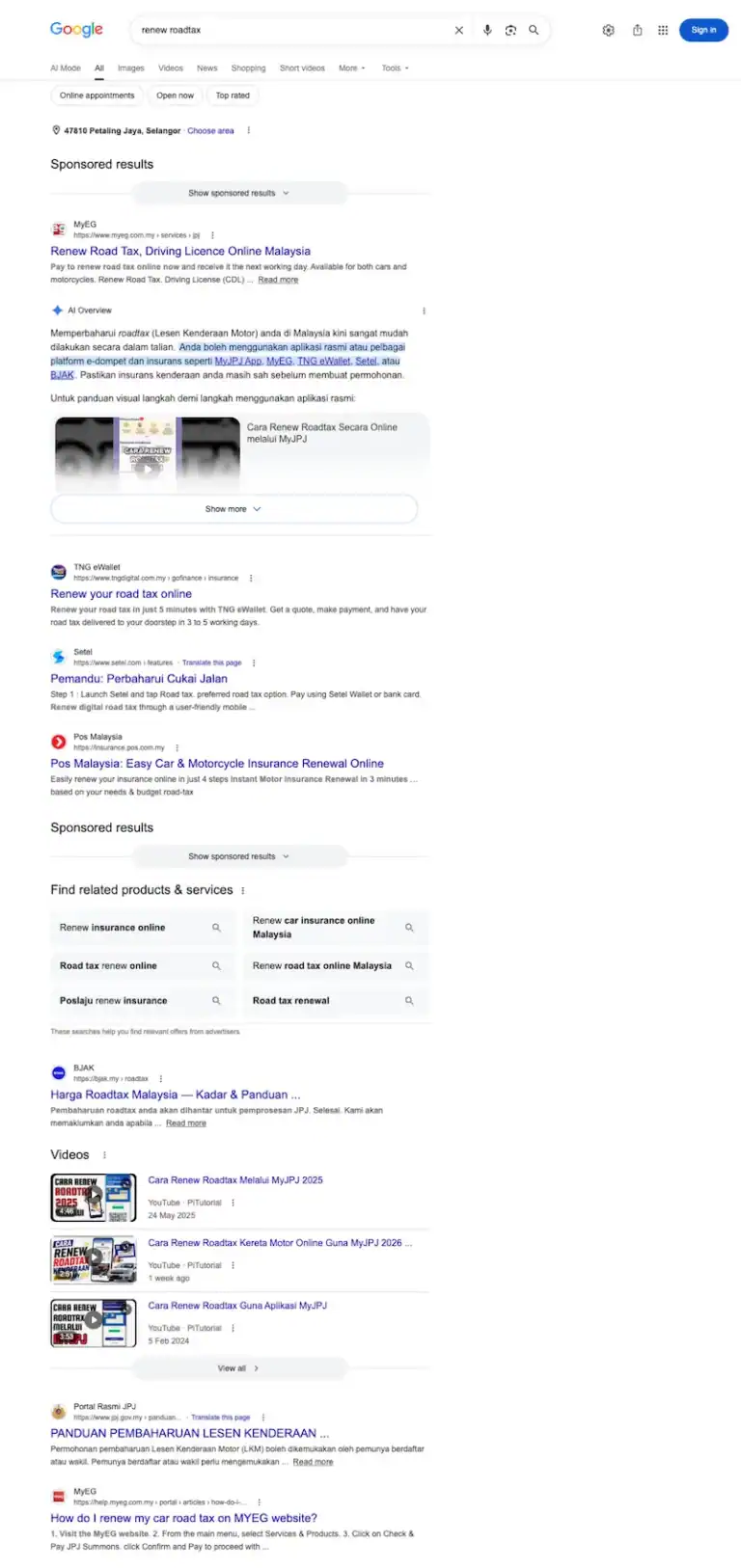
Search “renew roadtax” — a tax invented by, collected by, and payable only to the Malaysian government.
Of the nine organic results, the government holds one. Position eight. The rest of the page belongs to MyEG, Touch ‘n Go, Setel, Pos Malaysia, bjak, and two blogs explaining how the renewal actually works.
Now search “semakan ptptn.” Government: eight of ten. “Ssm search”: seven of nine. “E filing”: LHDN wall.
Same government. Same Google. Two completely different outcomes — and the difference between them is the most precise market map we’ve ever pulled for Malaysian B2B service firms.
This study is written for the accountants, company secretaries, HR consultancies, payroll providers, agencies and service businesses whose work lives next door to a government portal — and, secondarily, for the business owners trying to navigate those portals. We classified 188 page-one results across 22 government-territory searches — tax, company registration, EPF, PERKESO, JPJ, immigration, health, education — by who owns them and, crucially, what format they rank with.
The headline isn’t that the government ranks badly. It doesn’t — it holds every single #1 in the study. The headline is what it ranks with, and the layer of search it structurally cannot hold. That layer is open. Parts of it are a gold rush already in progress.
Key Findings (TL;DR)
- The government owns its named territory outright: 53.7% of all 188 results, and all 11 organic #1 positions in the study. On “semakan ptptn,” “ssm search,” “i-akaun”, and four other queries, the government sweeps 70–80% of the page.
- But 69.3% of everything the government ranks is a portal, login, PDF or tool — only 30.7% is an actual prose explainer. The state ranks the form. The question goes elsewhere.
- Private winners are the mirror image: 49 of their 63 results are explainers, plus 10 transaction services and 4 calculators. The entire private playbook in government territory is answering what the portal won’t.
- Five genuine gaps where the government holds under 40% of its own page: renew road tax (11%), e invoice malaysia (25%), tax rebate malaysia (25%), lesen memandu antarabangsa (29%), renew lesen memandu (38%).
- The agency league table is brutal: JPJ defends 30.3% of its own territory — the weakest in government. SSM and PTPTN defend 77.8% — the strongest. Your opportunity depends on which ministry you live next to.
- AI Overviews sit on 68.2% of these searches and prefer the explainers — citing YouTube walkthroughs, DR-12 service sites and a battery shop’s blog even where government sweeps the organic results below.
- 19% of private wins come from DR≤20 sites — the fifth consecutive study where roughly 1 in 5 winners is a small site.
Methodology
22 Malaysian search queries across nine government territories: LHDN (e filing, e invoice malaysia, cukai pendapatan, tax rebate malaysia), SSM (ssm search), KWSP (i-akaun, pengeluaran kwsp akaun 3), PERKESO (caruman perkeso, perkeso claim), JPJ (renew lesen memandu, semak saman jpj, renew roadtax, lesen memandu antarabangsa), Imigresen (renew passport malaysia, cara buat passport, visa malaysia), MOH (klinik kesihatan, mysejahtera), and MOE/PTPTN (bayar ptptn, semakan ptptn, permohonan upu, semakan spm). English and BM, researched natively, all volumes validated (≥50/month; most run in the thousands — “e filing” alone is 28,000/month). SERPs pulled via Ahrefs serp-overview, country Malaysia, top 10, 11 June 2026.
Every one of the 188 organic results was classified in two ways:
- Owner: government / private / platform (social networks, app stores, Wikipedia).
- Format: portal or login page, PDF, prose explainer, tool/calculator, transaction service, app-store listing, social post.
The format classification is the study’s engine. “Ranking” and “answering” are different jobs — a login page at #1 serves the person who already knows what to do, and serves nobody else. Six government-adjacent SERPs from our page-one anatomy study (epf withdrawal, ssm renewal, cara daftar ssm and others) corroborate the patterns as context but are not counted in the 188.
The dataset and analysis script are available on request — reach out and we’ll send the pack.
Finding 1: The Government Is Malaysia’s Most Dominant Publisher. Nobody Tells You That.
Start with the result that corrects the lazy premise — including ours when we scoped this study.
The government holds 53.7% of all results, private sites 33.5%, and platforms 12.8%. And the government holds all 11 true organic #1 positions in the study. Eleven for eleven.
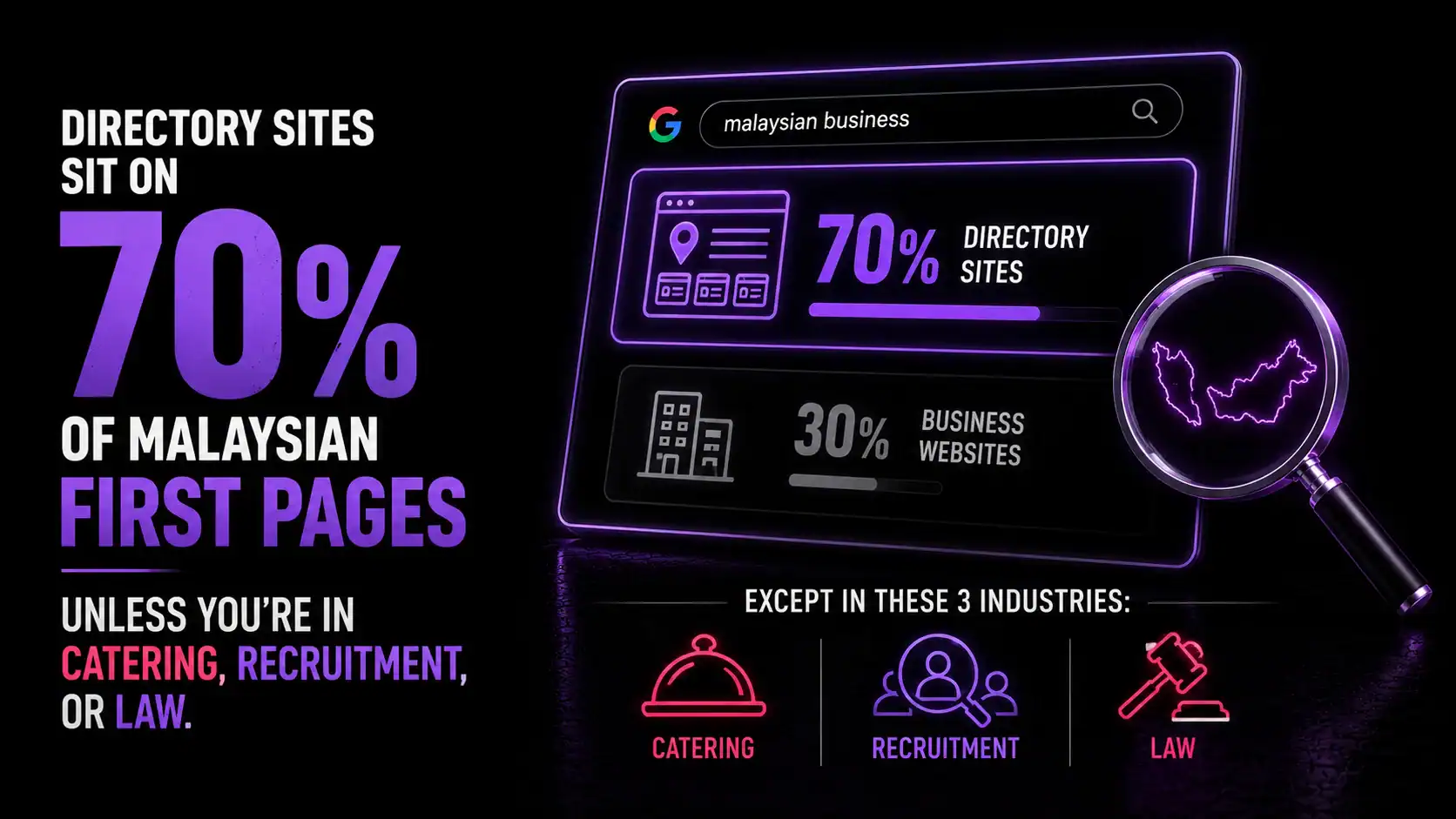
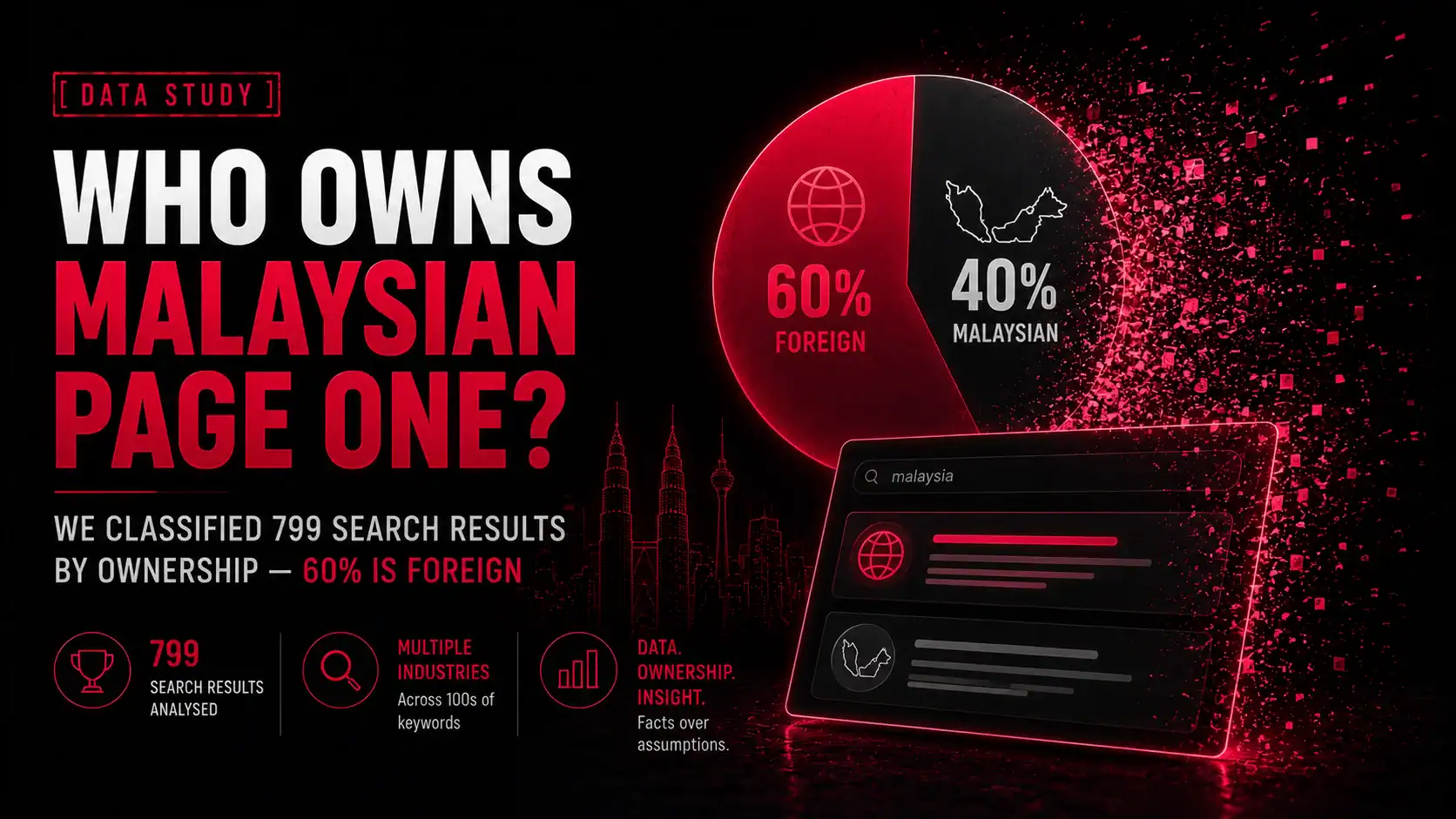
For comparison: across our 799-result ownership study, no single class of owner came close to that #1 strike rate. Brands — the strongest commercial category we’ve measured — took 17 of 20 #1s on product queries. The government just went perfect on its home turf.
The sweeps are fortress-grade: “semakan ptptn” 80% gov, “ssm search” 78%, “bayar ptptn,” “caruman perkeso,” “perkeso claim” and “permohonan upu” all at 75%, “i-akaun” 70%. If your content plan includes outranking LHDN for “e filing,” your content plan includes losing.
This finding matters because it kills the wrong strategy before the right one: the opportunity in government territory is not beating the government on the queries it names. Google has decided — correctly — that when a Malaysian types the name of a government service, the government’s own page is the answer.
Look at what the fortress queries share and the dominance explains itself: they’re effectively brand-navigational. “I-akaun,” “ssm search,” “semakan ptptn” — the searcher is typing the name of a government product, and Google treats the product’s owner the way it treats any brand: own name, own page, position one. The government didn’t win these SERPs with content strategy. It won them by being the thing searched for.
One wrinkle inside the sweeps is worth a sentence for anyone mapping this territory: on “i-akaun” and “mysejahtera,” positions two and three belong to Apple’s and Google’s app stores — the government reaching its citizens through listings it doesn’t own, on platforms that take a cut of the attention. Even the state, at its most dominant, rents some of its shelf.
The state is the strongest SEO competitor in Malaysia, and it doesn’t even employ an SEO team.
The rest of this study is about the asterisk on that dominance — because what the government ranks with is not what searchers are asking for.
Finding 2: 69% Of What Government Ranks Is A Form. The Question Goes Elsewhere.
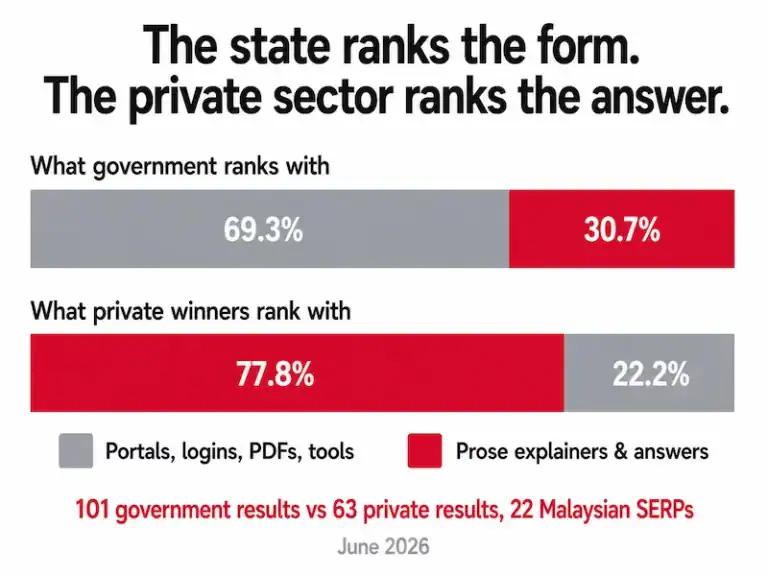
Classify the government’s 101 ranking results by format:
Format | Share of government results |
Portals, logins, listings | 64.4% |
Actual prose explainers | 30.7% |
PDFs | 4.0% |
Tools | 1.0% |
69.3% of everything the Malaysian government ranks is a portal, a login screen, a PDF or a tool. Not an explanation — a door.
Now classify the private sector’s 63 winning results the same way: 49 explainers, 10 transaction services, 4 calculators. Seventy-eight percent of the private sector’s presence in government territory is prose that answers a question.
Put the two distributions side by side, and the market structure of government-territory search falls out: the state ranks the form; the private sector ranks the answer. The government’s job is service delivery — its pages exist so you can do the thing. The searcher’s need, on most of these queries, is to understand the thing: how much, which documents, what happens if, which option, by when. That gap between doing and understanding is not a temporary content shortfall the government will fix next quarter. It’s structural. Statutory bodies publish circulars, portals and PDFs because that’s what statutory bodies are for.
The PDF detail deserves its own paragraph because it produced the strangest result in the study. On “caruman perkeso,” PERKESO’s contribution-rate PDF ranks #2 — and the image pack above it is full of Scribd and SlideShare re-uploads of that same PDF, posted by third parties. Private accounts are earning Malaysian page-one positions with the government’s own documents, because a rate table locked in a PDF is an answer nobody can read on a phone.
When you publish the answer in a format Google can’t quote, the internet republishes it for you — and keeps the position.
Finding 3: The Gap Map — Five Territories The Government Left Open
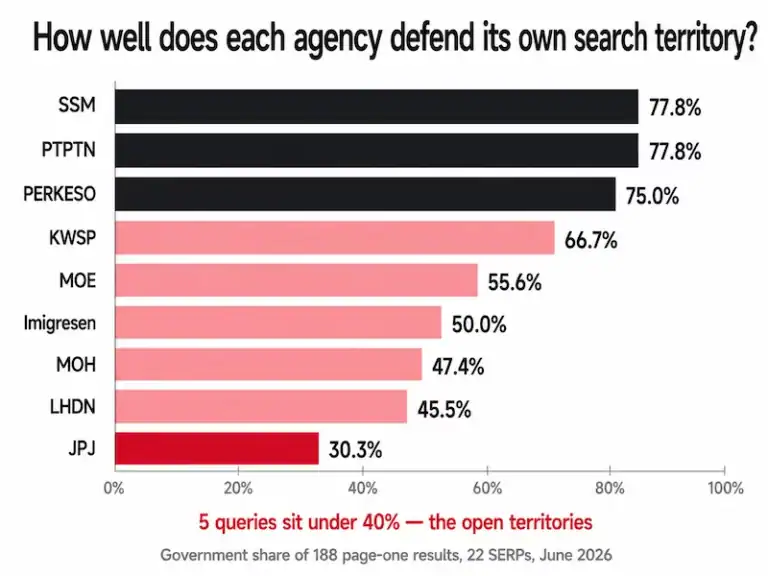
Score every query by the government’s share of its page, and the 22 searches sort into three bands: 7 sweeps (≥70% government), 10 contested (40–69%), and 5 genuine gaps where the government holds less than 40% of a page about its own services:
Gap query | Government share | Who’s collecting |
renew road tax | 11% | MyEG, Touch ‘n Go, Setel, Pos, bjak — the entire transaction layer |
e invoice malaysia | 25% | ClearTax, PwC, BDO-tier advisories, vatcalc, yyc — a consultancy gold rush |
tax rebate malaysia | 25% | iMoney, QuickHR (DR 9), Landco (DR 19), PwC |
lesen memandu antarabangsa | 29% | motorist.my (DR 29), IDA, thaminsurance (DR 0) |
renew lesen memandu | 38% | MyEG, lesen2u (DR 12), a battery shop’s blog (DR 16), metrodriving (DR 6) |
And aggregate the same scores by agency, and you get the league table no procurement document will ever show — how well each ministry defends its own search territory:
SSM 77.8% · PTPTN 77.8% · PERKESO 75.0% · KWSP 66.7% · MOE 55.6% · Imigresen 50.0% · MOH 47.4% · LHDN 45.5% · JPJ 30.3%.
JPJ — the agency behind four of the five biggest-volume queries in this study — defends less than a third of its own territory. Three of the five gap queries are JPJ’s. Meanwhile, SSM and PTPTN run near-fortresses.
Health deserves its own footnote in the league, because MOH’s 47.4% hides a different structure rather than a weakness: “klinik kesihatan” page one is state health-department directories plus the Facebook pages of the clinics themselves, plus a private appointment tool (Qmed) — and “mysejahtera,” the most-searched health term in the basket, resolves through app stores, Facebook, X and Wikipedia around a thin government core. Health isn’t being out-published by consultants the way tax is; it’s the most platform-mediated territory in government search, run through channels the ministry uses but doesn’t own. Different gap, different play — and mostly a social-channel one.
Why the spread? Look at what the gap queries have in common: they’re renewal and how-to queries with a money decision attached — which channel, what price, what documents, what if it expired. The sweep queries are status checks and applications with one official door — semakan, login, portal. The government wins wherever the answer is “go to the portal.” It loses wherever the answer requires comparison, explanation, or a transaction that the private sector is allowed to intermediate.
The gap map is not a list of government failures. It’s a price list of the questions Malaysians ask that nobody official is answering — sorted, conveniently, by ministry.
Finding 4: Who’s Collecting — The Three Business Models Already Mining The Gaps
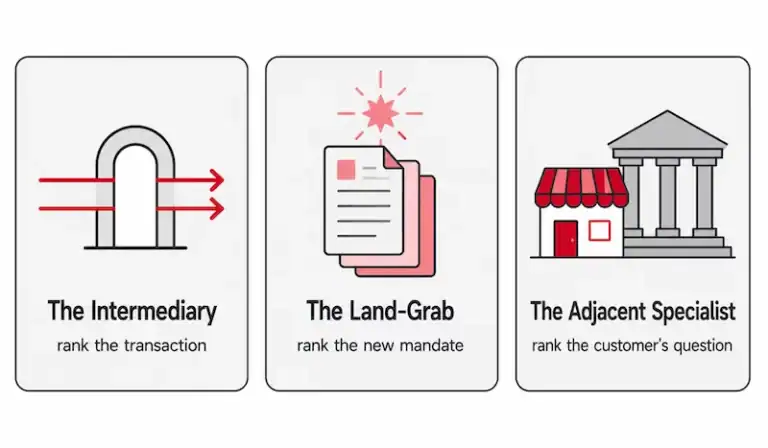
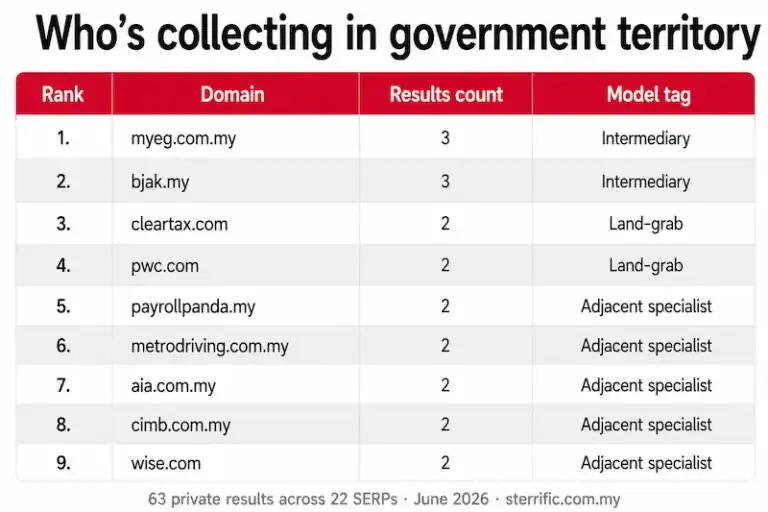
Walk the 63 private results, and the winners cluster into three repeatable models:
Model 1 — The intermediary (rank the transaction). MyEG appears three times in this study; bjak three times; Touch ‘n Go, Setel, and Pos Malaysia fill the road tax page. These companies built businesses on a simple bet: the government’s transaction works, but the experience around it — reminders, payment options, delivery — can be owned by whoever ranks for the renewal query. MyEG’s market cap is, in a real sense, a monument to JPJ’s 30.3%.
Model 2 — The advisory land-grab (rank the new mandate). “E invoice malaysia” — 10,000 searches a month, created from nothing by LHDN’s own e-invoicing mandate — is 75% owned by private advisors: ClearTax, PwC, vatcalc, B2Brouter, yyc, Edicom. LHDN holds its portal and one PDF guideline. The government created the demand through regulation, then ceded the explanation layer to the consulting industry within a single compliance cycle. Every accountant in Malaysia should study that page: it’s what a regulatory gold rush looks like in SERP form, and SST expansion, CKHT changes and every future mandate will reprint it. The same pattern appeared in our page-one anatomy study, where private explainers for searches such as “sdn bhd vs enterprise” consistently outranked purely transactional pages by answering the questions businesses actually have.
Model 3 — The adjacent specialist (rank the questions your customers ask). This is the model most readers of this study can copy on Monday. A battery-change shop (tukarbateri.com.my, DR 16) ranks for “renew lesen memandu” — because its customers are drivers. A driving school (metrodriving, DR 6) ranks for license and saman questions. An insurance blog at DR 0 (thaminsurance) ranks for international driving permits. A payroll software company (PayrollPanda) ranks twice in the PERKESO territory with calculators and contribution tables. None of them outranked the government’s portal. All of them ranked beside it, on the question layer — and 19% of all private wins in this study came from DR≤20 sites, the fifth study in a row where the small-site share lands at roughly one in five.
The government portal is not your competitor. It’s your anchor tenant — and the shops beside it are mostly still empty.
Finding 5: The AI Overview Doesn’t Quote The Portal
AI Overviews appear on 68.2% of these searches — 15 of 22 — squarely in line with the 83% we measured on general informational queries and far above the 52% on product queries. Government territory is answer-engine territory.
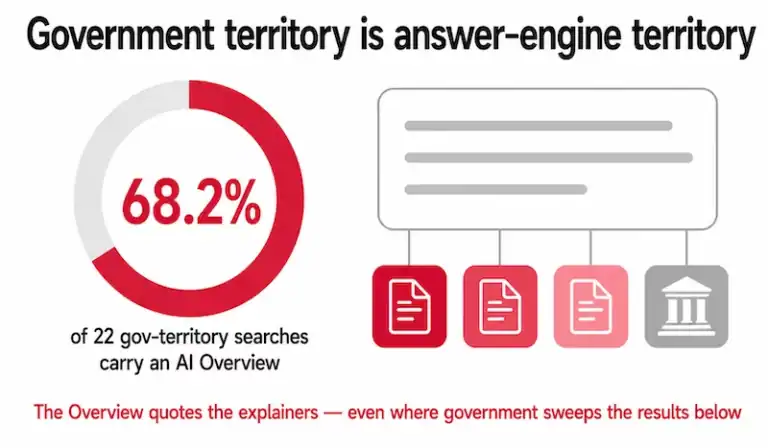
And here is the layer where the government’s format problem compounds: walk the citation lists, and the Overview consistently quotes the explainers — even on pages the government sweeps underneath.
On “renew lesen memandu,” the Overview cites JPJ once — then YouTube walkthroughs, a Pos Malaysia Facebook video, lesen2u (DR 12), visafoto, and the battery shop’s blog. On “cara buat passport,” it cites Imigresen — then TikTok, Facebook, Instagram, solehahtravel (DR 14) and Wise. On “e invoice malaysia,” the citation list reads like a consultancy directory with one government link attached.
The mechanics are obvious once the format proxy is in view: an AI Overview is built from quotable prose. A login page cannot be quoted. A PDF rate table can barely be quoted. So even where the government’s organic dominance is total, the answer layer above the results is assembled substantially from private and social content — which means the explainer publishers are collecting twice: once in the organic slots the portals don’t want, and again in the citation layer the portals can’t enter.
The seven searches without an Overview complete the proof from the other direction: “e filing,” “i-akaun,” “mysejahtera,” “visa malaysia,” “klinik kesihatan,” “semakan ptptn,” “semakan spm” — every one a pure status-check or login query. Google withholds the Overview exactly where the correct answer is a door rather than a paragraph, the same withholding pattern our anatomy study found on portal-action queries. Read the two lists together, and the rule is clean: where a question can be answered in prose, there’s an Overview, and the Overview quotes whoever wrote the prose. The government, 69% of the time, didn’t.
This is the same “entry fee vs prize” structure our Cited vs Ranked study measured, transplanted into the one territory where the incumbent literally cannot restructure its pages for quotability — statutory portals are unlikely to be redesigned around long-form FAQ prose simply because Google prefers it.
In two-thirds of government-territory searches, the first answer a Malaysian reads was written by someone who doesn’t work for the government. That sentence is the entire B2B opportunity, in one line.
What This Data Does NOT Say
Before the playbook, the balance — because this study measures structure, not failure:
- It does not say government digital services are failing. The opposite pattern shows up repeatedly: government sweeps the status check and application queries because the portals work and Google trusts them. A login page at #1 for “i-akaun” is the correct result.
- It does not say the government should be publishing like a media company. Statutory bodies have statutory jobs. The question layer is open precisely because explaining edge cases, comparing channels and writing phone-readable guides is not what a regulator is for — that’s the market’s job, and this study maps the market doing it.
- It does not say you can outrank the government. Eleven for eleven on #1s. The playbook below is about ranking beside the portal, never instead of it.
- It does not say the gaps will stay open. E-invoice filled with private advisors within one compliance cycle. The gap map has a clock on it.
The Overlap Playbook: When Your Money Keywords ARE Government Keywords
This section is for a specific Malaysian reader: you run a driving school, an insurance agency, a travel agency, an accounting or cosec practice, a payroll bureau, a clinic — and the keywords that feed your business are the same ones JPJ, LHDN, Imigresen or KWSP rank for. Maybe you already hold positions there, and every MyJPJ update or new portal launch makes you wonder how long you’ll keep them.
The data in this study is effectively a survival map for you. Here’s how to read it.
Step 1 — Sort your keywords into the three SERP types before planning anything
Pull your ten money queries and score the government’s share of each page, exactly as we did. Every keyword lands in one of three games, and the correct strategy is different in each:
Sweep territory (government ≥70% — the “semakan ptptn” type). Do not spend organic budget attacking the named query; eleven-for-eleven says you lose. Your plays here are the question constellation around the name — the “berapa,” “macam mana nak,” “apa beza,” “kena bawa apa” phrasings that the portal will never answer — plus paid ads on the named query itself if you need that traffic (the intermediaries on these pages already do; renting a sweep is legitimate, owning one isn’t available).
Contested territory (40–69% — “e filing,” “cara buat passport,” “semak saman”). The explainer slots here are live and winnable today: Great Eastern and AIA hold e-filing positions, Wise and a DR-14 travel blog hold passport positions, and a DR-6 driving school holds saman positions. One definitive, maintained, phone-readable guide per query — with this year’s rates and fees in HTML — is the entry ticket. This is where most service businesses should concentrate first.
Gap territory (government <40% — road tax, e-invoice, IDP, lesen renewals, tax rebates). Treat these as normal commercial SERPs that happen to have a government tenant: full content play, service page, ads, the works. The incumbents include DR-0 and DR-12 sites. If your business touches one of the five gaps and you’re not building for it, you’re donating it.
Step 2 — Answer the fear directly: “What happens when the government improves its portal?”
This is the anxiety underneath the overlap, so let’s use the data on it. The government has already built first-party tools in every territory we measured — MyJPJ, MyTax, MyPTPTN, ezBiz, MySejahtera — and the private layer beside them did not die. MyEG holds three positions in this study, next to fully functional government portals. PayrollPanda’s calculators rank beside PERKESO’s own calculator. The explainer winners sit two slots under the portals they explain.
Why: a statutory portal can only ever answer “do it here.” It cannot compare your options, warn you about the expired-license trap, bundle the insurance with the renewal, answer in twenty seconds on TikTok, or pick up the phone. When the government upgrades its portal, it kills the thin affiliates and the doorway pages — and leaves more room for whoever genuinely answers and serves. Build the layer a regulator structurally can’t, and portal upgrades become your filter, not your threat.
Step 3 — Build the Malaysian question constellation, in both languages
For every named keyword you depend on, list the questions a Malaysian actually asks around it — and research them natively, because half this study’s basket is BM and three of the five gaps include BM phrasings. The constellation around “renew lesen memandu” alone: how much for B2 vs D, what happens if it expired three years ago, Pos Malaysia or MyEG or JPJ counter, can you renew for someone else, photo requirements. A battery shop ranks on that page because it answered the questions. The portal ranks because it’s the portal. There is no third reason anyone is on it.
Step 4 — Run the statutory calendar as your content calendar
Government territory moves on a schedule no other niche has: tax season, EPF announcements, rate revisions, SPM results, UPU windows, Budget day. Every revision re-opens the SERP — and the winners in our page-one anatomy study were the publishers who re-cut their pages every assessment year. Put the statutory dates of your territory in the same calendar your marketing runs on; being first-and-current on revision week is the cheapest ranking advantage in this entire market.
Step 5 — Look more legitimate than the territory’s scammers
One Malaysia-specific note, offered as practitioner observation rather than measured finding: government-adjacent SERPs are where renewal scams and phishing live, and Malaysian searchers know it. The private winners in this data are verifiable businesses — registered names, real addresses, named people. If you’re going to take positions next to gov.my, your pages need to out-legitimate the category: SSM registration visible, real contact details, the trust signals a wary searcher checks before paying anyone who isn’t the government. It’s conversion advice as much as ranking advice.
The government can own any named query it wants, whenever it wants. It will never take the questions, the comparisons, or the service — and those were always the parts that paid you.
The Final Take: Publish Beside The Portal
A measurement without a verdict is trivia. The verdict: government-territory search is a two-layer market — the state owns the form layer completely, and the question layer is the most precisely mapped, most underpriced content opportunity in Malaysian B2B. Your customers are already searching inside it; the incumbent is structurally barred from answering them; and the winners so far include a DR-0 insurance blog and a battery shop.
If you run a B2B service firm — accounting, cosec, HR, payroll, agency, consultancy
- Claim your mandate before the gold rush does. If a regulation touches your clients — e-invoicing, SST scope changes, EPF restructuring, any new compliance cycle — the explainer SERP for it will be owned within months, the way ClearTax and PwC now own LHDN’s e-invoice page. Publish the definitive guide while the mandate is news, not after. The next “e invoice malaysia” is being decided right now in some ministry’s drafting room.
- Build the question layer around your service, not the service page alone. The queries your clients’ staff actually type — “caruman perkeso berapa,” “tax rebate vs relief,” “renew roadtax mana murah” — are answerable by you, unanswerable by the portal, and quotable by the AI Overview. One genuinely complete explainer per money question, with the current-year rates in HTML (never PDF), beats ten brochure pages. Consistent content production is what turns those explainers into a long-term search asset that continues earning visibility in both search results and AI answers.
- Add a calculator where there’s a rate table. PayrollPanda holds two PERKESO-territory positions with calculators. Every statutory rate table locked in a government PDF — SOCSO, PCB, stamp duty, CKHT — is a tool waiting to rank, and tools earn links the way prose doesn’t.
- Watch the agency league, not just the keyword list. JPJ-adjacent businesses (driving schools, insurers, fleet services, workshops) are operating in the most open territory in government search at 30.3%. SSM-adjacent firms face fortress conditions on named queries — go after the comparison and consequence questions instead (“sdn bhd vs enterprise” is won by private firms in our anatomy study for exactly this reason).
- Structure for the citation, not just the click. 68% of these SERPs answer above the results, and the Overview quotes prose. Direct answers high on the page, current-year stamps, scannable steps — you’re auditioning for the answer box your clients’ customers actually read.
If you’re a business owner whose keywords overlap with government territory
Your full strategy is the Overlap Playbook above — the three-SERP diagnostic, the portal-upgrade answer, the question constellation, the statutory calendar, the legitimacy layer. The compressed version: classify each money keyword as sweep, contested or gap; concede the names, take the questions; and let every government portal upgrade clear your thinner competitors out for you.
And if you’re a business owner simply navigating these services, the explainer beside the portal is where you understand what the portal won’t tell you — and its publisher is showing you exactly which firms in the private sector want your business badly enough to answer your questions for free. The firms publishing the answers are the firms paying attention.
The one-sentence version
You will never outrank the government for the form — so own the question beside it, because 69% of what the state ranks can’t speak, the AI Overview only quotes things that can, and the rent on that layer is still DR-0 cheap.
Run This Yourself
The classified dataset (188 rows: owner + format + AIO flags) and the analysis script are available on request — reach out and we’ll send the pack.
To map your own territory: list the 15–20 queries your clients’ customers ask around your government-adjacent service (include the BM phrasings — they’re often the volume). Pull the top 10 for each, tag every result as government/private/platform and portal/PDF/explainer/tool, then score each query by government share. Anything under 40% with real volume is your gap map; anything the government answers only with a PDF is your calculator-or-explainer shortlist. The whole exercise takes an afternoon, and it will outperform any generic keyword research your category has been sold.
Limitations (Read These Before Quoting)
- 22 SERPs across nine territories, single snapshot (11 June 2026). Chosen for business relevance and volume, not as a census of government search; festival-cycle queries (tax season, UPU windows) move with the calendar.
- Format classification involves judgment calls — a portal FAQ page sits between portal and explainer; we tagged it by the page’s dominant job. The full classified table ships in the pack; audit our calls.
- Owner classification follows our ownership study’s rules (MyEG = private; malaysia.gov.my aggregator pages = government; app stores and social = platform).
- AIO citation observations are qualitative reads of the captured citation lists, consistent with our Cited vs Ranked methodology, but this study did not re-run that study’s full per-citation classification.
- Government share ≠ service quality. A ministry can serve citizens superbly and still cede the question layer; the league table measures search defence only.
- The Overlap Playbook’s legitimacy note (Step 5) is practitioner observation, not survey data — labelled as such in the section. The measured findings end at the classification tables.
FAQ
Should we try to outrank the government on the main service queries?
No — 11 for 11 says don’t. Target the question layer (how much, which documents, what if, which channel) and the comparison queries. You’re renting the shop beside the anchor tenant, not bidding for the anchor’s lease.
Isn't government-territory content risky — what if the rules change?
The rules are changing the business model. Every rate revision and mandate update re-opens the SERP and rewards whoever updates fastest — the same maintained-editions pattern our anatomy study found in winning tax content. Set a statutory-calendar refresh cycle, and the volatility works for you.
We're a small firm with a weak domain. Realistic?
A DR-0 insurance blog ranks for international driving permits, and a DR-6 driving school ranks in JPJ territory. 19% of private wins here are DR≤20. Government territory is, counterintuitively, one of the friendliest neighbourhoods for small specialist sites — because the big content industry mostly ignores it.
Does this apply to BM queries too?
Yes — half this basket is BM, and the gaps include BM queries (“renew lesen memandu,” “lesen memandu antarabangsa”). The BM question layer is, if anything, thinner on credible answers and cheaper to win, consistent with our BM vs English study.
What about paid ads on these queries
Where the gap is transactional (road tax, renewals), the intermediaries already run the paid layer too — organic explainers plus a service CTA is how the small winners compete without their budgets. Where the government sweeps, save your ad spend for queries a click can actually convert.
If you run a service firm next to a government territory — accounting, cosec, HR, payroll, insurance, anything with a portal beside it — send us your service category, and we’ll map your question layer: the queries your clients’ customers ask, the government share on each, and the five gaps worth claiming first. A focused SEO programme can then turn those gaps into a practical content and visibility plan. Drop us a line for the gap-map audit.