The Malaysian Finance Trust Gap: We Analysed 6 Money SERPs to See Who Google Actually Lets Rank, and Who It Locks Out
The Malaysian Finance Trust Gap: We Analysed 6 Money SERPs to See Who Google Actually Lets Rank, and Who It Locks Out
By Steve Chan, Director, Sterrific Sdn Bhd (Petaling Jaya). SEO analysis by Alfi Rahman, SEO Lead. Published 15 July 2026. This is an original study: we analysed live Malaysian page-one results across six financial-services query types with Ahrefs (country = Malaysia) and cross-checked the regulatory and search-quality findings against primary sources (Bank Negara Malaysia, the Securities Commission Malaysia, and Google’s own guidelines). It is SEO and market analysis, not legal, financial, or compliance advice; verify any licensing specifics directly with BNM and the SC.
TL;DR
Finance is the hardest SEO in Malaysia, by design. Google classifies money topics as “Your Money or Your Life” (YMYL) and applies its strictest quality bar, with Trust the single most important factor in its Experience-Expertise-Authoritativeness-Trust framework. For finance, Google wants identifiable, credentialed sources; a good-looking blog is not enough.
There is a “trust gate,” and in Malaysia it is literally a licence. Financial advice here is a regulated activity, advisers and insurance planners are approved by Bank Negara Malaysia under the Financial Services Act 2013; investment, planning and robo-advisory sit under the Securities Commission and the Capital Markets and Services Act 2007.
Who wins splits cleanly by query type. Across six money SERPs, banks and insurers own the product terms (personal loan, life insurance), comparison aggregators own the “best/compare” terms (credit cards), and government and regulators own the high-trust help terms (AKPK, at ~57,000 searches a month, dominates debt help). A small independent has near-zero chance at the head terms.
But there is real, measurable good news. On advisory and investing terms, licensed independents rank despite tiny authority, we found licensed advisory firms at Domain Rating 20–26, and a licensed insurance-comparison site at DR 1. Where a genuine licence meets genuinely helpful content, the door is open.
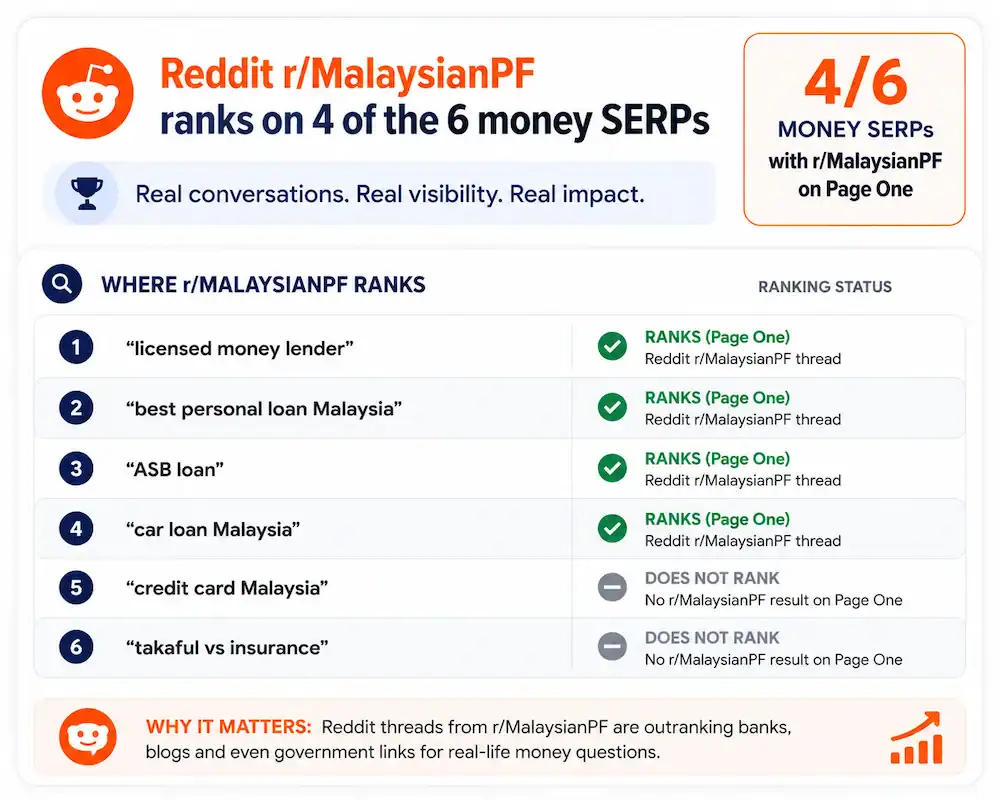
AI is raising the bar again. In finance, Google’s AI Overviews are reportedly 3× more likely to cite government, academic, or verified sources over standard blogs, and Malaysians increasingly settle money questions on Reddit’s r/MalaysianPF, which ranks on four of the six SERPs we checked.
The playbook is different for every kind of finance business, bank, insurer, aggregator, licensed adviser, fintech. We lay out each, plus a 90-day plan, in the second half.
Why we built this, and who it’s for
If you market a financial-services business in Malaysia, a bank, an insurer or takaful operator, a licensed financial adviser, a fintech, a comparison platform, you have almost certainly felt this: the content that ranks effortlessly in other industries simply does not move in finance. You publish a genuinely useful guide, it gets buried under a bank’s product page and a government portal, and you cannot work out why.
The reason is not that your content is bad. It is that finance is the most heavily gated category in all of search, and Malaysia adds a second gate on top of Google’s: a real, legal licensing regime. This article maps both gates with data, so you can stop guessing and start playing the game that is actually being scored.
The stakes are unusually high here. Malaysian household debt sits at roughly RM1.73 trillion, about 84% of GDP, among the highest ratios in the region, and Bank Negara continues to monitor repayment capacity closely (BNM via Bernama). Translate that into search behaviour and you get enormous, anxious demand: hundreds of thousands of Malaysians every month typing “personal loan,” “debt consolidation,” “best credit card,” “how much insurance do I need.” The money is real, the CPCs are among the highest in the market (we saw “licensed money lender” at RM140 per click, medical card at RM60, life insurance and financial planner at RM50), and the trust required to win it is the highest Google demands of anyone.
This article is written for the growth, marketing and digital leaders at banks, insurers and takaful operators, comparison platforms, licensed advisers and fintechs, because the patterns below are quietly deciding whether your content is ever seen, and most of them are invisible in a generic SEO audit.
The analogy we’ll come back to. Ranking for finance in Malaysia is like getting into a members-only club where the bouncer is a regulator. In most industries the bouncer checks whether you’re dressed well, is the content good, is the site fast, are there links? In finance, the bouncer checks all of that and then asks for your licence. No licence, no entry to the best tables, no matter how sharp your suit.
A note on method: everything labelled “our data” is first-party SERP analysis from Ahrefs (country = Malaysia, pulled 10 July 2026). Regulatory facts are attributed to BNM, the SC, and named legal summaries; search-quality facts to Google’s own documentation and reputable industry analysis. Where something is an estimate, we say so. Full methodology and limitations are at the end.
1. Why finance is the hardest SEO in Malaysia: the YMYL bar
Google sorts the web into ordinary topics and a special, higher-stakes category it calls YMYL, “Your Money or Your Life.” These are pages that could affect a person’s health, financial stability, safety, or the well-being of society. A recipe blog is not YMYL. A page telling someone which loan to take, which insurance to buy, or how to get out of debt absolutely is. In its September 2025 guidelines update, Google even expanded the YMYL definition to explicitly include government information and civic trust (Google Search Quality Rater Guidelines).
Why does the label matter so much? Because Google applies a deliberately stricter standard to YMYL pages. Its own systems “give even more weight to content that aligns with strong E-E-A-T for topics that could significantly impact the health, financial stability, or safety of people,” and its human quality raters are instructed to judge these pages harshly, precisely because inaccurate money or health content can cause real harm.
E-E-A-T, Experience, Expertise, Authoritativeness, Trust, is the lens. Two things about it decide the fate of every finance page in Malaysia:
First, Trust is the most important of the four. Google’s guidelines are explicit that Trust sits at the centre; Experience, Expertise and Authoritativeness all feed into it, but a page that is expert and yet untrustworthy still fails. For finance, “trust” means the reader can see who is behind the advice, what qualifies them, and whether the claims are sourced and accurate.
Second, for finance specifically, the guidance names its price of entry. Google’s rater guidance for YMYL financial content is unusually concrete: sources must be authoritative, authors must be identifiable, transparency must be maximal, and financial guidance should come from certified professionals, with claims properly sourced and expert-reviewed. This is why so much Malaysian finance content, published anonymously under “Admin,” with no credentials, no author page, no citations, simply cannot rank against a bank or a government agency, regardless of how well-written it is.
What this means: in finance, Google is not primarily asking “is this a good article?” It is asking “can I trust the entity behind this article with a stranger’s money?” In Malaysia there is a legal answer to that question, and Google leans on it.
2. The trust gate nobody tells you about: Malaysia’s dual licensing regime
Here is the part that generic, imported SEO advice completely misses. In this country, giving financial advice is not a content activity. It is a licensed, capital-gated, legally regulated activity, split across two regulators. That legal reality is the invisible hand shaping every money SERP.
Gate one: Bank Negara Malaysia (BNM), under the Financial Services Act 2013. An “approved financial adviser” is a company approved by BNM to carry on financial advisory business. To hold that approval, a firm must meet real thresholds: capital funds of at least RM50,000, professional indemnity insurance of at least RM200,000, and at least two directors, one of whom must be a licensed financial adviser’s representative (summary via Allen & Gledhill; BNM, FSA 2013). Insurance and takaful products sit under this regime.
Gate two: the Securities Commission Malaysia (SC), under the Capital Markets and Services Act 2007. Anything involving investments, unit trusts, portfolio management, and robo-advisory requires a Capital Markets Services Licence (CMSL), with advising individuals needing a Representative’s Licence (CMSRL). Robo-advisers are licensed as Digital Investment Managers (SC licensing; robo-advisory framework, Zurina Law). The SC runs a public register and an “Investment Checker” so the public can verify whether an entity is authorised.
And the gate is getting wider. Malaysia has moved to regulate financial influencers (“finfluencers”), the SC has been clear that people dispensing investment advice to the public need to be authorised. Even the social-media and forum layer of finance advice is being pulled under the licensing umbrella.
Why does this matter for SEO? Because Google’s YMYL trust signals and Malaysia’s licensing regime point at the same entities. The entities that satisfy Google’s trust criteria, licensed, regulated, capitalised, accountable, are exactly the banks, insurers, licensed advisers and government agencies the law has already vetted. The regulator did Google’s trust assessment for it. Your on-page SEO cannot out-argue a missing licence, but a visible, verifiable licence is the strongest trust signal you can put on a page.
This also caps the field. In a licensed category, the pool of entities Google can safely trust is bounded by who the regulators have approved, a few dozen banks, a handful of licensed comparison platforms, the takaful and insurance operators, the government agencies, and the licensed advisers and fintechs. The real competitive set for the trust-gated terms is far smaller than the crowded search results make it look.
How to convert a licence into a ranking signal: put your regulator and licence/approval number in visible, crawlable text on every key page (not a footer badge image Google cannot read) and link it to your entry in the public register. Name the licensed individuals responsible for each page, the financial adviser’s representative, the CMSRL holder, with a credential line and a link to their professional profile, and mark up your organisation and authors with structured data. Google cannot read a licence certificate, but it can read a consistent web of signals, your name matching the regulator’s register, your people matching the SC/BNM directory and LinkedIn, that together confirm you are who you claim to be. That web is exactly what an anonymous competitor cannot fake.
3. The data: who actually ranks across six Malaysian money SERPs
Theory is cheap, so we went and looked. We pulled the live top-10 results for six representative financial-services queries, spanning lending, cards, insurance, debt, advice and investing, from Ahrefs (country = Malaysia, 10 July 2026), and classified every ranking result by the type of entity that owns it. This is a composition analysis, not a claim about which brand is “best.”
Money query
Demand (Ahrefs, /mo)
Who owns the top 10
The takeaway
personal loan malaysia
2,200 (KD 62)
7 licensed lenders, CIMB (DR 71), Maybank (DR 75), HLB (DR 68), RHB (DR 69), UOB, AEON Credit, Bank Rakyat, plus one aggregator (RinggitPlus)
A bank fortress. No independent content site ranks.
credit card malaysia
2,900 (KD 63)
Comparison aggregators lead, RinggitPlus (#1), CompareHero, iMoney, alongside banks, a foreign entrant (Wise, DR 89), and Reddit
Aggregators own “compare” intent.
life insurance malaysia
900 (KD 30)
Insurers, Great Eastern (DR 68), Allianz, FWD, Prudential, Generali, plus government EPF i-Lindung and a DR-1 licensed comparison site
Insurers and government, with a licensed minnow sneaking in.
debt consolidation malaysia
600 (KD 1)
Banks (Bank Rakyat, AmBank, Alliance, HSBC Amanah) plus government agency AKPK, aggregators, one specialist firm, Reddit and a Facebook group
Government is a top-four result.
financial planner malaysia
250 (KD 34)
Regulator/industry bodies, MFPC, the BNM approved-advisers directory (DR 79), plus licensed advisory firms at DR 20–26, a personal-finance blogger, and Reddit
Licence-gated, but genuinely open.
robo advisor malaysia
200 (KD 1)
Licensed fintechs (StashAway, MyTheo), finance blogs (DR 37–44), Statista, an academic paper, and Reddit
No bank dominance, the most winnable of the six.
Source: our Ahrefs SERP analysis, country = Malaysia, 10 July 2026. Domain Rating (DR) is Ahrefs’ 0–100 authority score.
A few individual data points carry the whole argument:
On personal loan malaysia, the top of the page is wall-to-wall licensed lenders. CIMB’s personal-financing page alone pulls an estimated 20,000+ organic visits; RHB’s, over 15,000. The only non-bank is RinggitPlus, itself a licensed comparison platform. A blog is not getting in.
On credit card malaysia, the very first result is the aggregator RinggitPlus, not a bank. When the intent is “compare my options,” Google prefers the neutral comparison layer. Reddit’s r/MalaysianPF ranks on page one here too.
On life insurance malaysia, at position eight sits fiselect.my, a Domain Rating of 1, a licensed insurance-comparison service. Authority score of one, on page one of a YMYL insurance term. That is not supposed to happen, unless trust, not raw authority, is doing the work.
On debt consolidation, the government’s AKPK is a headline result, and the bare term “akpk” draws roughly 57,000 searches a month, the single largest finance query in our set.
On financial planner and robo advisor, the fortress cracks open. Licensed advisory firms rank at DR 20–26; StashAway and personal-finance blogs (DR 37–44) hold the investing SERP.
Two winners reveal the mechanism. On the takaful SERP, Syarikat Takaful Malaysia ranked number one on a Domain Rating of just 51 with an estimated 45,000 organic visits, because it is the Shariah-certified product the searcher wants. And on “licensed money lender,” a single licensed lender ranked at the very top on a Domain Rating of 18, pulling roughly 24,000 visits, because it is verifiably licensed on a query where “licensed” is the whole point. Neither won on links or size, both won on being the trusted, relevant entity for one precise intent.
4. The four archetypes that win Malaysian finance search
Step back from the individual SERPs and the winners sort into four archetypes. Knowing which one you are, and which queries each archetype is allowed to win, is the whole strategy.
They own the product and head terms: “personal loan,” “credit card,” “life insurance,” “home loan.” Their advantage is the licence, decades of brand and link equity (DR 60–75), and the fact that they are the product. For them, SEO is a game of not fumbling an almost-unloseable position and defending against aggregators skimming the comparison intent above them.
They own the “best / compare / which” terms, the consideration layer. They satisfy an intent no single institution can: neutral comparison, and they are licensed financial entities themselves, which clears the YMYL trust bar. You rarely beat an aggregator at “best credit card”, you go around it, to the advice and education queries it covers thinly.
Archetype 3, Government and regulators (AKPK, EPF/KWSP, BNM, the SC)
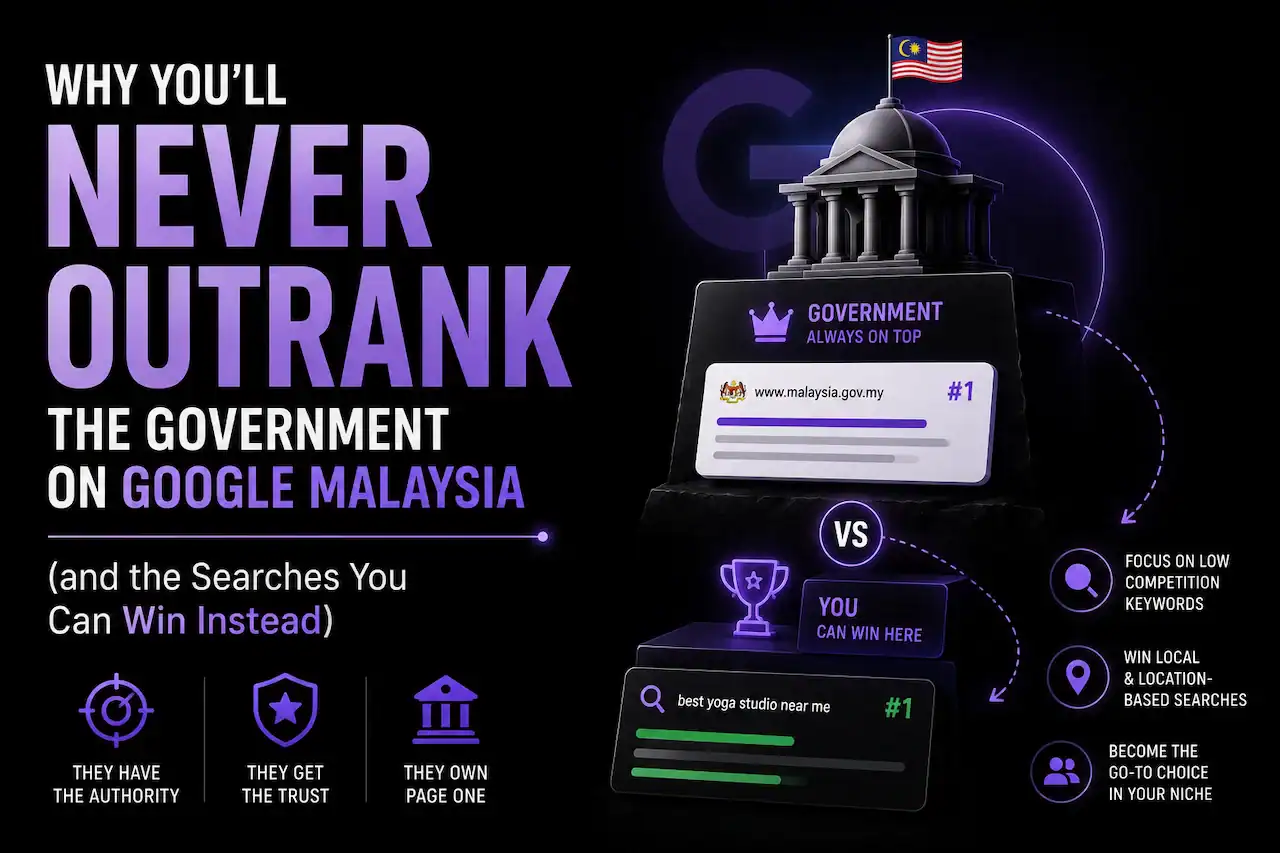
They own the highest-trust, highest-distress, highest-volume terms: debt help, retirement, “is this legit,” official directories. “akpk” draws ~57,000 searches a month, “asb” ~35,000. You cannot out-rank a government agency on its own mandate, but you can be the source that explains and complements it, the licensed adviser who writes the genuinely useful “AKPK vs a debt-consolidation loan” piece the agency never publishes.
Government dominance is not uniform across every type of Malaysian search. In our separate analysis of 22 government-service SERPs, official sites overwhelmingly owned portals, logins and status checks, while private explainers and intermediaries captured many renewal, comparison and how-to searches. See our study of the gaps in Malaysian government SERPs.
Archetype 4, Licensed independents and the community
The open field: licensed advisers and planners, licensed fintechs, credentialed personal-finance bloggers, and the forums Malaysians trust, above all Reddit’s r/MalaysianPF (ranked on four of our six SERPs) plus Lowyat’s finance boards. This archetype wins advice, education, comparison-of-approaches, and long-tail queries. It is the one place where the trust gate works for you: your licence, a mere cost of entry everywhere else, becomes a differentiator, because so few blogs competing for advice queries can claim one.
The strategic move is to be honest about which archetype you are, stop fighting for territory that belongs to another, and dominate the queries your archetype is actually allowed to win.
5. The good news: a licence beats a Domain Rating
The most important, and most hopeful, finding in this study is that in Malaysian finance, being licensed and genuinely helpful beats being big. We can show it in numbers.
faadvisory.my, Domain Rating 26, ranks on page one for “financial planner malaysia.” A licensed advisory firm, above sites with three times its authority.
vka.com.my, DR 20, also ranks on that same SERP.
StashAway, DR 41, holds the top independent position for “robo advisor malaysia,” as a licensed Digital Investment Manager, above far larger foreign finance brands.
fiselect.my, DR 1, ranks on page one for “life insurance malaysia,” as a licensed comparison service.
Personal-finance creators with real, named authors rank across the advice and investing terms at DR 19–44, well below the institutions’ authority.
Contrast that with the head terms, where no small site ranks at any authority level, and the pattern is unmistakable. When the query is transactional and the entity type is “bank,” authority and brand win. But when the query is advisory, educational, or comparison-of-approaches, and the site can demonstrate a licence plus genuine expertise, Google will rank a DR-1 or DR-20 site over a DR-70 one. Trust is doing the work that links used to do.
What to actually build: a licensed adviser should build around decisions, not products. The winnable page is not “our financial-planning service”; it is “How much does a licensed financial planner in Malaysia actually cost, and is it worth it?”, written by a named, credentialed planner, citing real fee structures, honest about when you do not need one, and linking to the SC register so a reader can verify the author. That page does what a bank cannot (candour), what an aggregator will not (depth), and what an anonymous blog may not (a verifiable licensed author). Build a dozen like it and you have a moat raw authority cannot buy.
→ Go deeper: the same “market fit beats raw authority” pattern showed up across industries in our May 2026 core-update study, a low-authority local site out-ranking far bigger competitors when it fit the query better.
6. Islamic finance: a second trust layer only Malaysia rewards
There is a dimension of Malaysian finance search that no imported playbook accounts for: Shariah compliance as a distinct, rankable trust signal. Malaysia is one of the world’s largest Islamic-finance hubs, and its money SERPs are shot through with Islamic products, the “-i” suffix is everywhere: “personal financing-i,” “ASB financing-i,” HSBC Amanah, Bank Islam, HLB Islamic. For a huge share of Malaysian searchers, “is this Shariah-compliant?” is as load-bearing a trust question as “is this licensed?”
We pulled the takaful SERP and the pattern is emphatic. The bare term “takaful” draws around 9,500 searches a month at a CPC of RM35, and page one is owned outright by licensed takaful operators: Syarikat Takaful Malaysia at number one with ~45,000 organic visits on a Domain Rating of just 51; Takaful Ikhlas ~27,000; Etiqa, Sun Life and FWD round it out. No aggregator at the top, no foreign disruptor, the operators win, at mid authority, because they are the Shariah-certified product. The only outsiders that break in are reference sources: the Malay-language Wikipedia entry for Takaful (DR 97) at position four, and Investopedia. The education layer of Islamic finance is being served by encyclopaedias, not operators, an obvious content gap.
The strategic point is that Shariah governance is an E-E-A-T asset a foreign competitor structurally cannot fake. A takaful operator has a Shariah advisory committee, Shariah certification, and a fatwa trail behind its products. Displayed properly, named Shariah scholars, certification references, plain-language explanations of the Islamic contract underneath the product, that is exactly the identifiable-expert, sourced-and-reviewed trust signal Google’s YMYL guidance craves, layered on top of the BNM or SC licence.
How to turn that into rankings, not a footer badge: First, give each Islamic product a plain-language explainer of the contract beneath it, what tabarru’ or wakalah actually means for the customer’s money, authored or reviewed by a named member of your Shariah committee. Second, build a small “Islamic finance, explained” hub answering the questions the encyclopaedias currently own, is takaful halal, takaful versus conventional insurance, what makes financing Shariah-compliant, because those education SERPs are winnable and feed the AI answers. Third, make your Shariah governance visible and verifiable: name the committee, link the certifications. The angle no foreign competitor can copy is that you are not merely Shariah-compliant, you can prove it, in Malay, with named local scholars.
7. The Bahasa layer: where the language of trust changes the game
Our next pull exposed a layer English-first marketers routinely miss, and it is enormous. The unit trust ASB (Amanah Saham Bumiputera) is one of the most-searched financial products in the country: the bare term draws around 35,000 searches a month, and “asb loan” / “asb financing” is a whole ecosystem of its own. When we pulled that SERP, the composition looked nothing like the polished, English, institutional pages seen elsewhere.
Yes, the banks are there, CIMB, Maybank, Bank Islam and HLB Islamic with their ASB-financing-i products, alongside the official fund manager ASNB. But interleaved with them, on page one, are things a bank’s SEO team would never predict: a Malay-language personal-finance blog (Domain Rating 26) ranking with posts titled “salah faham ASB financing” and “cara pengiraan ASB financing”; Facebook and Instagram posts from independent ASB-financing agents; and small BM-language lead-gen sites. The search is happening in Bahasa Malaysia, in an informal register, and Google is ranking exactly that.
This is the single biggest under-served opportunity in Malaysian finance content: Malaysians search for money in Malay, but institutional finance content speaks English. A DR-26 Malay-language blog out-ranking the wealth-management arms of major banks is not an accident; it is filling a vacuum the institutions left open. A genuinely useful Bahasa content stream faces a fraction of the competition its English equivalent does, and reaches the exact audience that most needs guidance and is least served by it.
There is a caveat that ties back to the trust gate: that agent-and-social layer is precisely the zone the finfluencer regulations are aimed at. So the durable Bahasa play is not to mimic the anonymous agent posts, but to be the licensed, credentialed, Bahasa-fluent source, offering the informal layer’s accessibility with the institutional layer’s accountability. Almost nobody occupies that intersection today.
How to capture it: take the exact questions the ranking Malay content answers, salah faham ASB financing, cara kira, and publish the definitive licensed version, with real calculations and honest caveats, under a named, credentialed Malay-speaking author. Do not translate your English pages; write natively, because the register and the local examples are the whole point. Then make your licensed identity unmistakable on the page, because verifiable accountability is the one thing the informal layer cannot offer and the finfluencer rules now demand.
8. The trust gap is also a safety gap: why “licensed” is itself a search term
The darkest and most revealing corner of Malaysian finance search is the query “licensed money lender.” It carries the highest cost-per-click in our entire study, around RM140, despite modest volume, and the reason is stark: Malaysians search for the word “licensed” because the alternative is an illegal loan shark. This is where the abstract idea of a “trust gap” becomes a genuine safety issue.
The SERP tells the whole story. At the top sits jcl.my, a licensed money lender with a Domain Rating of just 18 pulling an estimated 24,000 organic visits, a low-authority site dominating a high-value term purely on relevance and trust. Alongside it rank the official Bank Negara Malaysia register of approved and registered intermediaries (DR 79), small licensed lenders at Domain Ratings as low as 2, comparison lists of “licensed moneylenders in Malaysia,” and, most tellingly, BNM’s own public alert, “Beware of fake money lending licence purportedly issued by Bank Negara Malaysia,” ranking on page one. (Money-lenders are in fact licensed under the Moneylenders Act 1951, administered by the Ministry of Local Government Development, not BNM, but scammers routinely forge BNM’s name, which is why the regulator’s warning is fighting for space in the results.)
Three lessons come out of this corner, and they generalise to all of finance:
Trust is not a marketing nicety here; it is harm-prevention. Google elevates official registers and regulator warnings precisely because getting this SERP wrong can route a vulnerable person to an unlicensed lender. This is YMYL in its most literal form.
Scammers are SEO-literate too, which raises the trust bar for everyone. For a legitimate licensed lender, your verifiable licence, displayed prominently and cross-checkable against the official register, is not just a trust signal but a way of distinguishing yourself from the fraud Google is actively trying to suppress.
jcl.my proves the whole thesis in miniature. A Domain Rating of 18, ~24,000 visits, number one for a RM140 term. Authority did not put it there; a licence and relevance did. You do not need to be big. You need to be verifiably trustworthy on a query where trust is what the searcher is desperately looking for.
9. The AI layer: finance is where Google trusts machines the least
Just as finance marketers were getting a handle on classic SERPs, a second front opened: Google’s AI Overviews and AI Mode, plus answer engines like ChatGPT and Gemini. Finance is the category where these systems behave most distinctively, because it is exactly where a wrong answer does the most damage.
The headline is that Google is deliberately cautious with AI answers on money topics. The coverage data shows it plainly: educational finance queries reportedly hit around 91% AI-Overview coverage, while real-time queries like live stock prices sit near 7% (Search Engine Land, AI Overviews & YMYL).
The part that should reshape strategy is what the AI chooses to cite. In YMYL finance, Google’s AI is reported to be about three times more likely to cite government (.gov), academic (.edu), or otherwise verified sources than a standard blog. The AI layer leans even harder on the licensed-and-official entities than the blue links do.
For a private finance brand, that bias hides an opening. AI answers still need a private-sector voice for the parts official sources do not cover: the practical “how do I actually choose,” the honest trade-offs, the lived detail a regulator will never write. If the credentialed, licensed, well-sourced private source in your category is you, you become the natural second citation sitting alongside the government link.
The click is not the only prize any more, the citation is. If the AI cites your firm as the source, you have arrived pre-trusted, worth more than a cold click.
Your licence and named experts become machine-readable trust signals. A clearly identified, credentialed author tied to a licensed, verifiable organisation is far more citable than anonymous prose.
Volatility means you cannot set-and-forget. Finance AI citations are reported to swing wildly (~95% citation volatility), which rewards brands that publish consistently and build durable entity authority.
How to become the private-sector source the AI quotes: lead each page with a direct, factual answer to the question, then the nuance, so the extractable summary is yours. Attach the entity signals, a named licensed author, an organisation marked up with structured data, sourced claims, so the model can attribute you with confidence. And publish the specific, non-generic detail only you have, real Malaysian figures, real fee ranges, real local rules, because a model cannot invent those and must cite a source that carries them. Optimising to be quoted by the AI is almost identical to optimising for Google’s YMYL trust, so this is one job, not two.
10. What Malaysians actually do: the community trust layer
There is a final actor in the Malaysian finance SERP that most brand marketers underestimate, and it is arguably the most revealing: ordinary people talking to each other. In four of the six money SERPs we analysed, a Reddit thread from r/MalaysianPF ranked on page one, for credit cards, financial planners, robo-advisers and debt consolidation. On the debt SERP, a Facebook group thread ranked too. Lowyat’s “Finance, Business and Investment House” boards are a long-standing venue for exactly these discussions.
That Google elevates community discussion into YMYL finance results tells you something important: for money decisions, Malaysians trust the lived experience of peers who have no product to sell, and Google has learned to reflect that trust. A genuine r/MalaysianPF thread of people describing what a financial planner cost them and whether it was worth it can out-rank the planners’ own marketing, because it reads as experience, the “E” in E-E-A-T, in its purest form.
There is a sharp local twist that reinforces this whole article’s thesis. Malaysians have been burned by unlicensed finance “gurus,” and the country is now regulating finfluencers, pushing the message that you should verify whether someone dispensing investment advice is authorised by the SC before you act (discussion on Lowyat). Even in the freewheeling world of forum advice, the trust question keeps collapsing back to the same axis: is this person licensed and accountable, or not?
What this means for you: the implication is not “go spam Reddit,” it is the opposite. The community layer rewards genuine presence and punishes astroturfing ruthlessly. The durable moves: make your genuinely useful content the thing community members choose to link and quote; ensure your licensed experts are real, findable people whose names hold up when someone Googles them; and read recurring forum questions as a running content brief, then publish the authoritative answer the thread is groping toward. The forum tells you the demand; your licence and expertise let you meet it with credibility the anonymous thread cannot.
11. The playbook: what to actually do, by finance archetype
Enough diagnosis. Here is the game plan, split by the archetype you are, because the right move for a bank is the wrong move for a licensed adviser.
Universal foundations (every finance brand)
Put your licence on the page, proudly. Your regulator (BNM or the SC), your licence or approval status, your registration number, your professional-indemnity cover. In a YMYL world this is not fine print; it is your strongest trust signal and, increasingly, a machine-readable one.
Name and credential your authors. Every substantive page should carry a real, bylined author with genuine qualifications (the licensed adviser, the actuary, the CFP), an author-entity page, Person/author structured data, and links to their professional profiles. Anonymous “Admin” finance content is disqualified before it starts.
Show your work. Cite primary sources (BNM, the SC, official rate tables), date every page, and add a visible review/updated line.
Add the right structured data and entity signals so both classic search and AI systems can identify who you are and trust you enough to cite you.
Target the queries your archetype can win, not the ones the incumbents already own.
If you are a bank, insurer, or takaful operator
You already hold the licence and the authority; your risk is complacency and losing the consideration layer to aggregators. Keep product pages fast and technically clean; layer real expertise onto them (named product specialists, transparent fees, honest eligibility); and build the educational and comparison content that currently sends your customers to aggregators and Reddit first. Your biggest search threat is not another bank, it is the aggregator and the AI Overview sitting above your product page. You are the one institution with the authority to credibly publish the category-education content (“how to choose a personal loan in Malaysia”) that most banks cede for no reason other than that no one owns it internally.
If you are a comparison platform / aggregator
Your moat is neutrality and coverage; your risk is being disintermediated by AI Overviews that summarise comparisons without a click. Deepen genuinely original data (real rate tracking, methodology, first-hand testing) that an AI must cite rather than replace; strengthen author and methodology transparency; and defend the long-tail comparison queries where nuance still earns a click. A directory of affiliate links wrapped around scraped product tables is precisely what the update cycle and the AI Overview are built to replace.
If you are a licensed financial adviser, planner, or fintech (the winnable path)
This is where the biggest opportunity sits, and where most players badly under-invest. You cannot out-muscle a bank for “personal loan,” and you should stop trying. Instead:
Own the advisory and education queries, “do I need a financial planner in Malaysia,” “how much life insurance do I actually need,” “AKPK vs debt-consolidation loan,” the decision-stage questions the institutions cover thinly.
Lead with your licence and your named, credentialed advisers on every page. Recall fiselect at DR 1 and faadvisory at DR 26 ranking on page one: trust, not authority, put them there.
Write the honest, first-hand content a bank’s compliance team will never approve, real numbers, real trade-offs, “here’s when you should not buy this.”
Build to be cited by AI and quoted by the community, because in finance those are now the two roads to the customer.
If you are a takaful operator or Islamic bank
You hold two trust badges most competitors cannot: your BNM or SC licence and your Shariah compliance. Use both, loudly. Make Shariah governance a content pillar rather than a footer stamp, name your Shariah committee, explain the Islamic contract underneath each product in plain language, and take back the education SERPs that currently belong to Wikipedia. Treat Bahasa Malaysia as a first-class channel, not a translation afterthought.
The compliance tension, and how to resolve it
There is an elephant in every finance marketing meeting: the tension between what makes content rank, specific, honest, first-hand, and what compliance will approve, hedged, generic, risk-averse. It is resolvable, and resolving it is itself a competitive advantage. First, compliance and E-E-A-T are not enemies, both want accuracy, sourcing, clear authorship and no misleading claims. Second, put the compliance-heavy elements to work as trust signals, the disclosures and risk statements are precisely the transparency Google’s YMYL bar rewards. Third, build a repeatable review workflow: a named expert drafts, compliance reviews against a checklist, and the sign-off becomes a visible “reviewed by” line on the page.
Mapping which queries your archetype can actually win, then producing the credentialed, sourced, trust-first content that ranks and gets cited, is precisely the work we do with Malaysian financial-services brands. If that’s the gap between where your money SERPs are and where they could be, this is where we’d start.
Losing money SERPs to banks, aggregators and Reddit?
We build licence-aware, YMYL-compliant content strategy for Malaysian finance brands, mapping the winnable queries and producing the trust-first content that ranks and gets cited.
12. A 90-day plan for a licensed Malaysian finance brand
Days 1–15, Trust foundation. Audit every key page for missing trust signals; add licence/regulator disclosure, named credentialed authors and author-entity pages, Person schema, and sourced citations. Stop all anonymous publishing.
Days 16–45, Pick winnable ground. Map your queries to your archetype (Section 4). Kill head-term ambitions you cannot win; build a target list of advisory, education and long-tail queries you can. Publish the first two or three genuinely first-hand, expert-authored pieces.
Days 46–75, Build to be cited. Add original data (a small proprietary survey, real rate tracking, a worked case study), tighten structured data and entity consistency, and make the content clean enough for an AI Overview to quote.
Days 76–90, Measure and compound. Track rankings and, crucially, AI citations and assisted conversions by query type; double down on what moves; keep the trust signals and content current.
What happens next: finance is a slow SERP. Because trust compounds and Google is deliberately cautious with YMYL, measure this plan in quarters, not weeks, the first wins usually appear on long-tail advisory queries and AI citations well before the competitive head terms move. A licensed brand that publishes two genuinely expert, licence-forward pieces a month for a year will, in finance, almost always beat one that publishes twenty thin ones in a burst and then stops.
The Final Take
Finance is the hardest category to rank in, in the hardest market to fake trust in, because Malaysia has turned trust into law. Google’s YMYL standard and the country’s BNM-and-SC licensing regime point at the same small set of entities, which is why banks, insurers, government agencies and licensed players own the money SERPs while good-looking anonymous content bounces off the door.
But the same rules that lock the door also hand you the key. If you are licensed and you make that licence and your credentialed people unmistakably visible; if you target the advisory and education queries your archetype is actually allowed to win instead of the head terms it never will; and if you write with the depth and honesty an incumbent’s compliance team cannot, then Google will rank you over sites with far more authority, exactly as it already ranks a DR-1 licensed comparison site on page one for life insurance.
There is a bigger prize than rankings, too. The Malaysians typing these queries are making some of the most consequential decisions of their lives, which loan will shape the next five years of their budget, whether their family is protected if the worst happens, how to climb out of debt without falling into the hands of a loan shark. A brand that shows up as the trustworthy, licensed, genuinely helpful answer at that moment is earning a relationship at the precise instant trust is being decided. The good news, proven repeatedly in the data above, is that the door is open to anyone willing to be verifiably trustworthy on the queries that matter. You do not need to be the biggest. You need to be the one Google can trust.
In finance, trust is the ranking factor. In Malaysia, trust has a licence number. Put it on the page.
Methodology
What we measured. Live top-10 Malaysian results for six financial-services queries, “personal loan malaysia,” “credit card malaysia,” “life insurance malaysia,” “debt consolidation malaysia,” “financial planner malaysia,” and “robo advisor malaysia”, pulled from Ahrefs Site Explorer (SERP overview, country = Malaysia) on 10 July 2026, with domain rating and estimated traffic per result, plus demand and difficulty for a wider basket of ~20 finance terms.
How we classified. Each ranking result was tagged by entity type, licensed institution, comparison aggregator, government/regulator, licensed independent, community/forum, or foreign site, by its registered identity and regulatory status. This is a composition analysis, not a ranked league table.
Regulatory sources. Licensing facts are drawn from BNM (FSA 2013), the SC (CMSA 2007 licensing), and named legal summaries; treat them as general background, not compliance advice.
Search-quality sources. YMYL/E-E-A-T and AI-Overview findings are attributed to Google’s Search Quality Rater Guidelines and Search Central documentation, and to named industry analysis, cited inline.
Limitations
This is not legal, financial, or compliance advice. Licensing requirements change; verify anything actionable directly with BNM and the SC.
A SERP snapshot is a moment in time. Results reflect 10 July 2026; six queries are a deliberate cross-section, not the whole finance market. Directional, not definitive.
Composition, not causation. We show who occupies page one and pair it with the regulatory and search-quality context that explains it; we do not claim to prove Google reads licence registers directly.
AI-Overview figures are third-party estimates. Coverage and citation numbers vary across trackers and move quickly; we cite representative figures and link sources.
No client or first-party performance data appears in this study, by design.
Steve Chan is the Director of Sterrific Sdn Bhd, a full-service digital agency in Petaling Jaya, and has led Malaysian search and digital-marketing campaigns for over a decade. SEO analysis by Alfi Rahman (SEO Lead, Sterrific). Sterrific works with Malaysian financial-services brands on YMYL-compliant, licence-aware content and search strategy. This study is based on Sterrific’s own live-market SERP analysis and primary-source research.
FAQ
Why can’t my finance blog rank for “personal loan malaysia”?
Because that head term is a transactional, product-buying query, and Google fills it with licensed lenders, the banks that actually issue the loan. A content blog is the wrong archetype for that query; target the advisory and education questions around it instead.
Does being licensed actually help my SEO?
Indirectly but powerfully. Google does not read the BNM or SC registers as a ranking signal, but its YMYL trust criteria reward exactly what a licence represents, accountability, credentialed people, verifiable identity. Making your licence, regulator and credentialed advisers visible is one of the strongest trust signals you can put on a finance page.
Which finance queries can a smaller licensed firm realistically win?
Advisory, educational and long-tail queries, “do I need a financial planner,” “how much insurance is enough,” “AKPK vs a debt-consolidation loan,” robo-advisor comparisons. We found licensed firms ranking at Domain Rating 20–26, and a licensed comparison site at DR 1, on exactly these kinds of terms.
How do AI Overviews change finance SEO in Malaysia?
They raise the trust bar further. In finance, AI answers are reported to cite government, academic and verified sources about three times more often than standard blogs, and many educational queries are answered without a click. The goal shifts from winning the click to being the credentialed, sourced entity the AI quotes.
Should we engage on Reddit and forums like r/MalaysianPF?
Be present and genuinely useful, never manipulative, communities detect and punish astroturfing. Because Malaysia is also moving to regulate financial influencers, the durable play is to be a licensed, credible source the community chooses to reference, not a marketer pushing a line.
Is it a compliance risk to market financial products online?
It can be, financial promotion is regulated. This article is SEO and market analysis, not compliance advice; work with your compliance team and verify requirements with BNM and the SC before publishing regulated financial content.
Is Islamic finance / takaful a separate SEO opportunity?
Yes, and a large one. Shariah-compliant products have their own high-intent SERPs, takaful, financing-i, Islamic investment, where the winning trust signal is genuine Shariah governance, something only a real, locally-rooted operator can produce. Much of that audience also searches in Bahasa Malaysia, where competition is noticeably thinner than in English.
Should our finance content be in English or Bahasa Malaysia?
Both, but Bahasa is the under-served opportunity. We found Malay-language finance blogs and agent posts out-ranking major banks’ wealth-management pages, because so much money search happens in Malay while institutional content stays English-first. A licensed, credentialed Bahasa content stream faces far less competition for the same high-intent demand.
We’re a small licensed adviser with no SEO budget, is it hopeless?
No. This is the most hopeful finding in the study: on advisory and investing queries, we repeatedly saw licensed sites at Domain Rating 18–41 out-ranking far bigger players. You cannot win the product head terms, but a focused set of genuinely expert, licence-forward advice pages can rank and get cited long before you build significant authority.
How is ranking for finance different from ranking for e-commerce in Malaysia?
In most categories, better content and more links win. In finance, a YMYL category layered on top of BNM and SC licensing, Google is effectively asking whether it can trust the entity with a stranger’s money, and leans on regulatory and institutional signals to decide. That is why a brilliant anonymous finance page loses to a plainer bank or government page.
What is the single fastest thing a finance brand can do to improve YMYL rankings?
Add real, credentialed authorship. Replace anonymous “Admin” bylines with named, qualified experts, an author page, their credentials, and a link to the relevant regulator’s register, and surface your licence prominently on the page. It is low-cost, it directly answers Google’s central YMYL question, and most competitors still have not done it.
Steve Chan is the Director of Sterrific with over a decade of experience in SEO and digital marketing. He leads data-driven digital strategies that help Malaysian businesses improve visibility, generate opportunities and achieve sustainable online growth. His work spans SEO, digital strategy, advertising and web development, with a strong focus on turning digital performance into measurable business results.
Make your brand stand out with Sterrific
Reach out today, request a Free Marketing Plan, and schedule your consultation with our experts.
“Since we started working with Sterrific back in May, their team has been a true strategic partner—helping us drive real impact and outstanding results. Just a few months into the partnership, in September, we hit a major milestone: our biggest online sales month ever. Compared to the year before, we saw an incredible 878% growth, which speaks volumes about how powerful this collaboration has been for us.”