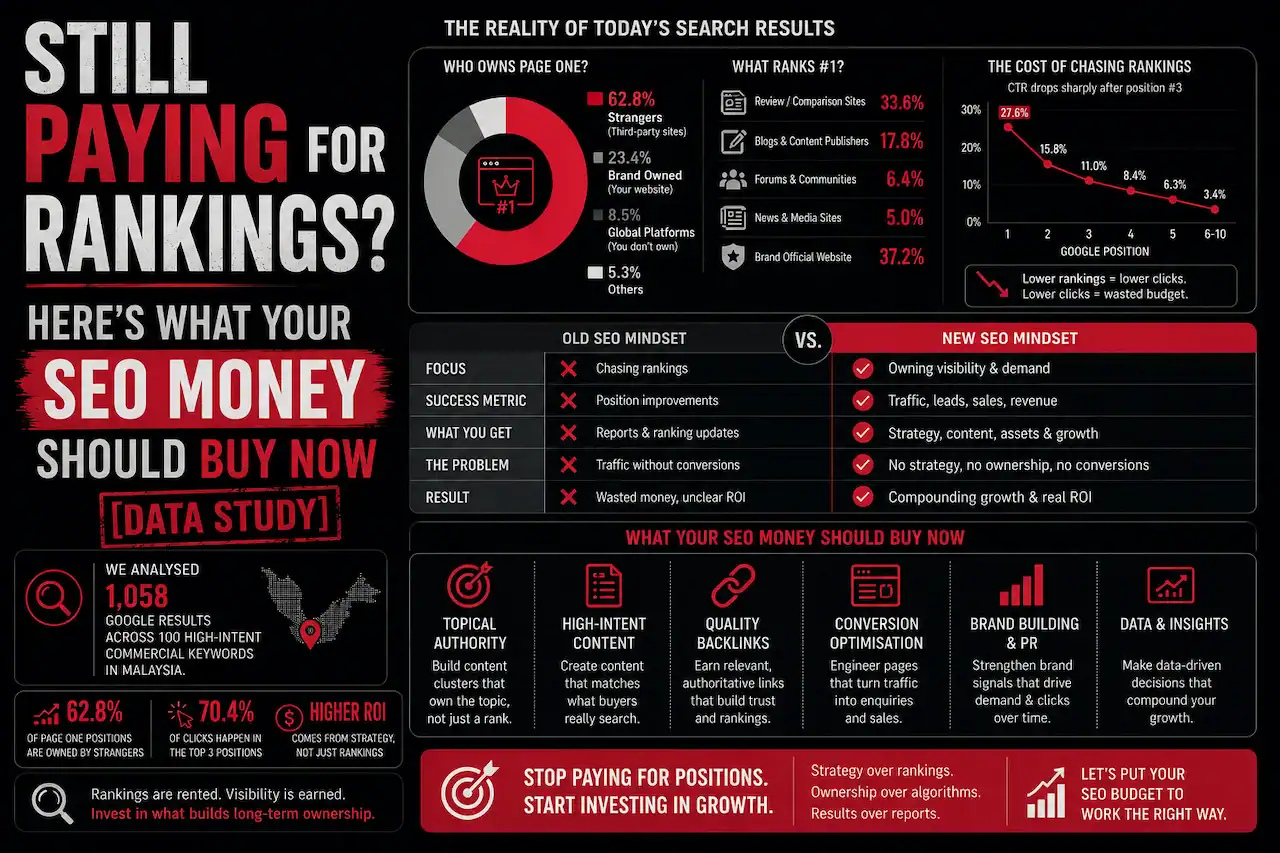
What Your SEO Invoice Actually Bought
A breakdown of the gap between what agencies charge for and what Malaysian businesses actually need in 2026.
Every month, the invoice arrives. SEO services — RM X, XXX. You pay it the way you've paid it for a year or three. And if someone asked you, right now, to explain what that money bought last month — specifically, concretely, in sentences a twelve-year-old could check — could you?
Most Malaysian business owners can’t. Not because they’re careless, but because the product they’re buying was named after its old job. “SEO” still sounds like one thing — get me up the Google rankings — and most of the packages sold in this country are still shaped like that one thing: several keywords, some articles, many links, a monthly report with green arrows.
Here’s the problem. Over the past year, we’ve published seven research studies on what actually decides who gets found in Malaysia — over three thousand classified search results, sixty-keyword price maps, winner-by-winner teardowns. And the picture they paint together is blunt: the work that gets a Malaysian business found in 2026 is genuinely different from the work most retainers were designed to deliver — not because rankings stopped mattering (they matter more than ever, and we’ll show you why), but because the page your customers see grew new layers that the old monthly checklist never touches.
This article is written for the business owner paying that invoice — and for anyone about to sign one. We pulled fresh data on how Malaysians shop for SEO and what the market’s shop window advertises. Then we rebuilt the retainer line by line: what each old deliverable should have become, the six jobs missing from almost every package, the blueprint for what a modern month contains, and the ten questions to ask any agency before you sign — including us.
- Disclosure
We are an agency. We sell retainers. You should read everything below knowing that — and you should notice that the checklist at the end is designed to be pointed at us too.
Key Findings (TL;DR)
Malaysians shop for SEO price-first:
"seo price malaysia" is searched three times more than "seo package malaysia" — and the page-one box of related questions on that price search includes "is SEO dead." The doubt is sitting inside the buying journey itself.
The shop window still sells the old product.
Of 14 pages winning the two buyer searches, the pitch language splits into ranking promises (4), price pages (7), and credentials — with "AI" now appearing as a sticker on the same old promise. The number of titles mentioning content depth, site structure, community presence, AI citations, or what you'd actually own: zero of 14.
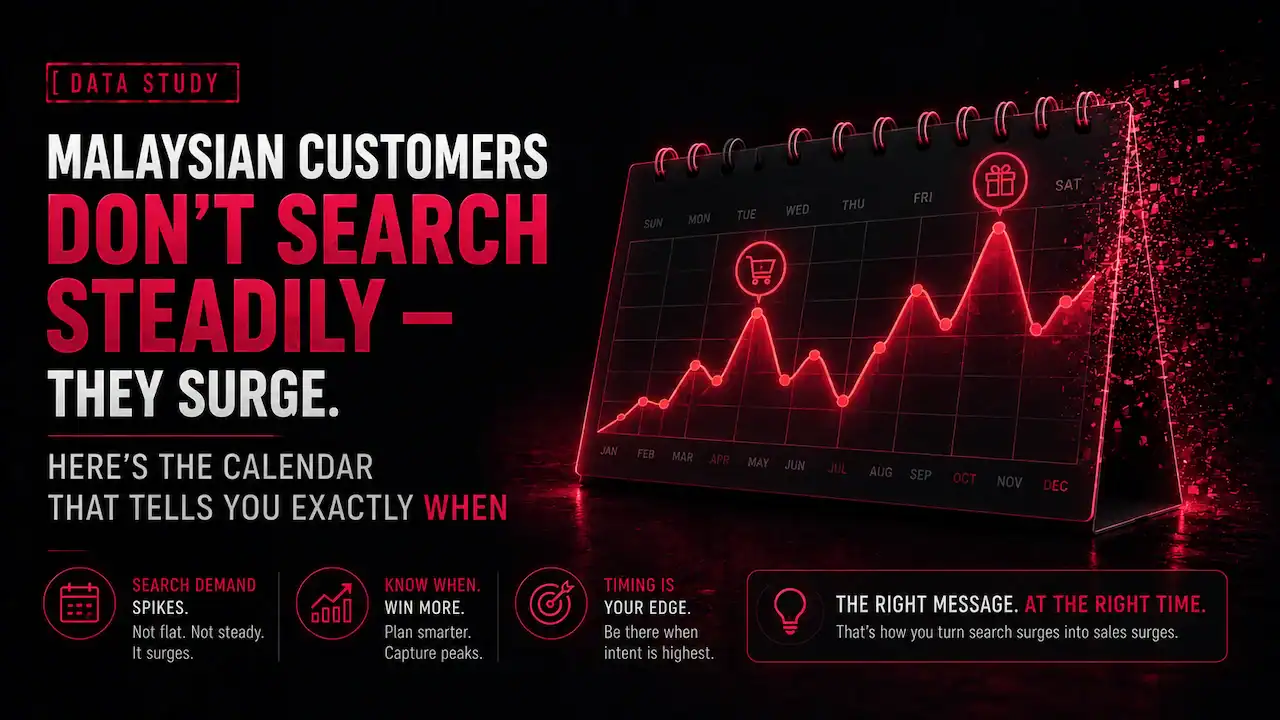
"Is SEO dead?" has a data answer: no — the results page grew three layers.
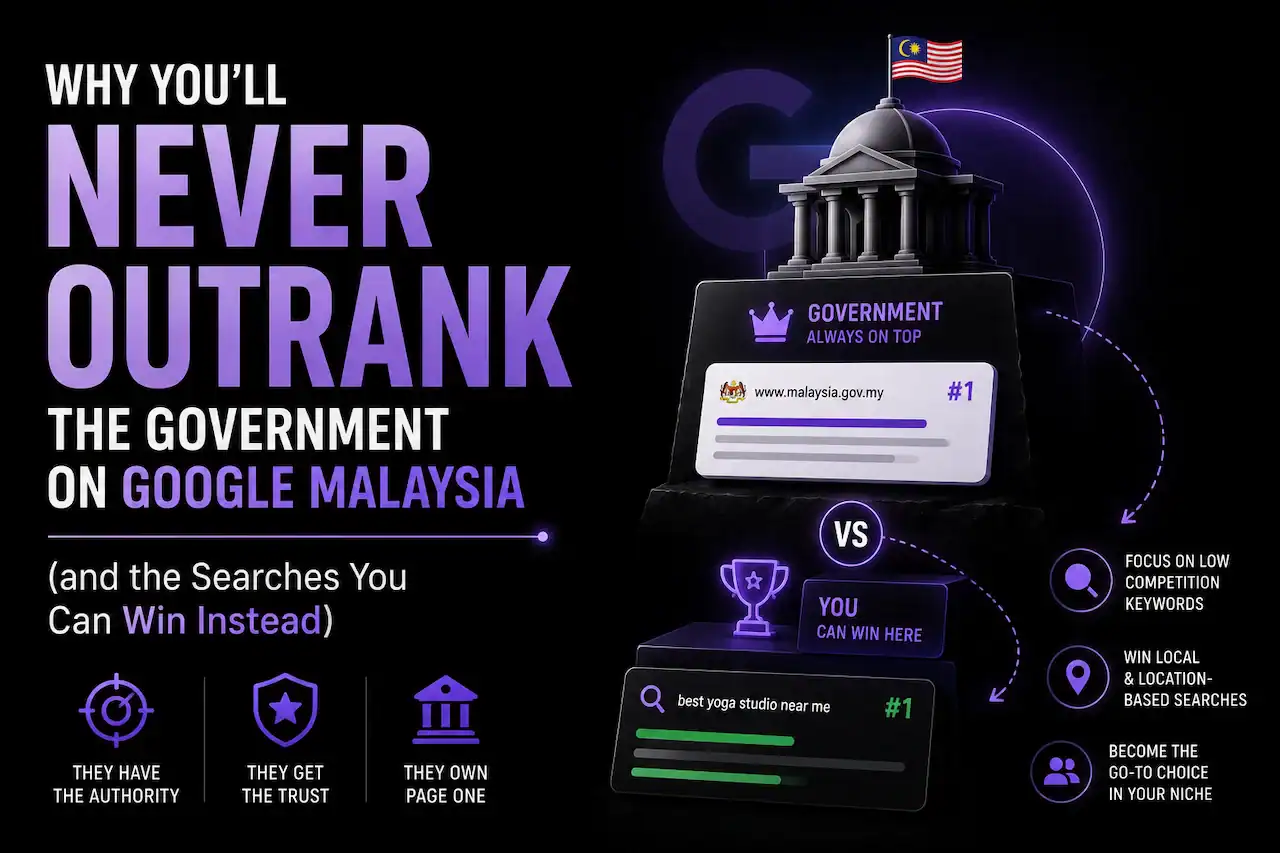
The slots you can rank (still the foundation), Google's AI answer layer (which quotes pages, including community threads), and the conversation layer (forums and groups deciding trust). The old retainer services exactly one of the three.
Every classic line-item has a modern replacement:
"20 keywords tracked" becomes a keyword portfolio priced in ringgit; "4 articles a month" becomes fewer, deeper pages maintained on a calendar; "monthly rank report" becomes a report that shows all three layers and shows what those positions are worth in money.
Six jobs are missing from nearly every package sold:
website structure, research beyond the volume column, getting quoted by AI answers, showing up (openly) in the communities that decide your category, the Malay and Chinese layers, and business-continuity assets you own.
The agencies themselves pay the most for clicks in Malaysia
in RM terms, the "seo agency" click costs ~$2.00, the most expensive vertical in our 60-keyword price map. The people selling visibility bid the hardest for it. Watch what they pay, not just what they post.
How we did this
Plain language breakdown of our research approach.
Malaysian search behavior
The competitive shop window
Research evidence base
- Data sourced: 13 June 2026 (Ahrefs, Malaysia).
The datasets and analysis script are available on request — reach out and we’ll send the pack.
Finding 1
Malaysians Shop For SEO Price-First — While Wondering If It’s Dead
Before judging what’s sold, look at how it’s bought:

What buyers type | Searches/month | Click price (ads) |
seo malaysia | 2,400 | $1.60 |
seo agency malaysia | 1,500 | $2.00 |
seo company malaysia | 900 | $2.00 |
seo price malaysia | 500 | $1.50 |
seo package malaysia | 150 | $1.50 |
Three things worth your attention as a buyer
Malaysians shop price-first, three to one
The package page is the most defended in the niche
"Seo package malaysia" carries a difficulty score of 47 — harder-fought than almost any client keyword we've ever mapped. Agencies fight hardest for their own shop window. They know exactly what a ranking is worth; in fact, the "seo agency" click costs about $2.00 — the most expensive click in our 60-keyword price map. The people selling visibility outbid every other industry to get it. That's not hypocrisy; it's the most honest market signal available. Watch what the experts pay.
The doubt is built into the journey
Continue reading below for data-driven answers to what buyers are actually asking.
Finding 2
The Shop Window Still Sells 2019 (Now With An AI Sticker)
We classified the headline pitch of all 14 unique pages winning the two buyer searches:

What the headline sells | Pages |
Price/cost transparency | 7 |
A ranking promise (“rank first,” “top of Google,” “boost your rankings”) | 4 |
An “AI SEO” claim | 2 |
An award/credential | 1 |
A who-to-pick guide | 1 |
The actual composition of the work — content depth, structure, community, citations, ownership | 0 |
Not one winning pitch, in the entire shop window of Malaysian SEO, describes the shape of the modern work. The promises are the 2019 promises — rank, boost, top — and where 2026 appears, it appears as an adjective: the same ranking promise with "AI search" bolted onto the sentence. A sticker on the old box.
To be fair where fairness is due: the seven price-transparent pages deserve credit — publishing prices is exactly what buyers reward (the data two sections up proves it), and a how-to-choose guide winning the SERP is the market educating itself. The villain here is not any agency. It’s a template — the keyword-counted, article-counted, link-counted monthly package that the whole industry (our own past included) standardised in an era when the results page was a simple list of ten blue links and ranking on it was the entire game.
- It's worth being honest about why the template persists, because the answer isn't villainy — it's economics. The old units are countable: twenty keywords, four articles, fifteen links. Countable units are easy to price, easy to compare across three quotes, easy to staff, and easy to invoice. Composition — "fewer, deeper, in three layers, maintained" — is genuinely harder to sell, because it asks the buyer to evaluate quality of thinking instead of quantity of stuff. So the market converged on the menu buyers found easiest to compare, and buyers kept comparing on it, and here we all are. Breaking that loop is precisely what the checklist at the end of this article is for: it gives you, the buyer, the comparison questions that measure the right thing.
That era measurably ended. Here’s what replaced it.
The shop window is selling you a map of a city that has since built two new districts.
Finding 3
“Is SEO Dead?” — No. The Page Grew Three Layers.
The honest, data-backed answer to the question sitting in your buying journey:

When a Malaysian searches today
The page that answers them has three layers, and we’ve measured all three.
The rankable results
Still the foundation, still the prerequisite, still where most clicks land — and still very winnable: across our studies, roughly one in five winning results comes from small, low-authority sites, as shown in our page-one anatomy study, while brands took 17 of 20 top spots on product searches in our marketplace study. Anyone telling you rankings stopped mattering is selling you a different mistake.
Google’s AI answer layer
On most informational searches, an AI-written answer now sits above the rankings, quoting a handful of pages. Our Cited vs Ranked study found the majority of those quoted pages weren’t in the top ten below — being quotable is related to, but different from, ranking.
Crucially, ranking remains the entry fee; the AI answer is a prize drawn substantially from those who paid it. The work changed from “rank the page” to “rank the page and write it so a machine can quote it.”
The conversation layer
On the searches that decide purchases — reviews, comparisons, “which one” — strangers now hold up to a third of the page: Reddit threads, Lowyat forums, Facebook groups. We measured one telco comparison at 80% community content. That pattern is explored in our conversation-layer study, which shows how forums, Facebook groups and community discussions increasingly influence buying decisions.
No amount of ranking work puts your website into that layer; only presence does — open, disclosed, useful participation.
- So: SEO is not dead.
SEO as sold by the 2019 template is incomplete by two-thirds.
The old retainer services Layer 1 and reports on Layer 1 — while your customers read an answer assembled in Layer 2 and make their final decision in Layer 3. That’s the gap your invoice has been quietly not covering.
Finding 4
The Old Line-Items, Audited One By One
Take the classic Malaysian package, line by line, and hold each line against the evidence:

What each old deliverable should have become
Deliverable: “4 blog articles a month”
Our page-one anatomy study performed the autopsy on this one: publish-and-pray is dead — winning Malaysian pages are fewer, deeper, genuinely useful (calculators, maintained guides, real expertise), and they’re re-edited on a calendar as rates and rules change, following the statutory refresh cycles measured in our government territory study. Those assets also reflect the structure measured in our website structure study, where dedicated pages consistently outperformed combined service pages.
Four thin posts a month are paying for the exact content type the data shows losing. The modern line: fewer, deeper assets — built first, then maintained like editions.
Deliverable: “X backlinks per month”
Links still power rankings — every winner study confirms it. But links bought by the dozen are the riskiest line on the old menu, and the winners in our data earn theirs with assets worth linking to: a fee calculator out-earning entire practice areas, original data others cite.
The modern line: build the kinds of assets that naturally earn links.
Deliverable: “Monthly ranking report”
A report that shows only Layer 1 positions is, in 2026, a dashboard that hides two-thirds of the war.
The modern report shows:
- Positions and their ringgit value
- Whether the AI answer on your key searches quotes you (and who it quotes instead)
- Who holds the conversation layer on your trust searches (the brand-plus-“review” page, the “versus” pages)
- The whole battlefield in five rows, fifteen minutes
Plus the one census that beats every estimate: your own Search Console data, because the tools’ samples miss what your real impressions catch.
The Six Jobs Missing From Almost Every Package
Beyond upgrading the old lines, six jobs our research shows deciding outcomes appear in essentially no standard package — including, until recently, the template versions of ours:

Website structure
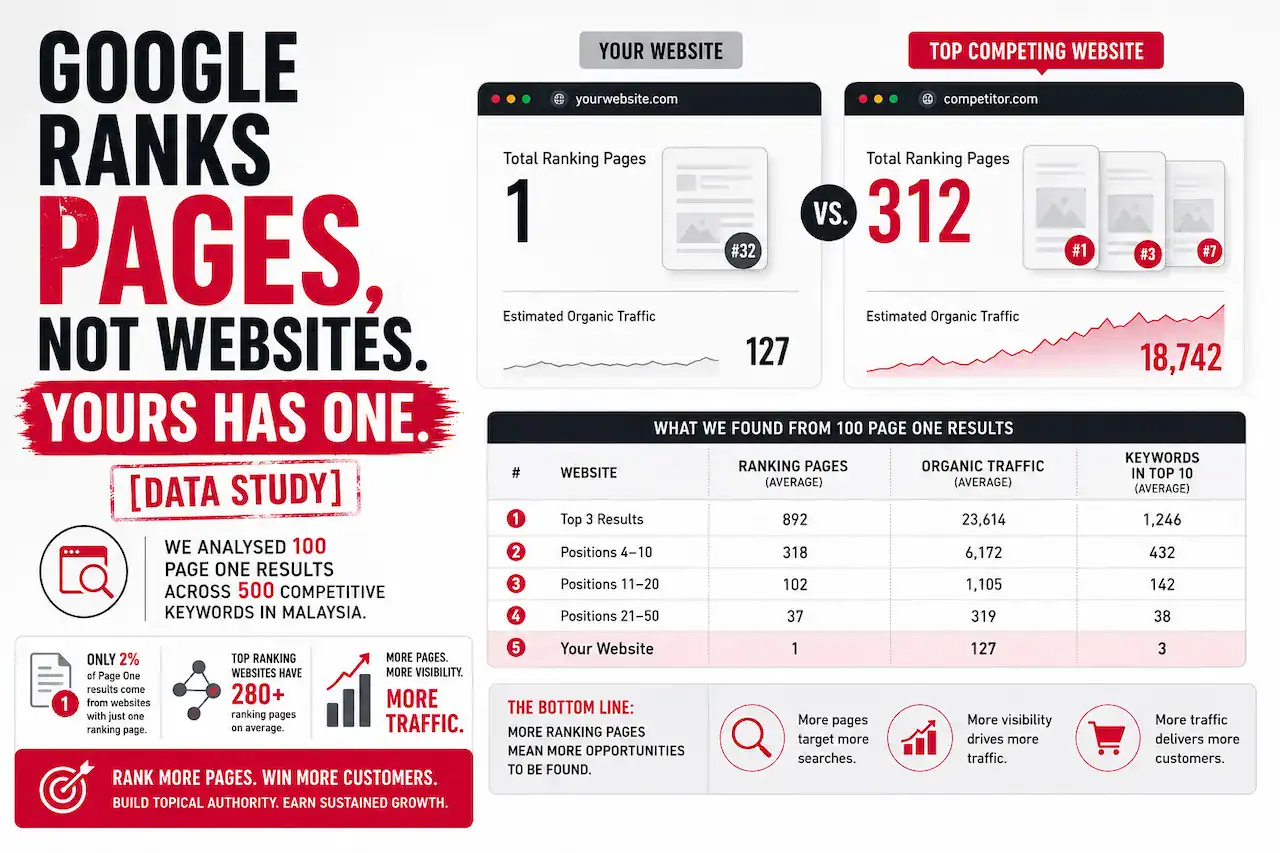
As our website structure study found, Google ranks pages, not websites — and zero of 39 combined "all our services" pages ranked in our structure study. If your site is one beautiful page for five services, no amount of monthly optimisation fixes the missing pages. A structure audit belongs at the start of any engagement, not anywhere.
Research beyond the volume column
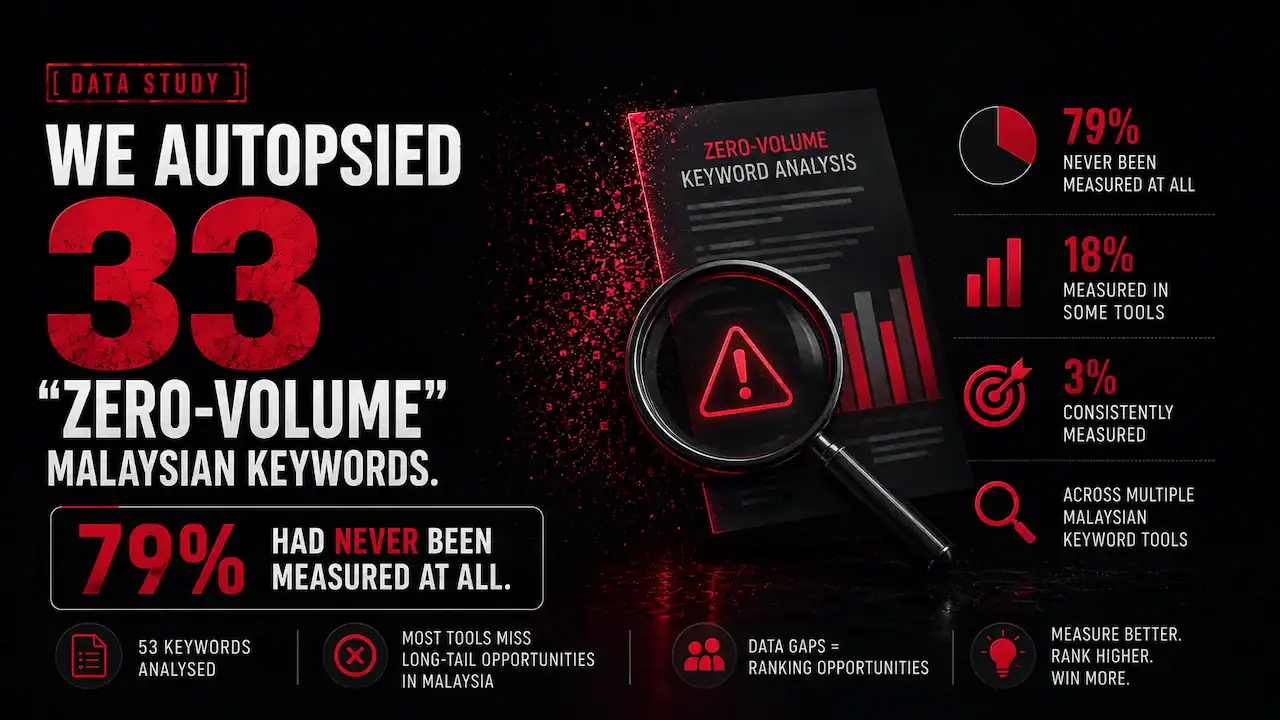
As our zero-volume study found, 79% of "zero-search" Malaysian keywords in our autopsy were never measured at all — and the B2B searches behind five-figure deals live exactly there. The modern retainer researches with the full instrument panel (traffic potential, live SERPs, your own demand ledger), not a spreadsheet filter from 2015.
Quotability
Getting cited by the AI answer layer is now a deliverable: direct answers high on the page, current-year stamps, scannable structure, facts a machine can lift. Nobody's package mentions it; two-thirds of informational SERPs already run on it. The mechanics behind this are covered in our Cited vs Ranked study, while our government territory study shows how this works in regulated industries.
Community presence — done in the open
The threads and groups deciding your category reward disclosed, useful participation (an owner answering real questions under the business's name) and punish fakery catastrophically. It's an hour a week, and it places your name inside results you can never outrank. It is marketing work; someone should be doing it; it's not on any menu. The evidence is detailed in our conversation-layer study.
The language layer
"Peguam" equals "lawyer" in volume at a seventh of the difficulty; BM clicks cost a third of English ones; winners rank the same guide in three languages on three URLs. An English-only retainer in Malaysia is a retainer for part of Malaysia. Those language opportunities are explored further in our BM vs English study and our Mandarin study.
Assets you own
As explored in our ownership guide, our suspension case study is the cautionary tale: rankings are rented reach. The modern engagement also builds the unseizable layer — your customer list, your data, your recurring relationships — so that no domain incident, algorithm update, or platform mood swing can unplug the business. If your marketing partner has never mentioned this, they're optimising the rented floor of your house.
The Modern Retainer: What A Month Should Actually Contain
Put it together, and a defensible monthly engagement looks like this — shaped to your situation, but with all three layers present:
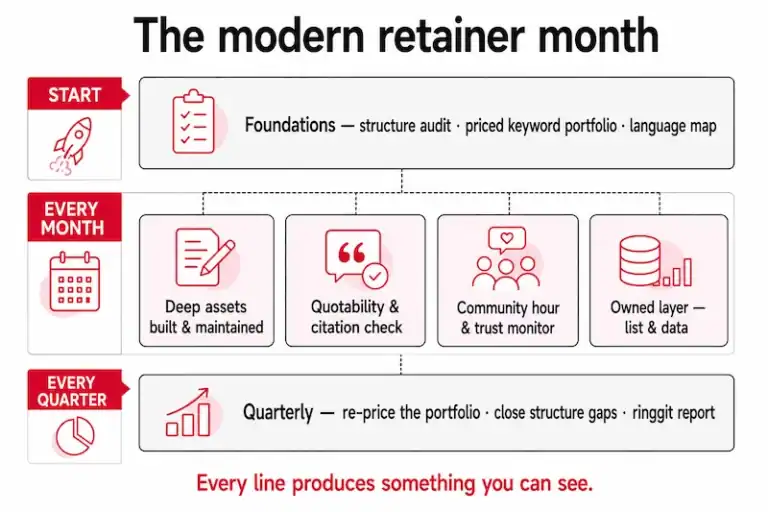
The blueprint for what a modern month contains
At the start (once, then revisited)
The structure audit — does a rankable page exist for every service that's searched?
The keyword portfolio, priced in ringgit, fights chosen by value-per-difficulty
The language map
The trust-search baseline: who holds your brand-plus-review and versus pages today
The monthly engine
Layer 1
One or two deep assets built or upgraded (not four thin posts) — service pages to full anatomy, a guide, a calculator; the maintenance pass on whatever the statutory calendar just changed; the technical hygiene.
Layer 2
The quotability pass on priority pages; the citation check — does the AI answer on your money searches quote you yet, and who is it quoting?
Layer 3
The community hour — useful, disclosed answers in the two or three rooms that rank for your category; the trust-SERP monitor (five rows: search, who holds top three, sentiment, change, action).
Owned layer
Contact capture working, list growing, data exported.
Quarterly
Re-price the portfolio (difficulties move, your authority moves, keywords change buckets between rank/buy/both)
Re-run the structure gaps
Review what the report's ringgit column says the year is actually worth
What this looks like for a real business — a dental clinic
- The start:
the structure audit finds five services sharing one page, so five pages get planned; the portfolio prices the fights — “klinik gigi” (3,700 searches, difficulty 0, worth ~RM1,200 a month at #1 by our price map’s method), “braces price malaysia” (600, difficulty 0), “scaling” and the treatment cluster behind them; the language map says the BM terms out-volume the English ones, so BM leads.
- A typical month:
the braces-price page built to full anatomy with this year’s actual prices (price transparency wins, remember); the quotability check on “braces price” — is the AI answer quoting the clinic or a forum?; the community hour in the two parenting groups where dental questions rank; the recall list growing.
- The quarterly:
re-price, and watch “klinik gigi” move from RANK to DEFEND as positions land. Every item visible. Every item checkable. That’s the whole philosophy in one clinic.
The test of the whole thing: every line above produces something you could see — a page, a citation, a thread, a number in ringgit. If a month’s work can’t be shown, it wasn’t work.
The Buyer’s Checklist: Ten Questions To Ask Any Agency (Including Us)
Print this. Ask them in order. Good agencies will enjoy them; the template will not survive them.
You’ll know the difference by the shape of the answers. Take question one: a template answer sounds generic and uncheckable. A real answer is specific, measurable, and can be verified. One of those answers can be checked. That’s the entire test, applied ten times.

"What is a #1 position on my main keyword worth in ringgit per month — show me the math."
(If keywords aren't priced, the plan is volume-chasing.)
"Which of my keywords would you NOT chase, and why?"
(A real method says no to something.)
"Show me a page you'd build for me — and the cluster of searches it would earn."
(Pages, not posts. Clusters, not strings.)
"What happens when Google's AI answers my customers' questions instead of ranking pages — what's your plan for being the one quoted?"
(Blank look = Layer 2 unserviced.)
"Which forums, groups or threads currently decide my category — and what would you do about them, openly?"
(Any answer involving fake accounts: leave the meeting.)
"Does my website have a page that can rank for each service I sell? If not, what's the structure plan?"
"What's your plan for the Malay (or Chinese) side of my market — researched natively, not translated?"
"What does the monthly report show besides rankings — and does it show what the rankings are worth in money?"
"When a keyword tool says a search I know my customers make has 'zero volume,' what do you do?"
(The right answer involves checking, not obeying.)
"When we part ways, what do I own — the content, the site, the data, the accounts? Put it in the agreement."
"When we part ways, what do I own — the content, the site, the data, the accounts? Put it in the agreement."(Our ownership guide exists because this question goes unasked until it's expensive.)
What This Article Does NOT Say
It does not say rankings stopped mattering.
The opposite is the data: Layer 1 remains the foundation and the entry fee for everything above it. An agency delivering strong rankings is delivering the prerequisite — the argument is that the prerequisite is no longer the whole job.
It does not say agencies selling packages are bad actors.
Packages make pricing legible, and the price-transparent pages winning the buyer SERPs are serving buyers honestly. The critique is aimed at a template's contents, not at its sellers — and our own older packages are inside the blast radius.
It does not say fire your agency.
It says audit the scope. Many agencies do modern work under old menu names; the checklist will tell you which kind you have in one meeting.
It does not say the checklist guarantees a good outcome.
An agency can answer all ten questions beautifully and still execute poorly. The ongoing guarantee is the visibility test — every month, work you can see — which is why it's the blueprint's closing rule and the report-decoder's whole point.
- It does not pretend we're neutral.
We sell retainers. This article is, unavoidably, also a description of what we think good ones look like. That’s exactly why the checklist is written to be used against us too — and why every factual claim links to a study with its data available on request.
The Final Take
Buy Work You Can See, In All Three Layers
The monthly SEO retainer isn’t obsolete — its 2019 contents are. The results page your customers actually use has three layers; the classic package services one of them, counts the wrong units, and reports in green arrows instead of ringgit. The fix isn’t spending more. It’s buying the right work — and being able to see it.
If you’re the business owner paying the invoice
Run the twenty-minute scope audit this week
Take your agreement, highlight every deliverable, and sort each into Layer 1 / Layer 2 / Layer 3 / owned assets. Most classic scopes put everything in one pile. Now you know your gap.
Ask for the ringgit column
Your next report should value your positions in money. It's one spreadsheet formula, and it changes every conversation about whether SEO "is working."
Take the checklist to your next review meeting
All ten questions. You're not being difficult; you're being a buyer.
Start the owned layer yourself today
Contact capture, the list, the data exports. No vendor required, no landlord possible.
If you’re the specialist or the agency
The shop window is the opportunity: fourteen pitches and not one describes the modern work — the first agencies in any market to sell the three-layer engagement, in plain buyer language with prices attached, get a SERP’s worth of differentiation for free.
Re-line-item the scope, put ringgit in the reports, and let the checklist above be the proposal structure. The template will keep losing quietly; you don’t have to lose with it.
The one-sentence version
Pay for rankings — they’re still the foundation — but stop paying only for rankings, because your customers now read an AI’s answer and a stranger’s thread before they ever see your position, and a modern retainer is simply one that works, visibly, in all three places.
Run This Yourself
- The buying-language dataset, the classified shop-window data and the analysis script are available on request — reach out and we'll send the pack.
The self-audit, twenty minutes
Your agreement's deliverables sorted
Highlight every deliverable and sort each into Layer 1 / Layer 2 / Layer 3 / owned assets. Most classic scopes put everything in one pile.
Your last report — does anything translate to ringgit?
Look for any mention of monetary value. If not, you know the gap.
Search your brand + "review" and your top "best X" term
Does anyone on your team know who holds those pages? This is your Layer 3 baseline.
Ask whoever runs your SEO question #4 from the checklist
Watch the answer. You'll know what you're buying by lunch.
When the next monthly report lands, decode it with three questions
“What is any of this worth in ringgit?”
If no number exists, ask for the formula — it’s volume × click price × a quarter.
“What sits above these rankings?”
The AI answer on your top three searches — quoted, or not?
“What sits around them?”
Your brand+review page, your versus page — friendly, hostile, or unknown?
A report that can answer all three is a modern engagement wearing any name.
A report of green arrows alone is a 2019 dashboard, whatever the invoice says.
Limitations (Read These Before Quoting)
The shop-window audit reads pitches, not full packages
14 winning pages' headline language across two buyer SERPs, single snapshot (13 June 2026). What agencies deliver may exceed what their titles sell; the finding is about how the market talks to buyers, and it's directional.
We are a competitor of every page we classified
The classification is anonymous, mechanical (pitch language only), and the dataset ships on request so anyone can re-run it — but read the conflict of interest as loudly as we've disclosed it.
The seven-study evidence base is our own work
Each with its own published limitations, every dataset available on request.
No pricing benchmarks are given deliberately
Scopes vary too much for honest ringgit ranges, and this article's argument is about composition, not cost.
FAQ
My agency is affordable, and my rankings look fine. Why change anything?
Maybe nothing needs changing — run the twenty-minute audit first. If your rankings are fine and the AI answer quotes you and your trust searches are healthy, and you own your data, you have a modern engagement under an old name. The audit exists precisely because “rankings look fine” describes one layer of three.
Is this just a pitch to spend more?
The blueprint mostly re-allocates: four thin posts become one deep asset; hours move from volume-counting to community presence and maintenance. Several items — contact capture, the trust-SERP monitor, the demand ledger — cost almost nothing. Composition, not budget, is the argument.
Can we do the modern retainer in-house?
Much of it, yes — the checklist doubles as a job description, and the owned-asset layer should be in-house regardless. The specialist work (portfolio pricing, quotability engineering, native-language research) is where outside help earns its fee. Hybrid is common and sensible.
Every agency we meet now says "AI SEO." How do we tell the sticker from the substance?
Question #4. Substance sounds like a mechanism: “here’s the answer box on your key search, here’s who it quotes, here’s why, here’s the change we’d make to your page.” A sticker sounds like the old promise with new letters. Two of the fourteen shop-window pitches we classified were stickers; the question unsticks them in thirty seconds.
We're locked into a 12-month contract. What now?
Use the time, not the exit. The audit and the checklist work mid-contract: most agencies will adapt scope within an existing agreement faster than they’ll fight a cancellation — re-allocating four thin posts into one deep asset costs them nothing.
And before renewal, question #10 becomes the main event: confirm in writing what you own — the content, the site, the analytics, the accounts — so that whatever you decide at month twelve, you decide it holding your own assets.
What should an SEO retainer cost in Malaysia?
We deliberately won’t print a number — scope varies too much for an honest range, and the price pages winning the buyer SERPs already publish their own. The better question is the one this whole article equips you to ask: for this monthly amount, which layers am I buying, and can I see the work?
If you’d like the twenty-minute audit done properly — your current scope sorted into the three layers, your keyword portfolio priced in ringgit, and the gaps marked in plain language — send us your website and we’ll run the audit as part of a tailored SEO programme. Drop us a line; the findings are yours either way.