The email doesn’t look like much. A few formal paragraphs, a reference number, and somewhere in the middle, the only sentence that matters: the domain has been suspended.
Everything else still exists. The products are in the warehouse. The team shows up. The brand is still remembered. But the address — the thing every ranking, every backlink, every saved bookmark, every Google result earned over years points to — has stopped resolving. The business didn’t burn down. It was unlisted on the map.
This happened to a client of ours. Twice.
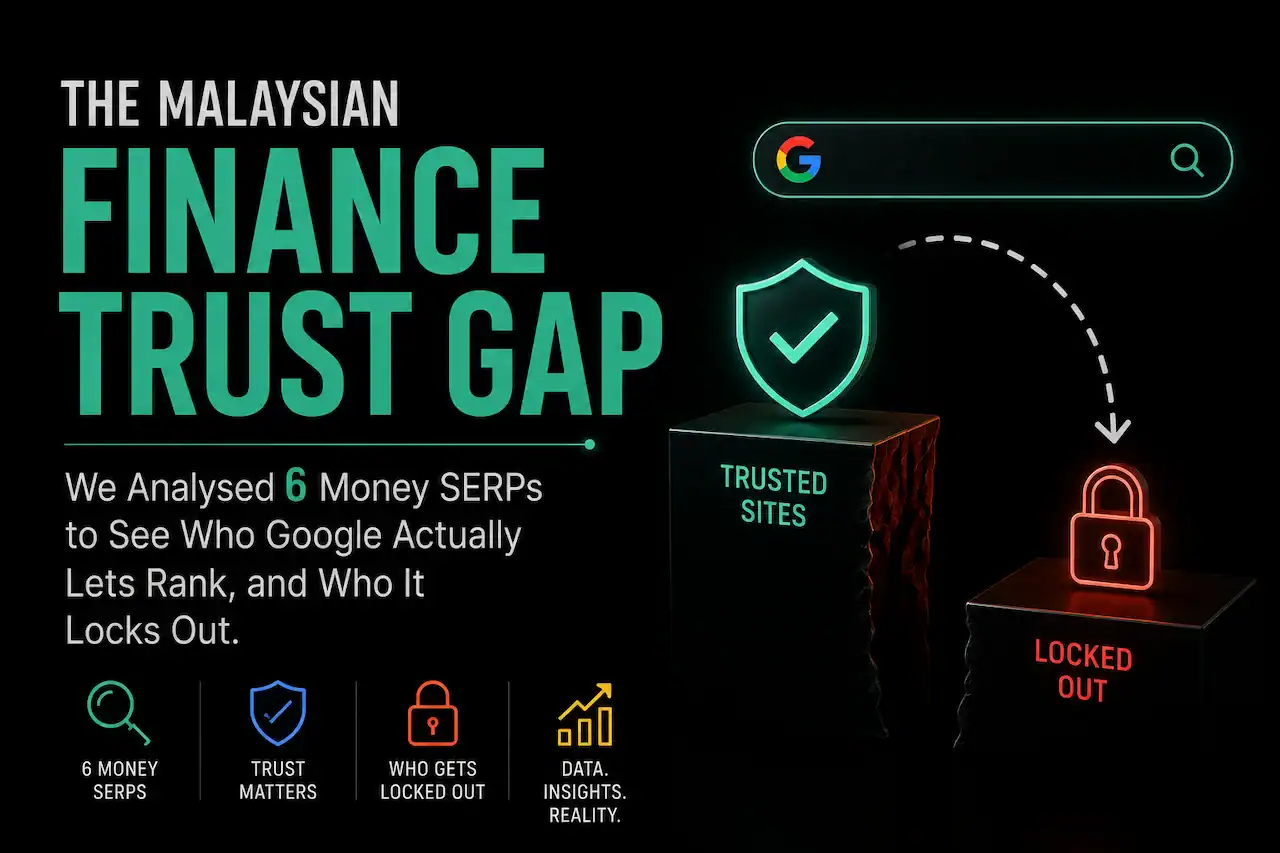
We’re telling the story anonymised — who they are doesn’t matter, and what happened to them is the point — because it’s the most expensive SEO lesson we’ve ever watched a Malaysian business pay for, and because the data says an entire category is making the same bet right now. More importantly, the lesson is not really about their industry at all. It’s about a fact every Malaysian business owner signs up to without reading it. You do not own your domain. You rent it — and the land under it has a landlord, and the landlord has rules, and some landlords answer to a regulator.
This article is the case, the mechanics of what was actually lost (it’s worse than “the site went down”), the public data on the category today — and then the part that applies to every clean, legitimate, fully-compliant business reading this: the list of assets no suspension can touch, and why you should be building them before you ever need them.
One disclosure before we start: nothing in this article is legal advice, and nothing in it endorses any product category. It’s an infrastructure story.
Key Findings (TL;DR)
- A Malaysian retailer in a restricted-adjacent category built several years of rankings on a .my domain, was suspended, won the appeal, was restored — and then suspended again. The second suspension destroyed not just the site but the redirect carrying its equity to a new domain. Years of SEO, stranded in a dead address.
- The .my namespace is administered by MYNIC under MCMC’s purview, with suspension powers built into the registrant agreement. A .com answers to a different landlord (an ICANN-accredited registrar) — but it is still rented, and Malaysian regulators can still block access to any domain at ISP level. There is no sovereign domain. There are only different landlords.
- The category’s page one today contains its own warning, and everyone ranks above it: the #1 result is a DR-2 .my domain earning ~9,800 visits a month — the identical bet our client lost, still running. Three of the five ranking independents sit on MYNIC-governed domains. A Reddit thread asking *”is it legal?”* ranks at #5. A news report about an enforcement fine ranks at #9.
- Every independent on that page is DR 0–7 — the authority vacuum of a category mainstream websites won’t touch, and proof of how much traffic low-authority sites can earn there: the top .com independent draws ~25,000 visits a month.
- The assets that survived were the ones no regulator can administer: the customer list, the chat threads, the repeat buyers, the brand memory. The assets that died were the ones rented from someone else. That ratio — owned vs rented — is the resilience score of every business reading this, including the completely legitimate ones.
The Case: Two Suspensions, One Stranded Asset
Here is the timeline, anonymised and slightly blurred by design:

Years 1–3: the build. A Malaysian retailer of adult toys registers a .my domain and does everything right by SEO standards.
Understand the legal texture they operated in, because it’s the setup for everything that follows. Malaysian enforcement online is not a binary; it’s a gradient. At the hard end sit categories like online gambling — prohibited outright, blocked and pursued on sight. At the other end sits a band of activity that is restricted on paper yet visibly tolerated in practice: enforcement exists (a Penang case in which a woman was fined over possession made the news, and ranks in this category’s own search results), but day to day, listings trade openly — our data pull found a marketplace storefront ranking at #4 for the category’s head term, in public, undisturbed. Adult toys live in that lowest band of “not allowed.” And the trap of that band is psychological: tolerance feels like permission. It isn’t. Tolerance is permission that can be revoked without notice — and a domain suspension is exactly what the revocation looks like. Dedicated product and guide pages, real content, earned links. Rankings compound the way rankings do: slowly, then steadily, then valuably. The domain becomes the business’s most productive employee.
The first suspension. The letter arrives. The domain stops resolving. The client appeals through the proper channel — and wins. The domain is restored. To the team, it reads as vindication. In hindsight, it was a final notice with extra steps.
The hedge. Rattled, the client registers a .com and 301-redirects the .my to it — the standard, textbook migration play. Redirects pass most of a domain’s earned equity to the new address as long as the redirect keeps running. The rankings begin transferring. It looks like the escape worked.
The second suspension — the one that did the real damage. The .my is suspended again. And here is the mechanism most business owners never see coming: the redirect died with it. A 301 is not a one-time transfer of equity; it’s a living bridge that must stay standing while Google re-attributes years of signals to the new domain. Suspend the source domain mid-migration, and the bridge is demolished with the traffic still on it. Every backlink earned over the years now points at a dead address. Every old ranking URL resolves to nothing. The equity wasn’t transferred and wasn’t even lost in a fight — it was stranded, fenced off inside a domain the business can no longer operate.
The aftermath. The client rebuilt on the .com — from a fraction of the authority, with a brand whose customers had now twice found a dead site. In a trust-scarce category, a vanished website doesn’t read as “technical issues.” It reads as if they ran. The SEO loss was measured in years; the brand damage compounded on top of it. They’ve moved on, and the business survives — on the assets the suspension couldn’t reach, which is the second half of this article.
The bridge was legal, the migration was textbook, and none of it mattered — because the landlord owned both ends of the bridge.
The Governance Layer: Who Actually Owns Your Address
Strip the category out of the story and look at the infrastructure, because this is where the lesson generalises.
A .my (or .com.my) domain is administered by MYNIC, which operates under the purview of MCMC, Malaysia’s communications regulator. Your registration is a contract — and like every registry on earth, MYNIC’s terms include the power to suspend or revoke a domain for breaches, including use connected to activity that violates Malaysian law. That is not a flaw or an overreach; it is the registry doing what its rules say, and any business registering a .my has agreed to those rules, usually without reading them.
A .com answers to a different landlord — an ICANN-accredited registrar under a different legal framework. Different landlord, different rules, different speed of enforcement. But it’s still a landlord. Registrars suspend domains too (fraud, abuse complaints, court orders, payment failures, even administrative errors). And critically for Malaysian readers: a regulator that cannot suspend a foreign-registered domain can still order Malaysian ISPs to block access to it — a power exercised routinely against offshore gambling and scam sites. The visitors you care about are in Malaysia; a domain that resolves in California and is blocked in Kuala Lumpur is dead where it counts.
So the honest map is not “.my risky, .com safe.” It is:

Every online business stands on five rented surfaces: the domain registry, ISP-level access, payment processing, marketplace accounts, and logistics/customs. Each has a landlord. Each landlord can act. They differ only in how fast, how likely, and how reversible — and a local registry in your own regulatory jurisdiction is, by construction, the fastest and cheapest surface for enforcement to reach. That’s not a comment about any category. It’s plumbing.
For a fully legitimate business, the same map reads as ordinary risk management: domains get suspended over trademark disputes, registrar billing errors, hijacking, abuse-report mistakes and expired credit cards every single day. You don’t need to be in a grey area to lose your address. You just need to be unlucky once.
The Data: An Entire Category Is Making The Same Bet Right Now
We pulled the public search data for the adult-toys category, partly to show the market reality and partly because the page one turned out to be the most self-aware SERP we’ve ever documented.
The demand is measured and open: the head term draws 800 searches a month in Malaysia at Keyword Difficulty 55 — a harder-fought page than almost any legitimate service SERP in our research library (air-conditioning service sits at KD 3; dental clinics at KD 0). People fight hardest for the territory they can least afford to lose.
And here’s who holds that territory today:

Position | What it is | DR | Est. monthly traffic |
#1 | An independent on a .my domain | 2 | ~9,800 |
#2 | An independent on a .com | 4 | ~25,500 |
#3 | An independent on a .com.my | 7 | ~9,400 |
#4 | A marketplace storefront | 87 | ~640 |
#5 | A Reddit thread asking “is it legal?” | 95 | ~410 |
#6 | An independent on a .com | 5 | ~3,970 |
#7 | An independent on a .com.my | 0 | ~190 |
#8, #10 | A Facebook group discussion | 100 | ~580 |
#9 | A news report on an enforcement fine | 56 | ~75 |
Three things in that table should stop you cold.
First: the #1 site in the category today is a DR-2 .my earning roughly 9,800 visits a month. Someone is, at this moment, compounding years of equity on precisely the infrastructure that took our client down — the identical bet, still running, currently winning. Three of the five ranking independents sit on MYNIC-governed domains. Whatever they believe protects them, it isn’t the land they built on.
Second: the SERP carries its own risk disclosure. The market’s legal uncertainty ranks at #5 in the market’s own results — Malaysians asking each other, in public, whether the thing being sold above and below the thread is allowed. It’s another example of the pattern documented in our conversation-layer study, where community discussions increasingly occupy high-intent search results alongside commercial pages. Four results later sits a news story about a real enforcement fine. The warning label ranks on the same page as the products, and commerce proceeds around it. We’ve never seen a dataset say “everyone knows” more plainly.
Third: every independent on the page is DR 0–7. Mainstream sites won’t touch the category, so its SERPs are an authority vacuum — which is exactly why low-authority sites can pull five-figure monthly traffic there, and exactly why the equity at stake is so painful to lose. The cheapest territory to win is also the easiest to be removed from.
The category’s page one is a queue of businesses building on land the landlord has already shown it is willing to repossess — in full view of the eviction notice ranking at #9.
What A Suspension Actually Destroys (It’s More Than The Site)
The loss anatomy, from the inside of the case:

- The rankings — years of compounding positions, gone in a DNS change you didn’t make.
- The backlink equity — every link ever earned points at the dead address. Links are the slowest asset in SEO to build and the only one that can be stranded in a place you can’t enter. As our page-one anatomy study found, link equity compounds over years, making it one of the hardest assets to rebuild once it’s lost.
- The in-flight redirect — the case’s cruellest mechanism: a migration is only as alive as its source domain. Lose the source, lose the bridge, strand the equity mid-crossing.
- Brand-search trust — customers who search your name and find a dead site don’t think “registry issue.” In any category, that’s damage; in a trust-scarce one, it’s a verdict.
- The operational nervous system — email on the domain stops. Logins, receipts, password resets, ad-account verifications, API callbacks: an astonishing amount of a business’s plumbing assumes the domain exists.
- The time — the only loss that can’t be re-bought at any price. Our client’s rebuild started years behind where their compounding curve had reached.
Notice what’s not on that list — and that’s the next section, the one that applies to every reader who will never sell anything restricted in their life.
The Assets No Regulator Can Suspend
Here is the part of the case that should change how clean, compliant, entirely boring-in-the-best-way Malaysian businesses operate — because what saved our client wasn’t anything on the domain. It was everything that wasn’t.
When the address died, these kept working: the customer database. The email list. The WhatsApp threads. The repeat buyers who knew the brand by name. The social followings. The supplier relationships. The remembered reputation. The business re-opened at a new address, and the people who mattered could be told — directly, on channels no registry administers.
That’s the resilience lesson, and it has nothing to do with grey areas:

Rented (dies with the landlord’s decision): the domain, the rankings, the marketplace storefront, the ad accounts, the social platforms’ reach (the algorithm is a landlord too), the payment gateway.
Owned (survives anything): the customer list with consent to contact, the email and WhatsApp channels, the subscription relationships and recurring orders, the CRM history, the first-party data, the brand in people’s memory, the products and the team.
Every Malaysian business should run the thought experiment our client lived: if your domain stopped resolving tomorrow morning — wrong category flag, trademark dispute, registrar error, expired card, a hack — what fraction of your revenue could you reach by lunchtime? If the answer is “whatever Google sends us,” your business is a tenant with no forwarding address. The practical build list:
- Capture contacts as policy, not an afterthought. Every order, every enquiry, every walk-in: email and phone, with consent. The list is the only marketing asset with no landlord.
- Build a recurring layer where your model allows it — subscriptions, memberships, standing orders, service contracts. Recurring relationships re-route themselves to a new address; one-off traffic doesn’t.
- Own your data outside the platforms. CRM exports, order history, analytics — backed up off the rented surfaces regularly. A marketplace ban with your entire customer history inside it is the same stranding as our client’s redirect.
- Make the brand the address. A business found by name survives any URL change; a business found only by keyword belongs to whoever holds the ranking. As our ownership study shows, the brand is the asset customers remember, while our structure study shows how resilient websites are built around assets that don’t depend on a single URL.
- Keep a migration runbook before you need one: a second domain registered and parked, DNS access documented, the redirect plan written, the announcement templates drafted. Resilience is cheap on a calm Tuesday and unbuyable during the fire.
To see the difference this makes outside any grey area, run two ordinary Malaysian businesses through the same accident — say, a registrar billing error that takes a domain down for two weeks. Business A is a tuition centre that built the owned layer: standing monthly enrolments, a parents’ WhatsApp group, and every family’s contact in a spreadsheet it controls. The site dies; one broadcast message later, classes run, fees collect, and the fortnight costs almost nothing but annoyance. Business B is its competitor across the road, which gets every student from ranking for “tuition [area]” and has never captured a contact. Same accident, same fortnight — but B’s pipeline is simply gone, and it has no way to tell anyone where it went. Identical businesses, identical incident, completely different bill — and the difference was built years earlier, in boring weeks when nothing was wrong.
The suspension letter can take every asset with a landlord. It cannot take a single customer who knows your name and has given you a way to reach them. Build accordingly.
What This Article Does NOT Say
- It is not legal advice, and it takes no position on the category. The legal texture — restricted, unevenly enforced, openly traded — is described because it’s the setting of the case; the enforcement example cited is public news reporting. Consult a qualified lawyer for anything touching your own situation.
- It does not say “move to .com, and you’re safe.” The second suspension in this very case is the proof: jurisdiction-shifting your domain does not shift your customers, your payment rails, your logistics or ISP-level access out of Malaysia. No architecture makes a restricted business unrestricted — and this article isn’t trying to design one.
- It does not say MCMC or MYNIC acted wrongly. A registry enforcing its published terms is a landlord enforcing a lease. The lesson is for tenants: know what you signed.
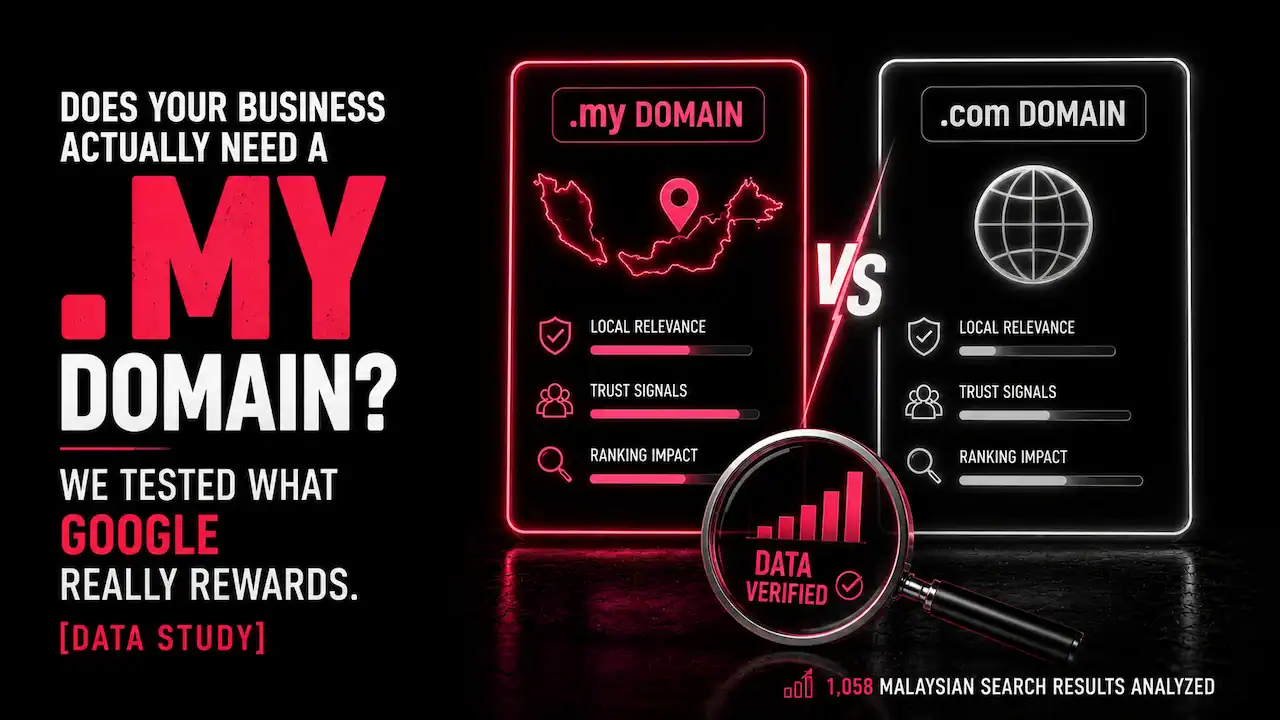
- It does not say .my is a bad domain. For the overwhelming majority of Malaysian businesses, .my’s local trust and geotargeting are genuine advantages, as shown in our domain study. The point is narrower: every domain is rented, so no domain should be the only place your business exists.
The Final Take: Be Findable, Not Just Ranked
The verdict in plain words: our client didn’t lose a website — they lost the assumption that the address was theirs. Every Malaysian business runs on rented surfaces; the rent is paid in compliance with rules you agreed to without reading, and the only true insurance is the set of assets that have no landlord: your list, your data, your recurring relationships, your name in customers’ memory.
If you run a business — any business
Run the lunchtime test this week: domain dies at 9 am — what revenue can you reach by noon? Then close the gap in order: contact capture as policy → recurring layer → data exported and owned → brand-first marketing → migration runbook in a drawer. None of these costs meaningful money. All of them cost exactly one thing, our client would tell you is the most expensive item in this article: doing it before the letter.
If you operate anywhere near a grey area
The data section is your mirror: the current #1 is making the bet that already failed, in view of the warning ranking four slots below it. We’re not your lawyers, and this isn’t a playbook for continuing — it’s the narrow infrastructure observation that concentrating years of equity on the enforcement surface closest to your regulator is the single most fragile version of an already fragile position, and the owned-asset list above is the difference between an incident and an ending. What you do with your category is between you, your lawyer and the law.
The one-sentence version
Your domain is rented land with a landlord who can end the lease — so build the rankings, enjoy the rankings, and make sure the business would still know how to find its customers the morning the address stops resolving.
FAQ
Is .my actually riskier than .com?
For a compliant business, no — .my’s local trust and geotargeting are genuine assets, and registrars suspend .coms over disputes and errors too. The risk isn’t the TLD; it’s treating any single rented surface as if it were owned. The category in this case faced faster, nearer enforcement on .my; your accounting firm does not.
We're a fully legitimate business. How much of this really applies to us?
The whole second half. Trademark disputes, expired cards, registrar errors, hijacks and mistaken abuse reports suspend clean businesses’ domains every day — and the lunchtime test doesn’t care why the domain died. The owned-asset list is ordinary business continuity that most Malaysian SMEs simply haven’t built because nothing has gone wrong yet.
What's the first thing to build?
Contact capture as policy — every customer’s email or phone, with consent, from today. It’s the cheapest item on the list, It compounds just as rankings do, and it’s the one asset that makes every other recovery possible.
Limitations
- Single anonymised case, told from the agency side. Timeline details are deliberately blurred for confidentiality; the mechanics (suspension, appeal, restoration, redirect, second suspension, stranding) are reported as experienced.
- The category SERP is one snapshot (12 June 2026), one head term. Composition shifts; the structural observations (MYNIC share, authority vacuum, the legality thread ranking) are the point, not the exact positions.
- Traffic and DR figures are Ahrefs estimates with the usual sampling caveats.
- Regulatory descriptions are simplified plumbing, not law. MYNIC’s terms, MCMC’s powers and registrar policies have nuance this article compresses; the pre-publish legal review exists for exactly this reason.
Research and case reporting by the team at Sterrific, a digital marketing agency in Petaling Jaya, Malaysia. The client in this case study is anonymised by agreement and design; identifying details have been altered or omitted. Nothing in this article constitutes legal advice.