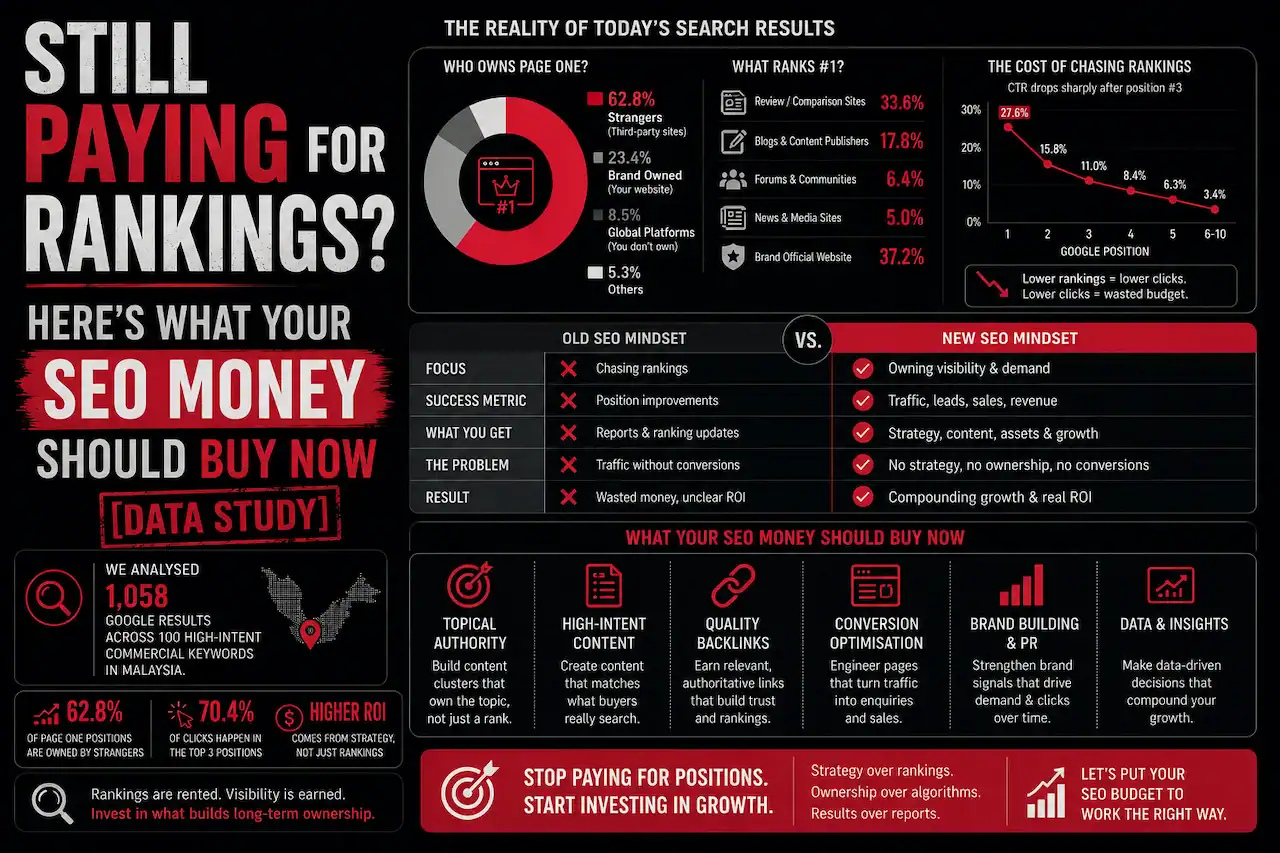

Search “carsome review.”
Position one is not Carsome. It’s a Reddit thread by a stranger asking if he should buy his first car there. Position three is another Reddit thread — this one titled “be careful with Carsome” — flanked by two Facebook group discussions. The company itself appears at position four, beneath three pages of conversation it doesn’t control, can’t edit, and mostly hasn’t read.
This is a funded, professionally marketed Malaysian company. It cannot rank first for its own name plus the word “review.”
Now search “unifi vs maxis” — two of the largest telcos in the country, comparing their core product. Eight of the ten results are forums, Reddit threads, Facebook groups, a Threads post, a TikTok and a Steemit speed test. The brands are not on the page. The decision is being made entirely by strangers.
If you own a Malaysian business, this study is about the moment your customer decides whether to trust you — and who Google has decided gets to speak in that moment. We analysed 1,058 Malaysian page-one results across five datasets, including a fresh basket of the review, comparison and trust queries where wallets actually open. The short version: the average SERP gives user-generated content a seat. The buying-decision SERP gives it the table.
And here’s the sentence that should genuinely worry you: every one of those threads, groups and comment sections is a sales conversation about your category, happening right now, without you in the room.
Key Findings (TL;DR)
- Across 1,058 Malaysian page-one results, 14.4% is user-generated content — forums, Reddit, Facebook groups, YouTube, TikTok. But the average is camouflage:
- UGC concentrates exactly where buying decisions happen. “Unifi vs Maxis”: 80% UGC. “Carsome review”: 70%, with Reddit at #1 and #3. “best broker malaysia”: 40%. On our fresh review/comparison/trust basket, UGC takes 32.4% of page one — more than double its share of ordinary commercial SERPs.
- Brands cannot rank for their own trust queries. The pattern is structural: Google has decided a company’s page is not a credible source about whether that company is trustworthy — a stranger’s thread is.
- The platform leaderboard across all datasets: Facebook 48 results, Reddit 33, YouTube 27, TikTok 15, X 10, Lowyat 6. Reddit punches absurdly above its Malaysian user base because Google boosts it; Facebook wins on volume through groups.
- UGC ranks on borrowed authority — reddit.com is DR 95, facebook.com DR 100, Lowyat DR 70. A three-comment thread outranks your DR 40 site not on merit but on the platform it sits on.
- The international contrast: on “best credit card,” America’s page one is 52.9% professional affiliate media (NerdWallet, Bankrate, Forbes). Malaysia and Singapore never grew that industry at scale — so the community layer fills the trust vacuum here in a way it doesn’t there.
Methodology
Five datasets, one question: how much of Malaysian page one is ordinary people talking — and where?
Fresh pull (98 results, 12 SERPs, 11 June 2026): eight Malaysian SERPs across the three query types where trust is the product — review queries (“carsome review”), comparison queries (“unifi vs maxis”, “best credit card malaysia”, “best car insurance malaysia”, “best personal loan malaysia”, “best savings account malaysia”, “best broker malaysia”, “best hosting malaysia”) — plus four matched-intent SERPs pulled against the US and Singapore for the international contrast. Every result classified as UGC (forum, subreddit, FB group/page post, video, Q&A), affiliate/review media (RinggitPlus, iMoney, NerdWallet-type), brand, or government.
Reused datasets (960 results), reclassified under one unified UGC detector: our marketplace study (455 commercial results), page-one anatomy study (188 informational), ownership study fresh pull (156), and government-territory study (188). Running a single detection rule across all five sets is what makes the pooled 14.4% figure honest; where it differs slightly from each study’s originally published classification (e.g., 17.1% here vs 16.3% in the marketplace study’s scheme), both figures and the rule are disclosed, and the gap is classification-rule noise, not data revision.
Volumes validated; one deliberate scope note: pure “is X scam” phrasings mostly carry near-zero measurable volume in Malaysia — the trust intent hides inside review and comparison queries instead, which is itself a finding about how Malaysians search.
The full dataset and analysis script are available on request — reach out and we’ll send the pack.
Finding 1: The Average Says 14.4%. The Average Is Lying To You.
Pool everything — 1,058 results across commercial, informational, government and trust queries — and user-generated content holds 14.4% of Malaysian page one. Roughly one slot in seven, consistent with the one-in-seven we first measured in our domain study a year of datasets ago.
A seventh of the page sounds survivable. Here’s the same number, intent by intent:
Query territory | UGC share of page one |
9.0% | |
12.2% | |
17.1% | |
Review/comparison/trust queries (new) | 32.4% |
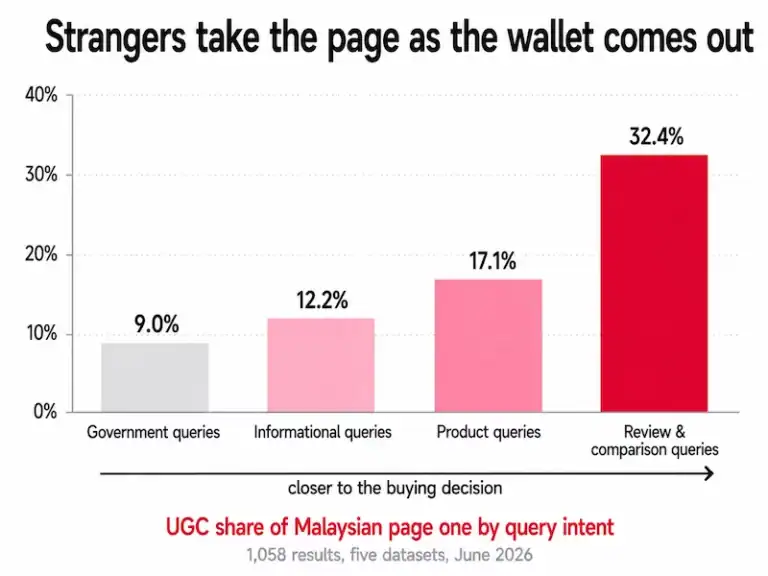
The gradient is the finding. UGC’s share of your page one triples as the searcher gets closer to a decision. When they’re learning, Google shows them institutions and explainers. When they’re comparing and trusting — the last search before money moves — Google increasingly shows them to each other.
So the real exposure isn’t “one slot in seven.” It’s this: the SERPs where your marketing budget either converts or dies are precisely the SERPs you control least. Your category pages rank for the research queries. Strangers rank for the decision.
Google didn’t take a seventh of your page. It took the seventh that closes.
The broader commercial context is explored in our marketplace study, where brands still captured 17 of the 20 organic #1 positions despite the growing conversation layer.
Finding 2: The Buying-Decision SERPs — Where The Takeover Is Total
Walk the fresh basket from worst to best, because the spread tells you exactly which businesses should be losing sleep:
Query | UGC share | Who’s actually on the page |
unifi vs maxis | 80% | Lowyat thread #2, Reddit ×2, two FB groups, Threads, TikTok, a Steemit speed test |
carsome review | 70% | Reddit #1 and #3, two FB groups, a DR-12 personal blog, YouTube, Lowyat |
best broker malaysia | 40% | Reddit ×2, Quora, Lowyat — wrapped around Bursa’s official ranking |
best car insurance malaysia | 25% | FB group at #6, Reddit discussion pack |
best credit card malaysia | 12.5% | Reddit r/MalaysianPF at #9 — and inside the AI Overview’s citations |
best hosting malaysia | 11.1% | Reddit at #8 — and cited first in the AI Overview |
best personal loan / savings account | 0% | The banks and affiliates still hold these — for now |
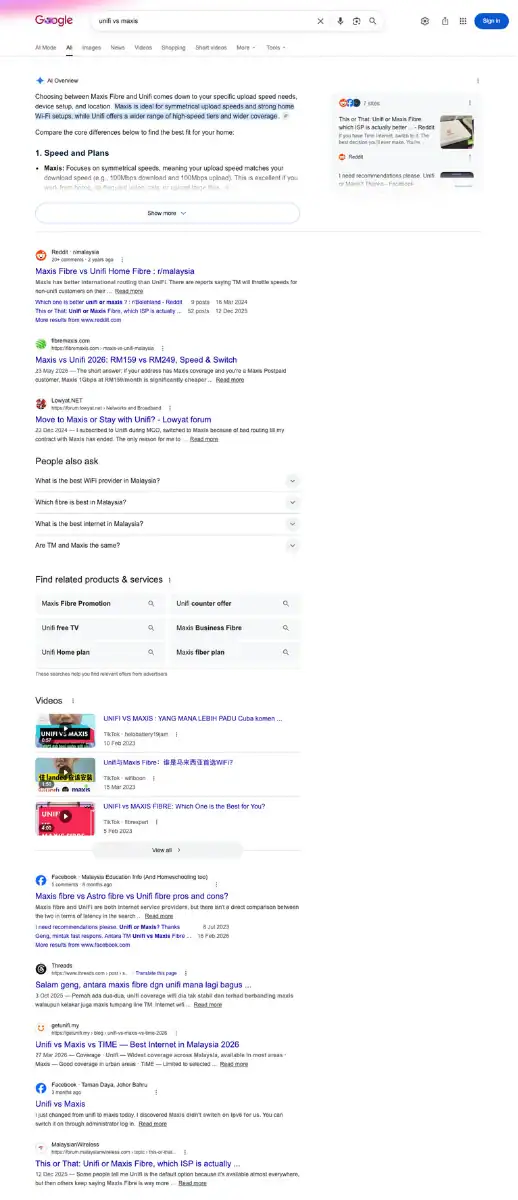
Read the top two rows again. A telco comparison where neither telco is present. A brand-review query where the brand is buried under three conversations about itself — one of them a warning.
Notice also what the 0% rows have in common: regulated banking products with heavy compliance and a thick local affiliate layer (RinggitPlus, iMoney) absorbing the comparison intent. The takeover isn’t uniform — it floods wherever the official answers are thin, the affiliate layer is missing, or the product is something Malaysians genuinely argue about. Telco service quality. Used-car platforms. Brokers. Hosting. If your category is one people complain about in groups, your buying-decision SERP is already theirs.
And the layer above the links is converging on the same sources: on “best credit card malaysia” and “best hosting malaysia,” the AI Overview’s citation list includes the Reddit threads — the conversation doesn’t just rank anymore; it gets quoted as the answer, the same ranked-then-cited mechanic our Cited vs Ranked study measured.
Your next customer’s final search before choosing isn’t reading your website. It’s reading the comments.
Finding 3: You Cannot Rank For Your Own Trustworthiness
The Carsome SERP isn’t an accident of one brand’s reputation. It’s a policy.
Since Google’s 2023–2024 “hidden gems” updates, the system explicitly promotes first-hand experience and forum content on queries seeking opinions — and the logic is brutal for brands: on the question “should I trust this company?”, the company is the one source Google treats as disqualified from answering. Your /reviews page is testimony from the defendant. A stranger’s thread is a witness.
The mechanics make it worse. That Reddit thread outranking you carries reddit.com’s DR 95. The Facebook group post carries DR 100. The Lowyat thread, DR 70. Our page-one anatomy study showed winning pages ride their domain’s earned authority — median 513 referring domains. UGC is the extreme case: a three-comment thread written in four minutes borrows the full authority of a platform with millions of links. You’re not being outranked by better content. You’re being outranked by better real estate, occupied by whoever posted first.
The result, measured across this basket: the brand’s own properties took the trust-query #1 exactly zero times where UGC was present in force. The only organic #1 in the new strata that isn’t an affiliate is the Reddit thread sitting on Carsome’s name.
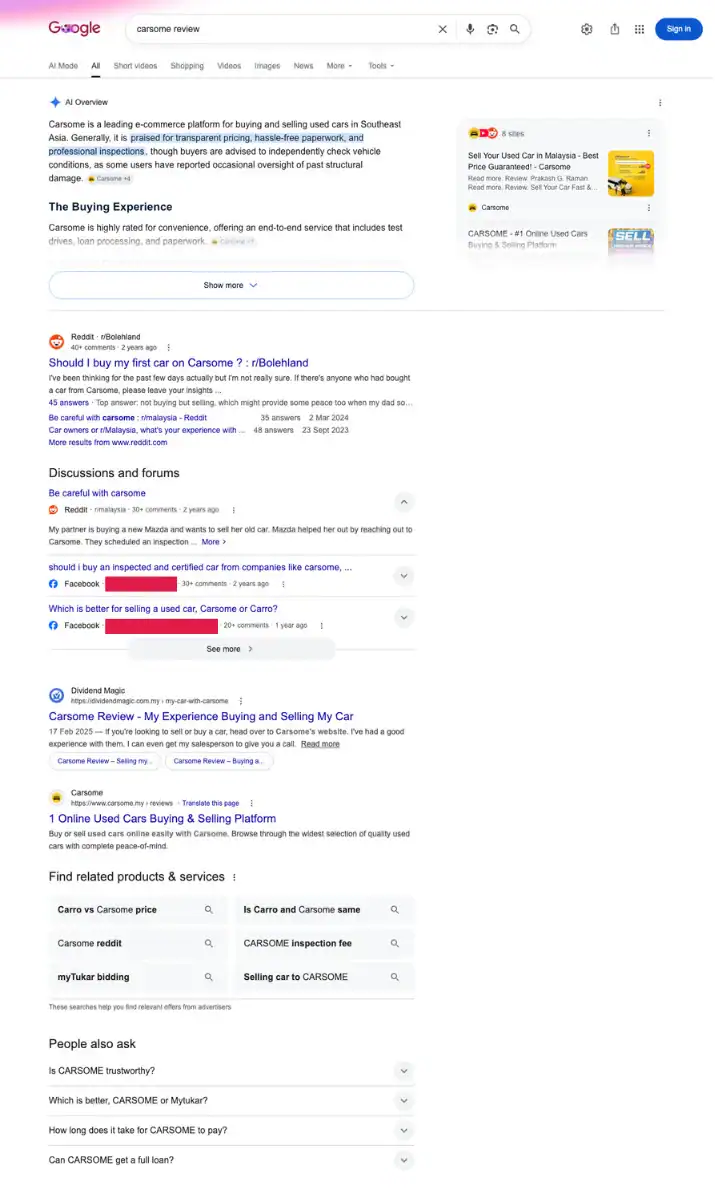
Walk the full page slot by slot, because its anatomy is a preview of your own brand’s review SERP at any scale:
#1 — a Reddit thread: a stranger asking r/Bolehland whether to buy his first car there; the community’s answers are the content.
#2 — the AI Overview, assembled substantially from the conversations below it.
#3 — a discussion pack: the “be careful” thread plus two Facebook group debates.
#4 — finally, the brand.
#5 — the brand’s Facebook page (still a platform’s land, note).
#6 — dividendmagic.com.my, a DR-12 personal finance blogger’s first-hand account of selling his car — one individual’s honest write-up, outranking nothing less than the company’s entire content operation on its own name.
#8–9 — YouTube and a Lowyat thread.
#10 — the brand’s own /reviews page, dead last: the defendant’s testimony, filed where Google thinks it belongs.
Count the brand’s properties: three slots out of ten on its own review query, none above position four. Count the first-hand human voices: six. That ratio — strangers two-to-one over the brand, strangers holding everything above the fold — is what “you cannot rank for your own trustworthiness” looks like in pixels.
There’s a sympathetic reading here that every Malaysian business owner should internalise, because what happened to a well-funded, professionally marketed company will happen to you at your scale: this is not a marketing failure. It’s a structural change in who gets to speak at the moment of trust. No amount of on-site SEO fixes it, because the fix isn’t on your site.
On the day a customer googles whether to believe you, Google mutes you and hands the microphone to the room.
Finding 4: The Room Has An Address — The Platform Leaderboard
Across all 1,058 results, where do the strangers actually live?
Platform | Page-one results | The shape of its presence |
48 | Groups and pages — the BM-heavy backbone, from kakirepair to insurance groups | |
33 | r/MalaysianPF, r/malaysia, r/Bolehland — the EN trust layer | |
YouTube | 27 | Reviews, walkthroughs, comparisons |
TikTok | 15 | The fastest riser — process videos ranking organically |
X (Twitter) | 10 | Brand/announcement queries |
8 | Visual categories | |
7 | Reels in image packs | |
Lowyat | 6 | Small in count, lethal in placement — tech and telco decisions |
Quora | 2 | EN long-tail |
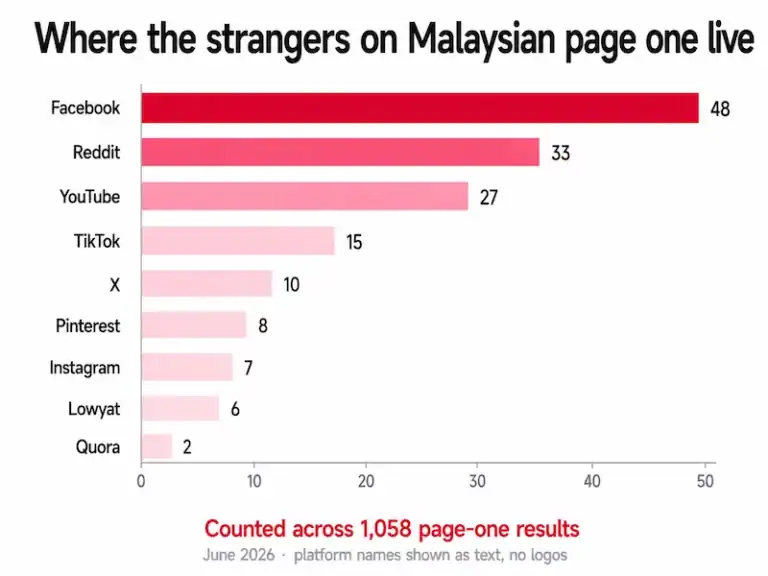
Three structural notes the raw counts hide:
Reddit is wildly over-weighted relative to its Malaysian user base. Facebook is where Malaysia actually talks; Reddit is where Google listens. The boost is platform-level and global — which means r/MalaysianPF threads with a few thousand views carry national SERP power on money queries.
Facebook’s 48 results are the BM story. Our marketplace study measured UGC at 28.2% of BM commercial SERPs versus 9.8% of English ones — and it’s overwhelmingly Facebook groups and sellers. If your customers search in BM, your conversation layer isn’t Reddit; it’s a group you’ve probably never opened, in the language your dashboard doesn’t monitor.
The same language pattern appeared in our BM vs English study, which showed that Malaysians often search natively in Bahasa Melayu rather than translating English intent, helping explain why Facebook groups dominate the BM conversation layer.
Lowyat’s six results are positioned like snipers. Tech, telco, broker — the high-ticket EN decisions. A 2009-era forum outranks 2026 brands because twenty years of threads taught Google it’s where Malaysians actually answer each other.
TikTok’s 15 results deserve a flag for where they showed up. A battery shop’s TikTok ranks inside the “unifi vs maxis” page — a workshop’s sixty-second video, in a telco comparison, because it answered something real about home internet during installs. Process video is becoming a SERP format in Malaysia, and the businesses producing it aren’t media companies; they’re tradesmen with phones. The format barrier to the conversation layer is now effectively zero.
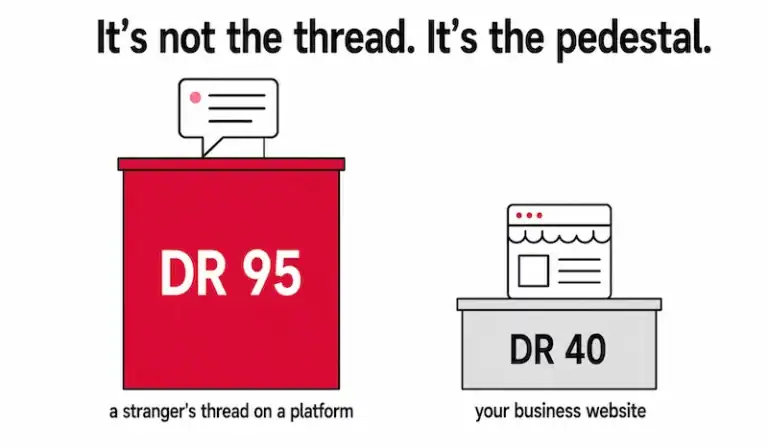
And understand the physics of why you can’t simply out-publish these results. The thread that outranks you took four minutes to write and borrows the full earned authority of a platform with tens of millions of links — our anatomy study measured winning pages riding domains with a median of 513 referring domains, and reddit.com sits at DR 95 with orders of magnitude more. Your counter-content starts from your domain’s authority and climbs at your domain’s speed. That asymmetry is also why “suppress it with more content” fails as a reputation strategy: you’re proposing to out-rank a skyscraper by stacking bricks beside it. The economics only work in the other direction — being inside the skyscraper costs a login and an honest answer.
The conversation that decides your next sale has a URL. Most Malaysian businesses have never visited it.
Finding 5: Why Malaysia Got It Worse — The Vacuum America Filled
We pulled the same intent against the US and Singapore to answer one question: is this a Google thing or a Malaysia thing?
Market — “best credit card”-class queries | UGC | Affiliate/review media | Brands |
United States | 23.5% | 52.9% | 23.5% |
Singapore | 40.0% | 40.0% | 20.0% |
Malaysia (full new basket) | 32.4% | 31.0% | 32.4% |
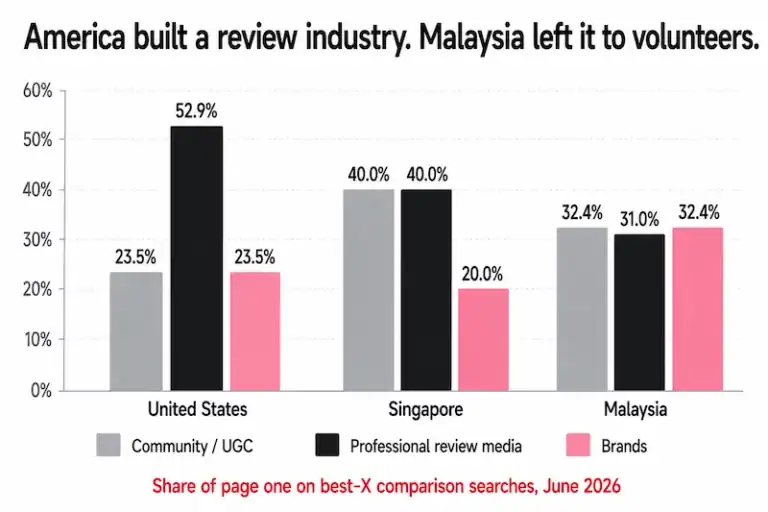
America’s buying-decision page is a majority professional review industry: NerdWallet, Bankrate, Forbes Advisor, The Points Guy — a twenty-year-old, billion-dollar affiliate-media sector whose entire job is occupying trust queries. When an American googles a decision, an industry answers.
Malaysia (and to a real degree Singapore, where Reddit’s r/singaporefi shares the page with MoneySmart and SingSaver) never grew that industry at a comparable scale. RinggitPlus and iMoney hold the regulated-finance core — which is exactly why “best personal loan” stayed 0% UGC — but step outside finance and there is no Malaysian NerdWallet for telcos, used-car platforms, brokers, hosting, gyms, clinics. The trust vacuum got filled by the only people answering: each other.
Two consequences fall out, and they point in opposite directions:
For brands, it means the Malaysian conversation layer is structurally heavier than the Western case studies you read — imported playbooks under-weight it.
For anyone willing to build, it means the seat NerdWallet occupies in America is, in most Malaysian verticals, still empty. Honest, current, genuinely useful comparison content for a Malaysian category is the least crowded high-intent real estate in this entire research series.
Consistent content production is what turns that opportunity into a lasting search asset across both organic results and AI answers.
Who claims the empty seat is genuinely open? In finance, RinggitPlus proved that a Malaysian comparison brand can own a vertical’s trust queries outright. Nobody has done it for renovation, clinics, hosting, gyms, weddings, tuition, or B2B services — which means in your category the seat will be taken either by an independent who builds the honest comparison site, or by the first brand confident enough to publish real comparisons including its competitors. The second option sounds insane to most boardrooms and is exactly what the winning pages in this dataset look like. Whoever moves first inherits a decade of trust queries at today’s prices.
America monetised the trust layer into an industry. Malaysia left it to volunteers — and the volunteers now outrank the brands.
Finding 6: Which Malaysian Businesses Are Most Exposed
Lay the eight Malaysian SERPs side by side, and the exposure pattern resolves into three questions you can ask about any business — including yours:
- Does an affiliate layer already absorb your comparison intent? Personal loans and savings accounts sat at 0% UGC because RinggitPlus and iMoney professionally occupy those pages (and banks defend them). If your category has a credible Malaysian comparison site, it’s your buffer. Most categories outside regulated finance don’t.
- Is your service something Malaysians argue about? Telco quality, used-car platforms, brokers, hosting uptime — categories with variance, horror stories and strong opinions ran 40–80% UGC. Categories where outcomes are uniform stayed quiet. The crueller version: the more your customers’ experiences differ, the more Google trusts their conversation over your copy. Renovation contractors, agencies, clinics, gyms, tuition centres, wedding vendors — every high-variance service business in Malaysia lives in the hot zone, whether its SERP has flooded yet or not.
- Do your customers search in BM? Then your conversation layer is Facebook groups, not Reddit — nearly triple the UGC share of English commercial queries, in rooms with no brands present and no analytics watching. The exposure is larger and less visible simultaneously.
Score yourself: no affiliate buffer + high-variance service + BM audience is the maximum-exposure profile — and it describes most Malaysian SMEs more accurately than it describes the multinationals whose playbooks they copy.
The businesses most exposed to the conversation layer are precisely the ones least likely to have ever measured it.
What This Data Does NOT Say
- It does not say SEO stopped working. Brands still took 17 of 20 #1s on product queries in our marketplace study, and the 0% rows above are brands and affiliates doing exactly that. Rankings remain the foundation; this study maps the trust layer built on top of it.
- It does not say you should fake the conversation. The obvious dark thought — seed the threads with personas posing as customers — is the one move this data rules out hardest. Platforms detect and ban it, Malaysian consumer-protection and advertising standards treat undisclosed promotion as misleading conduct, and Malaysian Reddit in particular treats unmasking shills as a sport. Manufactured authenticity, exposed, creates the exact SERP you were trying to prevent — permanently, on a DR-95 domain.
- It does not say the threads are wrong. Often the community’s verdict is accurate. The businesses with the least to fear from this study are the ones whose product survives an honest thread.
- It does not say every category is equally exposed. Regulated finance with a thick affiliate layer holds; argue-about-it services flood. Run the audit below before panicking or relaxing.
The Final Take: You Can’t Own The Conversation. You Can Be In It.
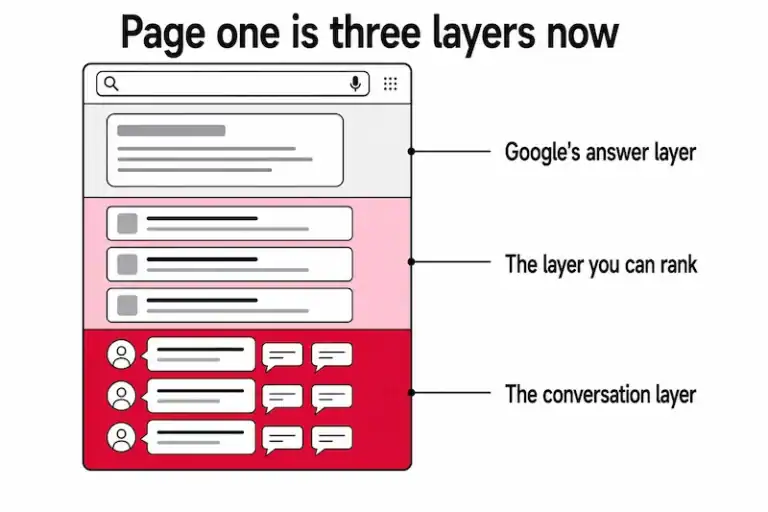
The verdict, in plain words: Malaysian page one now has three layers — the slots you can rank, the features Google keeps, and a conversation layer that decides trust — and the third one is occupied by strangers because most Malaysian businesses never showed up. The era when SEO ended at your own website is measurably over: on the queries that close sales, the page is part owned-content, part community, and the winners operate in both. This is exactly why search and content seeding stopped being separate disciplines — one wins the slots you can own, the other earns presence in the slots you never will.
If you’re a Malaysian business owner — the playbook
- Run the trust audit this week (it takes an hour). Search your brand + “review”, your category’s “best X malaysia”, and your two biggest “X vs Y” matchups. Tag every result: yours/affiliate/stranger. The strangers’ share is your exposure number — and now you know whether you’re a 0% personal-loan page or an 80% unifi-vs-maxis page.
- Win the layer you CAN own, completely. The affiliate-shaped vacuum in Finding 5 is claimable: the honest, current, genuinely comparative guide for your category — real prices, real trade-offs, named competitors treated fairly — is the content Google wants for these queries and almost no Malaysian brand has the nerve to publish. (The winners in our page-one anatomy study were exactly this: real businesses publishing their trade.) Pair it with the ranking fundamentals; the foundation still decides who’s eligible.
- Show up in the conversation layer — openly. The threads deciding your category reward presence, not absence: an owner who answers questions under the company’s name, a brand account that posts genuinely useful fixes in the kakirepair-type groups, fast public responses where complaints rank. Disclosed participation is welcomed on every platform that bans the fake kind — and an owner’s honest answer inside the #1-ranking thread is, functionally, a position-one placement no competitor can outbid.
Here’s what that looks like in practice, using a SERP from our own datasets: a Facebook repair group ranks #3 on “aircond service price” — a money query for every air-con company in the Klang Valley. The covert play is a fake account praising your company there; it gets sniffed out within a week, and the thread about that outranks everything you’ve ever published. The transparent play is the company’s technician answering the actual question — “for a 1.5HP wall unit, chemical wash usually runs RM130–180; here’s what changes the price” — signed with the business name. Useful, checkable, welcome under group rules, and now your name lives inside a top-three result every time that thread surfaces. One genuinely helpful answer per week, in the three groups that rank for your category, is the entire programme. It costs an hour and outperforms most link-building retainers being sold in this country.
- Feed the room instead of fighting it. Communities seed what’s worth seeding: a price list nobody else publishes, a calculator, a teardown, this study’s class of data content. The marketing job shifts from “rank our page” to “give the conversation something true to pass around” — that’s what content seeding means when it’s done in daylight, and it’s the half of search work most Malaysian retainers still don’t include.
- Monitor the layer like you monitor rankings. A rank tracker that doesn’t show the Reddit thread at #1 on your brand-review query is hiding the war. The concrete version is a five-column table in your monthly report — query / who holds positions 1–3 / sentiment (positive, neutral, hostile) / what changed since last month/action taken — across your brand-review query, your top “best X malaysia,” and your two versus-matchups. Five rows, fifteen minutes a month. When a hostile thread enters the top three, you find out in week one, while a useful reply still shapes the room — not in month six, from a confused sales report. You cannot manage a page you’ve never looked at.
If you’re an SEO or marketing specialist
The audit in step 1 is your new client-intake page one. Report the conversation layer alongside rankings; price participation and seeding as deliverables, not favours; and when a client’s trust SERP is hostile, the honest counsel is operational (fix the complaint pattern, then show up) — never cosmetic. The agencies that survive this shift are the ones selling the whole page through an integrated SEO programme, not isolated deliverables.
The one-sentence version
One slot in seven belongs to strangers — a third of the page on the searches that close sales — so own the layer you can rank, join the layer you can’t, and never let a dashboard that hides the conversation tell you you’re winning.
Run This Yourself
The full dataset (98 fresh classified results plus the four reclassified studies — 1,058 rows in total) and the analysis script are available on request — reach out and we’ll send the pack.
The one-hour version for your own business is the trust audit in the Final Take: brand+review, best-X-malaysia, and your two vs-matchups, top ten each, tagged yours/affiliate/stranger. If the stranger share beats 30%, the conversation layer is already deciding for you.
Limitations (Read These Before Quoting)
- The international comparison is illustrative, not a census — 3 matched SERPs (27 results) against the new MY basket’s 71. The US affiliate-majority pattern is consistent and stark; treat the exact percentages as directional.
- Unified detector vs original classifications: reclassifying the four reused datasets under one rule shifts their UGC shares slightly from the originally published figures (e.g., 17.1% here vs 16.3% in A006’s scheme). Both rules ship in the pack; the deltas are classification noise.
- Single snapshot (11 June 2026), 1,058 results. Discussion-forum visibility is among Google’s most volatile surfaces; shares move with core updates.
- “Trust query” volume is structurally understated — Malaysians embed trust intent in review/comparison phrasings rather than “scam” queries, so the exposure measured here is a floor for the intent, not the intent’s ceiling.
- Named-brand SERPs (Carsome, Unifi, Maxis) are reported as public ranking data, neutrally. Their pages today are not their pages forever; capture dates are stated on all screenshots.
FAQ
Should we reply to negative threads about us?
Publicly, factually, once, under the brand’s name — then fix the pattern causing them. A defensive pile-on ranks too. The measured reality is that the thread will outrank your rebuttal page either way; the only winning move is being usefully present inside it.
Can't we just get the threads taken down?
Rarely, and attempts become their own threads. The platforms’ DR-95 advantage means suppression-by-content is also slow. Presence and product fixes beat removal in every case we’ve watched.
Is this why our rankings look fine, but leads dropped?
Possibly — your tracker watches positions you own and ignores the conversation layer above and around them. Run the trust audit; if strangers hold your decision SERPs, your “page one” was never the whole page one.
Does posting in groups/forums actually do anything for SEO?
Directly, the links are mostly nofollow noise. That’s the wrong frame: the thread itself ranks. Useful, disclosed participation puts your name inside the result that’s already winning — placement, not link-building.
Should we just start our own Facebook group or community?
Only if you genuinely run it as a service, not a billboard — a contractor’s “renovation Q&A Malaysia” group that actually answers strangers can become the room that ranks, and you set its tone. But a dead branded group is worse than absence, and it doesn’t exempt you from the rooms that already rank. Sequence: be useful in the existing rooms first; build your own once you’ve proven you have answers people seek out.
Our category's threads are in BM Facebook groups, not Reddit. Same playbook?
Same playbook, different room — and arguably more urgent: BM commercial SERPs run nearly triple the UGC of English ones, and almost no Malaysian brand is present there in any organised way. The first credible brand in the room sets the tone.
If you want the exposure number without the afternoon: send us your brand name and category, and we’ll run the trust audit for you — every review, comparison and versus SERP that decides your sales, who holds each one, and where the open seats are across both the rankable layer and the conversation. Drop us a line for the integrated search + seeding audit.