Every Malaysian business has had this meeting.
Someone asks whether the website should be in English or Bahasa Melayu. Someone else says, “Our customers all speak English anyway.” A third person mentions that their cousin’s company gets all its leads from Malay Facebook groups. The decision gets made on opinion, budget, or whichever language the boss writes proposals in.
What rarely enters the room: data.
Which is how most Malaysian websites end up built in the language of the meeting instead of the language of the customer.
That’s not entirely the industry’s fault. Search the topic, and you’ll find that virtually everything written about “multilingual SEO” is a European hreflang tutorial — built for a world where French users search in French and German users search in German, in tidy, separate countries.
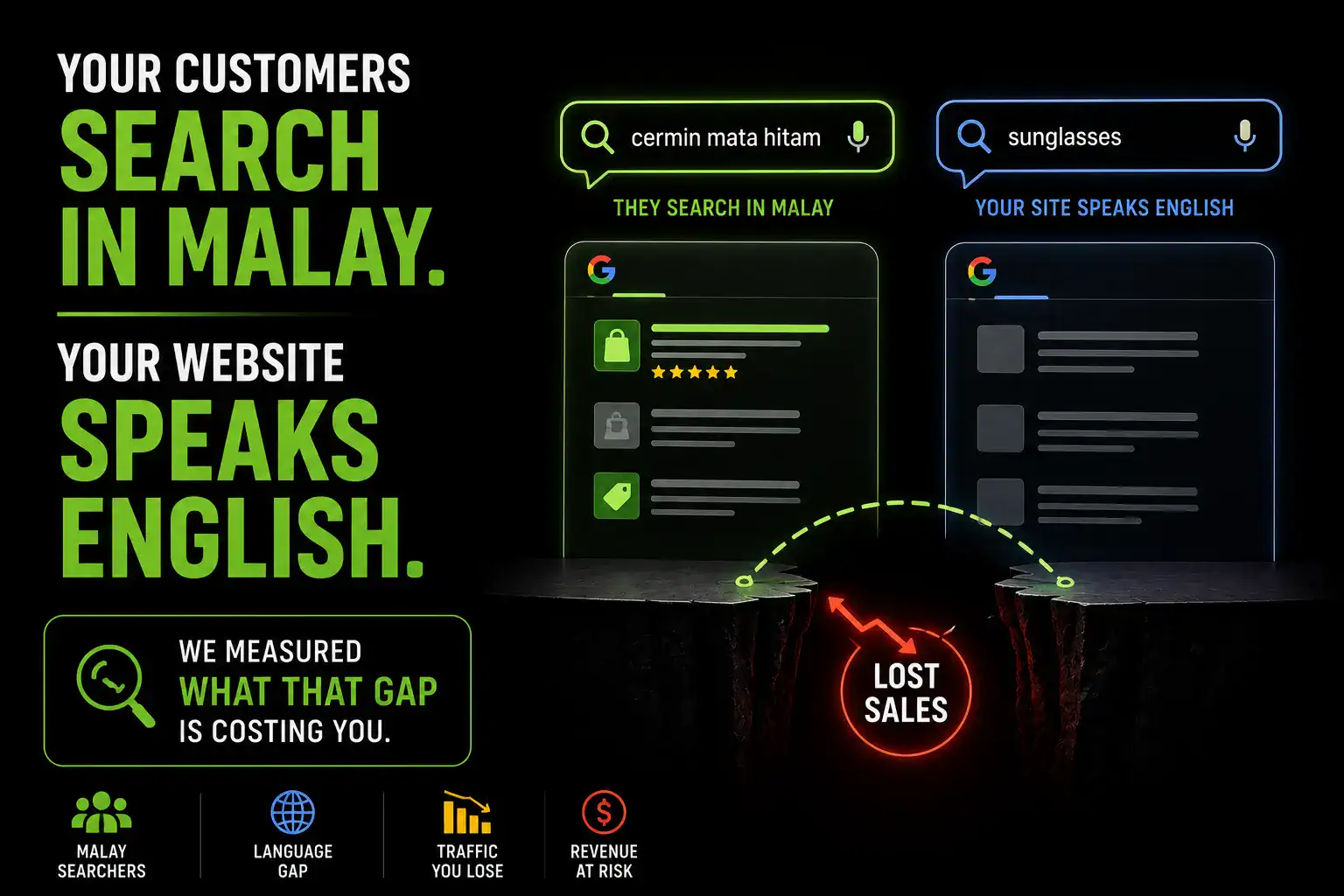
Malaysia doesn’t work like that. We code-switch mid-sentence, absorb English words into Malay (“servis,” “bateri,” “insurans,” “aircond”), and one household searches Google in two or three languages before lunch. No hreflang tutorial covers what happens when one market searches one Google in two languages — and whether those two streams of demand behave like one market or two.
So we pulled the data: matched BM/English keyword pairs across four consumer verticals — finance, automotive, e-commerce/retail, and F&B — with search volumes, ranking difficulty, and full side-by-side SERP comparisons from Google Malaysia.
The short version: they’re two different markets, one of them is dramatically cheaper to win, and most businesses are only competing in the expensive one.
Key Findings (TL;DR)
Demand is genuinely bilingual
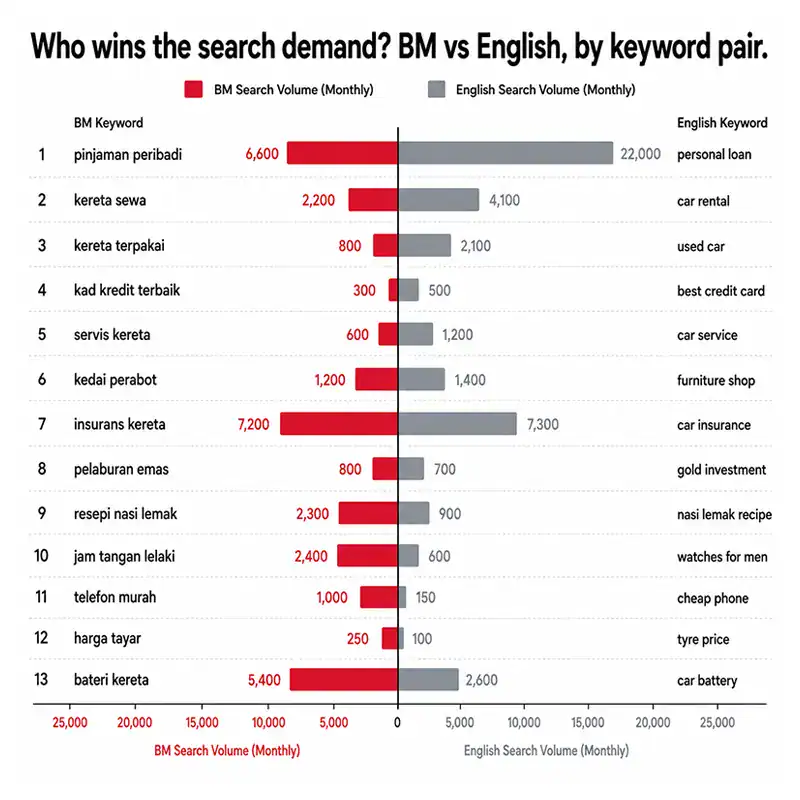
Across 13 matched keyword pairs, English won search volume in 7, Bahasa Melayu in 6 — and the split flips by vertical, not by some national preference.
The two languages barely share a SERP
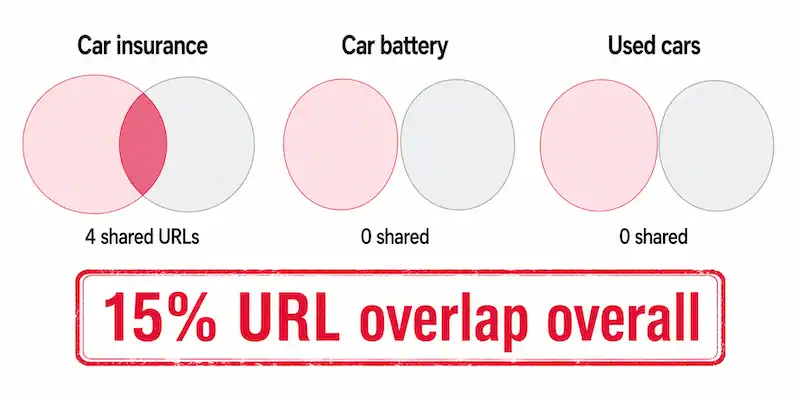
Comparing the top 10 results for BM/English versions of the same query, only 15% of URLs appeared in both — and every single overlap came from one vertical. Outside it, overlap was zero.
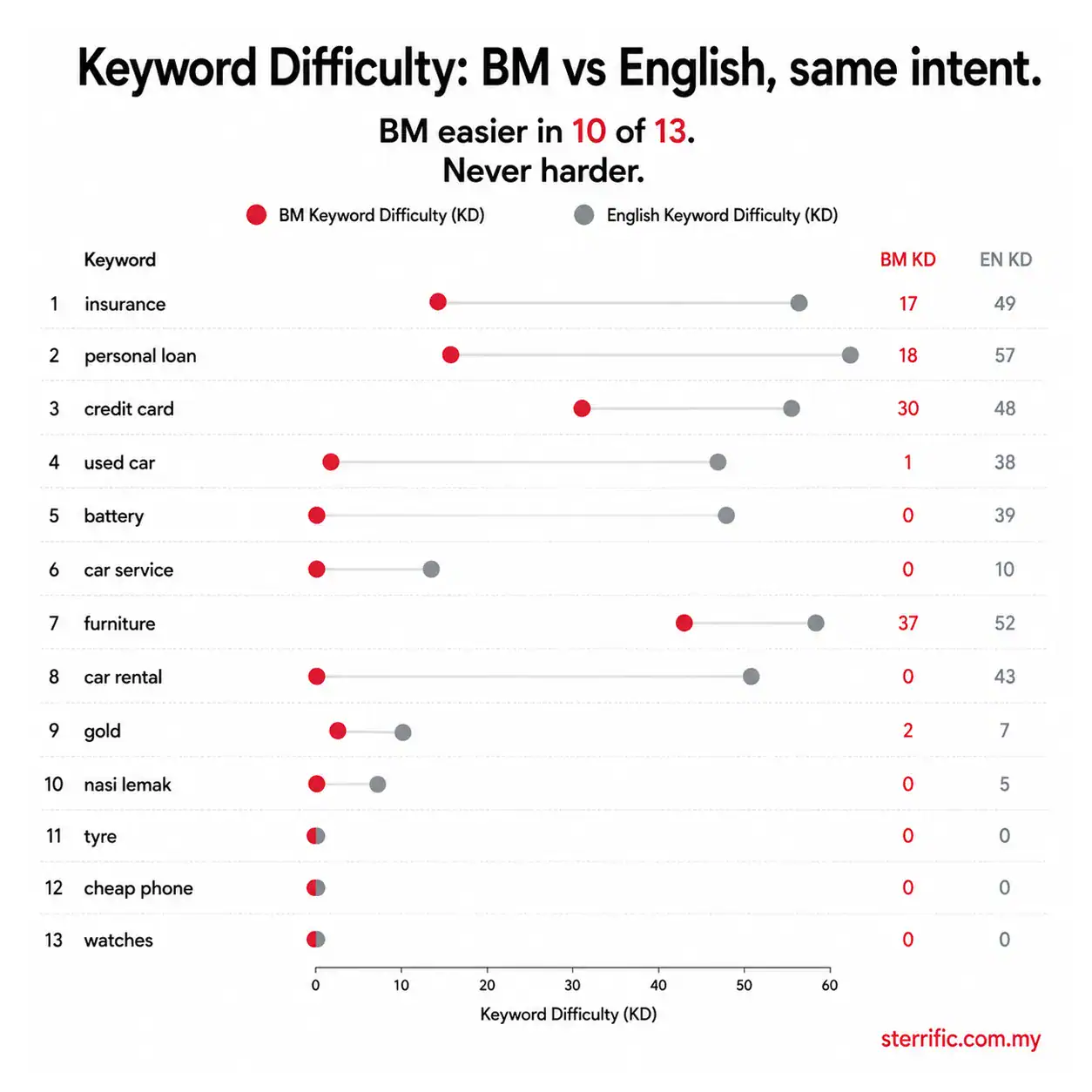
BM keywords were easier to rank for in 10 of 13 pairs
and never harder. Average Keyword Difficulty: 8 for BM vs 27 for English.
The flagship pair
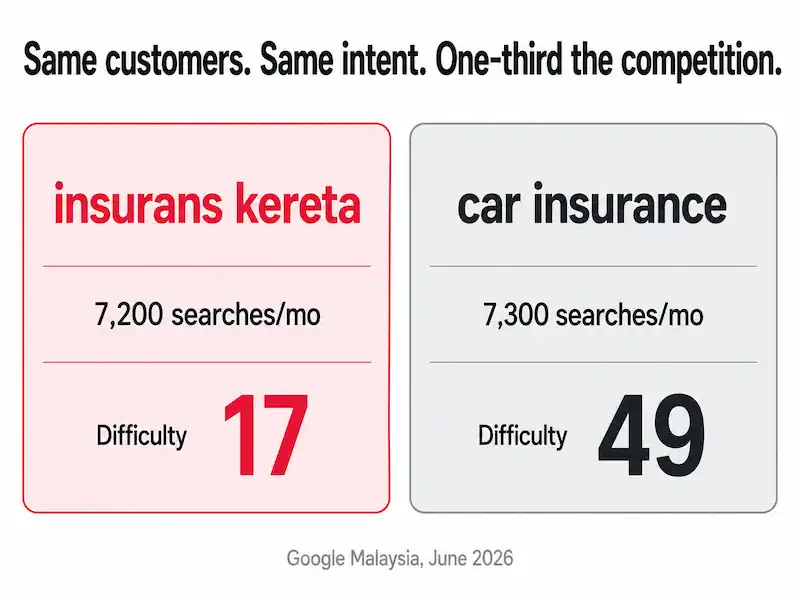
"insurans kereta" and "car insurance" have almost identical search volume (7,200 vs 7,300/month) — but KD 17 vs KD 49. Same customers, same intent, one-third the competition.
Malaysians don't type full "Manglish" sentences into Google
but loanword-Malay queries are huge ("aircond service": 3,700 searches/month), and the dominant code-switch pattern is a BM frame around an English brand ("harga iPhone": 3,300/month).
The brands winning both languages all use the same structure
one domain, two language versions of each page — and Google serves the matching version to each query.
Methodology
- 13 matched keyword pairs
the same commercial intent expressed in BM and in English — across finance (personal loans, car insurance, credit cards, gold investment), automotive (used cars, batteries, servicing, tyres, rentals), e-commerce/retail (phones, furniture, watches, baju kurung), and F&B (recipes, buffets).
- Market
Google Malaysia (country-level data, June 2026)
- SERP comparison
for each snapshot pair, we measured exact-URL overlap and domain-level overlap between the BM top 10 and the English top 10.
- Metrics
Ahrefs search volume, Keyword Difficulty (KD), and CPC for all pairs; full top-10 SERP snapshots for three pairs spanning different verticals (“insurans kereta”/”car insurance,” “bateri kereta”/”car battery,” “kereta terpakai”/”used car”).
A scoping note: this is a study of language targeting within one country — every query was measured against Malaysian search data. It is not an hreflang or international-targeting study, which is precisely the gap it exists to fill.
Finding 1
BM And English Are Two Demand Streams — And The Split Flips By Vertical
The lazy assumptions go both ways.
- "Malaysians search in English" is wrong
- "The mass market searches in Malay" is also wrong
The truth is vertical-specific, and the pattern in our pairs is consistent enough to be useful:
English dominates big-ticket finance head terms
"Personal loan" pulls 22,000 searches a month against "pinjaman peribadi" at 6,600 — a 3.3× gap. "Best credit card" edges out "kad kredit terbaik." The language of banking products, statements, and comparison sites pulls search behaviour with it.
Bahasa Melayu dominates everyday ownership and maintenance
"Bateri kereta" doubles "car battery" (5,400 vs 2,600). "Harga tayar" beats "tyre price" 2.5 to 1. "Telefon murah" outsearches "cheap phone" almost 7 to 1. "Jam tangan lelaki" quadruples "watches for men." When the purchase is routine and personal rather than institutional, Malay wins.
Some verticals split cleanly down the middle
Car insurance is the textbook case: 7,200 BM vs 7,300 English — statistically the same market expressing itself in two languages at once.
And culture-bound queries don't translate at all
"Resepi nasi lemak" (2,300/month) isn't competing with "nasi lemak recipe" (900) — they're different audiences, and nobody searching "resepi ayam masak merah" has an English alternative in mind.
The takeaway for a business owner: you cannot decide your website’s language by asking what language your customers speak. The data shows they search differently by category — sometimes the same person, in the same day.
Your customers never chose one language. Your website did — and it’s been forfeiting the other market ever since.
Finding 2
The Two Languages Barely Share A SERP
Here’s the question that started this study: if you rank for “website design price Malaysia,” does that ranking carry over when someone searches “harga website murah”? Are the BM and English versions of a query *one keyword cluster* in Google’s eyes, or two?
We compared the full top 10 results for both languages across three pairs. The answer:
15% exact-URL overlap. Total. And every single overlapping URL came from one pair.
- "bateri kereta" vs "car battery"
zero shared URLs
- "kereta terpakai" vs "used car"
zero shared URLs
The only overlap in the entire study came from car insurance, where a handful of insurers’ English product pages ranked on both SERPs.
It goes deeper than URLs. For used cars, even the platforms diverge: the BM SERP surfaces Mudah, Motorist, Carro, and Zigwheels; the English SERP surfaces Caricarz, Sime Motors, Carco, Motortrader, and Metacar. Even the Facebook groups are different — a BM “Kereta Terpakai Murah” community ranking on one side, an English “Malaysia Used Car Buy And Sell” group on the other.
Practical translation: ranking in one language buys you almost nothing in the other.
They are two separate battles with separate competitors, separate content, and — as the next finding shows — wildly separate pricing.
Right now, you’re funding one of those battles and forfeiting the other by default.
Finding 3
The Cheapest Customers In Malaysia Are Hiding In BM
This is the finding that should change budgets.
- In 10 of our 13 pairs, the BM keyword was easier to rank for than its English twin. In zero pairs, it was harder. Average Keyword Difficulty across the set: 8 for BM, 27 for English — more than three times the gap.
And the gaps aren’t marginal:
- "Kereta sewa"
KD 0. “Car rental” — KD 43.
- "Kereta terpakai"
KD 1. “Used car” — KD 38.
- "Bateri kereta"
KD 0 with double the search volume of “car battery” at KD 39.
- "Insurans kereta"
KD 17 vs “car insurance” KD 49, at identical volume.
The SERPs explain why. On “bateri kereta” — 5,400 monthly searches of pure commercial intent — the top 10 includes sites with Domain Ratings of 8, 3, 3, and literally 0. Single-location battery shops. A delivery service running on a fresh domain. On the English SERP for the same product, you’re up against marketplaces, national brands, and Wikipedia.
Read that as an arbitrage: the big brands and their agencies compete in English, because that’s the language their head offices and their reports are written in. The mass-market customer demand sits substantially in BM
where a small business with a modest site can take a top-3 position that would cost six figures in link building on the English side.
For SMEs especially, this inverts the usual advice. The conventional move is to fight for the English keyword because it “looks” more professional. The data says the BM keyword is frequently the same customer at a fraction of the acquisition cost.
And the arbitrage isn’t only organic. The same competitive asymmetry shows up in the ad auctions: in our pull, “insurans kereta” clicks are priced at roughly half of “car insurance” clicks (US$0.35 vs US$0.70 CPC) for the same buyer. If you run Google Ads alongside SEO, the language-allocation question applies to that budget too — BM campaigns frequently buy the identical customer at a discount while everyone else bids on the English term.
Before Anyone Misreads This: English Is Not The Wrong Choice
Finding this one-sided invites the wrong conclusion, so let’s close that door. The data does not say to abandon English.
- English won outright volume in 7 of 13 pairs — including the single biggest keyword in the study ("personal loan," 22,000/month).
- English carries the corporate, B2B, and high-ticket finance demand where most of Malaysia's larger contracts are decided.
- English KD is higher *because the customers there are worth fighting for* — competition follows money.
The accurate reading is about sequencing and allocation, not abandonment:
Most Malaysian businesses have
100% of their SEO budget in the language with 3× the competition, and 0% in the language where their customers also search.
The fix isn’t switching languages. It’s stopping the act of leaving one of the two markets entirely uncontested.
What A KD-0 Commercial SERP Actually Looks Like
Numbers like “KD 0 at 5,400 searches” sound too good to be true, so let’s open the hood on the “bateri kereta” SERP — because the texture is the lesson.
Battery retailer - DR 8
5 Jenis Bateri Kereta: Panduan Pilihan Terbaik
Products page - DR 3
Senarai Model Kenderaan & Jenis Bateri Terkini
24/7 delivery service - DR 3
24-hour delivery · location + pricing
Runner Bateri Ganu - DR 0
Local commercial · DR zero
- These aren't loopholes. They're positions a local SME with a realistic budget can compete for.
The ranking pages aren’t thin. They’re useful, specific, natively written BM commercial content — exactly the work most agencies would have priced at RM-nothing because it wasn’t targeting an English head term.
Same shop. Same product. Two completely different games.
- Play this game
bateri kereta
- KD 0
- 5,400 searches/mo
- Local SME competitors
- DR 0–8 SERP
- BM content · page one today
- Not this game
car battery
- KD 39
- Half the search volume
- Marketplaces & national brands
- AI Overview from UK/US above you
- "Looks professional" · ranks nowhere
The language choice was the strategy.
Finding 4
How Malaysians Actually Code-Switch In Search
Here’s where the spoken-language intuition misleads people. Malaysians speak Manglish — fluid, mid-sentence switching. So you’d expect search queries to look like a conversation. They don’t, quite.
20
- "repair phone murah"
A perfectly natural spoken Manglish phrase — but typed search compresses and normalises. The free-flowing rojak of speech mostly doesn’t survive the search bar.
- Pattern one
Loanword Malay — English absorbed into BM queries
The biggest “English” words in Malaysian searches aren’t in English queries — they’re absorbed into BM ones. A foreign content team optimising for “air conditioning service Malaysia” misses the entire market.
- Pattern two
BM frame around an English brand
Price, cheap, shop, and how-to expressed in BM — wrapped around English product names. This is the dominant real-world code-switch in commercial search.
Why you can’t build a BM keyword list by translating your English one
- English keyword
cheap phone
→ translates to “telefon murah” ✓
- BM result
telefon murah
Translation works here
- English keyword
air conditioning service
→ no translation produces this
- What Malaysians search
aircond service
3,700/mo · untranslatable
- English keyword
iPhone price
→ no translation predicts this
- What Malaysians search
harga iPhone
3,300/mo · outsearches most English phone queries
- The wrong approach:
Start with English keywords → run through Google Translate → publish BM version. You’ll miss “aircond service” and “harga iPhone” every time.
- The right approach:
BM keyword research has to start from BM search behaviour — not from Google Translate.
Finding 4
The Winners Run One Domain With Two Language Trees
Across every SERP we pulled, the brands appearing on both sides of the language divide had the same architecture: a single domain with parallel language versions, usually under a /ms/ or /bm/ path.
- carsome.my / carlist.my / etiqa.com.my
One domain. Full domain authority inherited by both trees.
- English tree
/buy-car
Ranks for “used car”, “buy car Malaysia”
- BM tree
/ms/beli-kereta-terpakai
Ranks for “kereta terpakai”, “beli kereta”
- Google reliably language-matches: BM URL to BM query, English URL to English query — same domain.
Why you can’t build a BM keyword list by translating your English one
Three operational rules
One domain, not two
Nobody in these SERPs wins both languages from separate BM and English domains. The language versions inherit the domain's authority — which is exactly why the structure works.
- Do this
carsome.my/buy-car + carsome.my/ms/beli-kereta
- Not this
carsome.my + carsomebm.my — authority split, zero inheritance
Real pages, not toggles
The ranking BM pages are crawlable URLs with their own content — not JavaScript language switchers that swap text on one URL. If the BM version doesn't have its own URL, there's nothing for Google to rank on the BM SERP.
- Do this
carsome.my/ms/beli-kereta — its own crawlable URL, indexable
- Not this
carsome.my?lang=bm — JS toggle, one URL, Google ranks nothing
Written, not machine-translated
Look at what's winning on the BM side. These are natively written commercial pages — and given Finding 4, a machine-translated page is optimised for queries nobody types.
- What's winning
“Panduan Pilihan Terbaik” · “Pandu Uji Hari Ini” · jenis, senarai, tips beli — native BM commercial content
- What loses
Google Translate output — optimised for queries nobody types, per Finding 4
Bonus Finding
BM Is Also A Moat Against The Whole Internet
One more pattern surfaced that we weren’t looking for — and it connects to where search is heading.
- Google AI Overview citations — same product, two languages
- "car battery" (English)
- UK battery retailer
- NZ tyre shop
- US Mazda dealership
- US insurance company
- Thai parts supplier
- 0 of 5 citations from Malaysia
- "bateri kereta" (BM)
- Malaysian retailer
- Malaysian review site
- Malaysian delivery service
- Malaysian workshop
- Malaysian auto portal
- All citations from Malaysia
The competition pool contrast
- Your English page competes with
The entire English-speaking internet — UK, US, Australia, New Zealand, South Africa, Canada. AI retrieval doesn’t care where a well-structured paragraph lives.
- Your BM page competes with
Malaysia. Whoever bothered to show up — which, for most industries, is a very short list.
The moat card
- Why the linguistic moat strengthens as AI Overviews expand
As AI Overviews expand in Malaysian SERPs, that linguistic moat is likely to become one of the most underpriced assets in local SEO. — the finding most agencies haven't built a product around yet
Not a slogan. Data-backed.
Which Language Should Your Website Target?
The honest answer the data supports is a decision framework, not a slogan. Find your business type below.
four audience decision cards
If you sell Mass-market consumer products & services
BM-first · English second
The BM keyword set is frequently larger, dramatically cheaper to win, or both. Most businesses in these verticals have the language priority backwards.
BM-first, with English as the second layer, is the data-backed default for these verticals.
If you sell Corporate, B2B, or big-ticket financial products
English-first
English head terms carry the volume and your buyers’ research happens in English. But check the BM twin before dismissing it entirely.
“pinjaman peribadi” — 6,600 searches/mo, KD 18. That’s not a segment. That’s a market.
If you sell Products where the vertical splits evenly
Bilingual — not optional
Insurance is the proven case. Half your customers are searching in a language your site may not have a single page in. Monolingual is a choice to ignore half your market.
Half your customers are searching in a language your site may not have a single page in.
If you are A smaller player facing big-brand SERPs
BM side is your opening — now
DR-0 websites are holding top-3 positions on five-figure-volume commercial keywords today, in 2026. That window exists because your larger competitors’ strategies are written in English.
It will not stay open forever.
architecture summary (applies to all four)
- One domain. Language versions inherit the domain's authority. Two separate domains split it.
- Dedicated URLs per language. /ms/ or /bm/ paths — crawlable, indexable. Not JavaScript toggles on a single URL.
- Natively written BM content. Researched from BM search behaviour. Not translated from your English pages.
Most businesses in these verticals have it backwards. The data-backed default is BM-first — and the window for smaller players is open right now, in 2026.
The Final Take
BM isn’t the smaller market. It’s the cheaper one.
The myth this study refutes — and what the measured data actually shows.
myth vs. reality banner
- Measured reality
BM keywords equal or beat English twins on volume, rank dramatically easier, and live on almost entirely separate SERPs.
- The myth
“Serious Malaysian search happens in English.”
three headline numbers from the study
- 10/13
BM pairs ranked easier — never harder than English
- 15%
URL overlap between EN and BM SERPs — near-parallel markets
- DR0
Sites holding top-3 commercial positions on 5-figure keywords today
Two parallel markets. One priced like nobody’s looking. Because nobody is.
dual audience action blocks
If you're a
Business owner
- Ask your agency this question
“Where are the BM keywords in our plan?”
Check if the answer is a translation.
Native-researched BM commercial pages on your existing domain.
Run ads on the same BM terms.
- BM terms carry the cheapest clicks in your category — the paid win arrives even faster than the organic one.
If you're a
SEO or content specialist
- The standard to hold yourself to
Dual-language keyword research as the default deliverable — not an add-on.
Make dual-language KW research the default.
Brief BM content against exact native search strings.
top letting "low KD" tools talk clients out of real walkovers.
Replicate the methodology.
- The 13-pair methodology takes an afternoon to replicate on any client's category — and produces a BM opportunity brief that no competitor has built.
-
BM isn't the smaller market. It's the cheaper one.
And right now, in 2026, it's also the emptier one.
The window is open. The data shows who’s already walking through it.
FAQ
Do BM and English keywords cluster as one topic in Google Malaysia?
Effectively no. Across our matched pairs, only 15% of top-10 URLs appeared on both SERPs — all from a single vertical. Outside that, the overlap was zero. Treat each language as a separate keyword set with separate competitors.
Is there really enough search volume in Bahasa Melayu to matter?
In our pairs, BM won outright volume in 6 of 13 — including doubling English for car batteries — and held near-parity in others. Combined with difficulty scores averaging a third of the English equivalents, BM frequently offers more demand per ringgit of SEO effort, not less.
Should I just translate my English pages into BM?
No — and the data shows why. Malaysian BM search behaviour includes loanword constructions (“aircond service,” 3,700 searches/month) and BM-framed brand queries (“harga iPhone,” 3,300/month) that no translation of an English page would target. Research BM keywords natively, then write for them.
Do Malaysians search in Manglish?
Not the way they speak it. Free-mixed phrases like “repair phone murah” barely register (20 searches/month). Code-switching in search happens at the word level — English loanwords and brand names embedded in BM query structures — not as full mixed sentences.
One website or two for bilingual targeting?
One domain with parallel language URLs (e.g., /ms/ paths) is what every dual-SERP winner in our data runs. Separate domains split your authority across two sites and appear nowhere in our results.
Does this apply to Mandarin and Tamil keywords too?
The dynamics plausibly rhyme — separate SERPs, lower competition — but this study measured BM/English only. Chinese-language search in Malaysia deserves the same treatment and is on our follow-up list.
Study data: 13 matched BM/English keyword pairs, Google Malaysia, Ahrefs volume/KD/SERP data, June 2026. Full keyword table and SERP snapshots available on request.
If you’d like this analysis run on your own industry’s keywords — your vertical, your competitors, both languages — that’s literally an afternoon of work with the right tools, and it usually changes the content plan.

Sterrific Agency
We’re a digital marketing agency based in Malaysia, specialising in SEO, local SEO, and technical SEO. We work with business owners who want their search visibility built on foundations they can actually trust — and own. If you’ve been through something similar to the story above, we’d genuinely like to hear about it.