For Malaysian business owners who’ve watched a website they’ve never heard of outrank them — and for the marketers who have to explain why.
You sell the service. You do the work. You have the reviews, the portfolio, the actual customers.
And yet when someone in Kuala Lumpur searches for exactly what you do, the first thing they see is a website that has never installed an air-conditioner, never argued a case, never built a single app. It’s a list. A directory. A middleman. And it is sitting in the spot you thought you were competing for.
We wanted to know how often that actually happens in Malaysia — not in the US, not in theory, but in live Malaysian search results. So we pulled 30 high-intent Malaysian searches across three very different industries and classified every single organic result.
The headline is smaller than the panic suggests. The story underneath it is bigger.
Because “directories are taking over search” turns out to be wrong in the way most scary generalisations are wrong: it’s true somewhere, false elsewhere, and the version that matters to you depends entirely on what you sell.
Key Findings (TL;DR)
- Across 30 Malaysian searches, commercial directories and marketplaces took 17.3% of all organic results — roughly one in six first-page slots. Not a takeover. But not nothing.
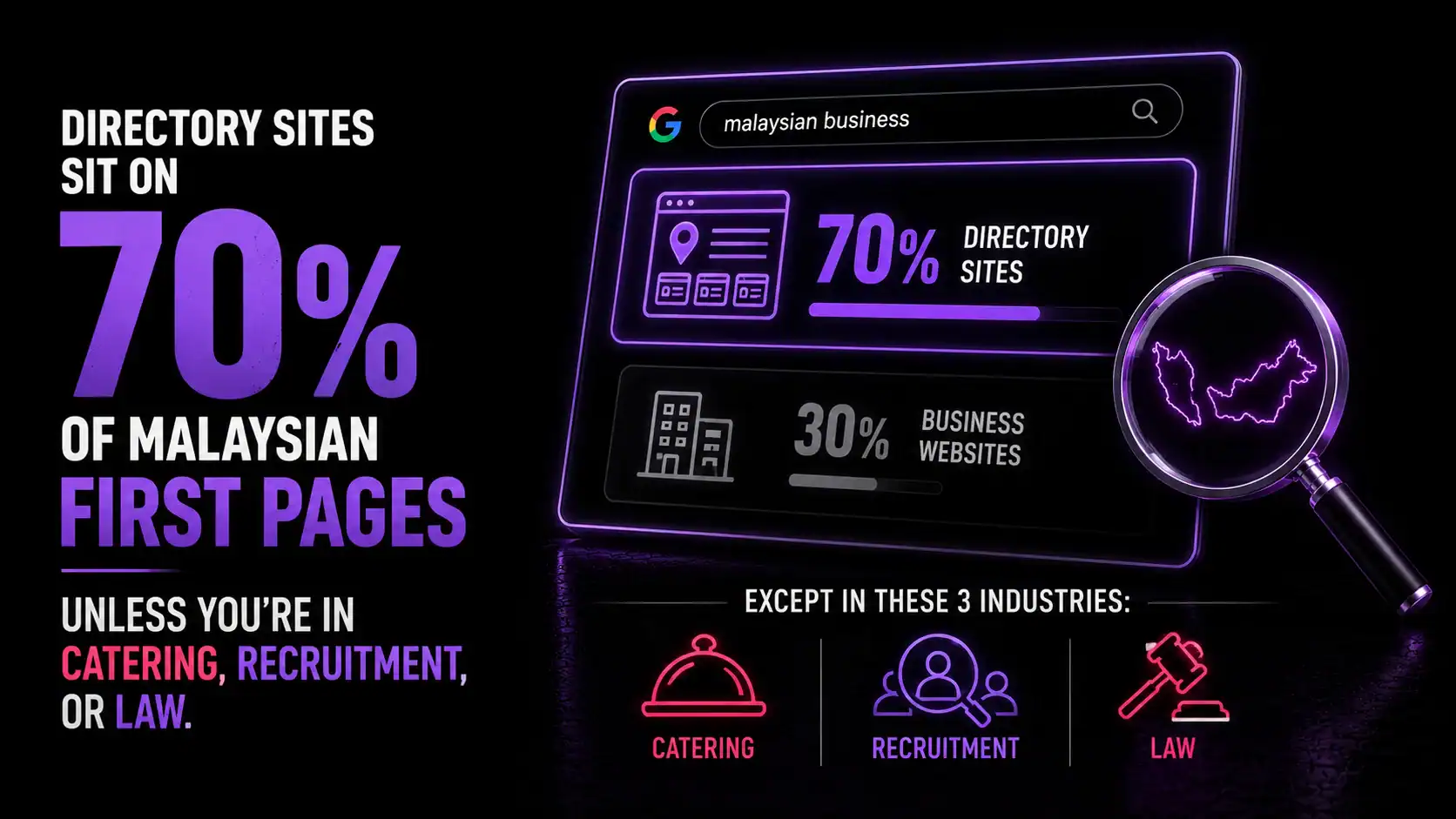
- 70% of the first pages we checked (21 of 30) had at least one directory or marketplace in the organic top 10. Prevalence is high even where volume is modest — they show up almost everywhere; they just don’t dominate.
- Who the middleman is changes completely by industry. Consumer services face foreign directories (Recommend.my, Yelp). Agencies mostly face each other writing “Top 10” listicles. Legal and professional services face government registries and the Bar — not commercial middlemen at all.
- The directories ranking above you have a median Domain Rating of 81. The real businesses ranking have a median of 21. A 60-point authority gap. Forty-nine of the 135 businesses that ranked did so at DR 10 or below.
- 78.6% of the directory results were foreign or regional, not Malaysian. The website intercepting your Malaysian customer mostly isn’t even based here.
- Google’s AI Overview was cleaner than the blue links. Where AI Overviews appeared, only 12.5% of citations went to directories. The AI answer layer is — for now — less directory-captured than the organic SERP beneath it.
Why We Ran This
There is a specific feeling that makes business owners furious, and it goes like this.
You search for your own service. You scroll. And before you find yourself — if you find yourself — you pass a site that exists only to list businesses like you, often with a “get quotes” button that takes your customer and sells the lead. Sometimes back to you. At a markup.
The fury is real. The question is whether the data supports it. So we measured it the only honest way: live Malaysian results, a spread of industries, every result classified, the judgment calls disclosed.
This is not an “SEO is broken” article. Directories are a legitimate part of how people find services, and as you’ll see, joining the right one is sometimes the correct move. This is a map of where the tolls are, how much they cost, and when to pay them versus when to go around.
Methodology
What we pulled. Thirty Malaysian search queries (`google.com.my`, country = Malaysia), captured live in June 2026 via the Ahrefs SERP API. For each query we recorded the organic top 10, plus any AI Overview citations and local-pack entries that appeared as SERP features.
The three classes. We deliberately split the basket into three industry groups, because we suspected — correctly — that they would not behave alike:
- Consumer services (10 queries): aircond service near me, electrician near me, pest control malaysia, plumber kuala lumpur, contractor near me, interior designer malaysia, photographer malaysia, event company malaysia, catering malaysia, movers malaysia.
- Agency / B2B (10 queries): seo agency malaysia, digital marketing agency malaysia, web design company malaysia, advertising agency malaysia, branding agency malaysia, recruitment agency malaysia, app developer malaysia, it company malaysia, software development company malaysia, audit firm malaysia.
- Legal / professional (10 queries): lawyer malaysia, peguam, law firm malaysia, divorce lawyer malaysia, immigration lawyer malaysia, criminal lawyer malaysia, financial advisor malaysia, company secretary malaysia, tax consultant malaysia, real estate agent malaysia.
Every query cleared a real search-volume floor (50+ monthly searches in Malaysia) before we spent a single unit pulling its SERP. These are searches Malaysians actually run.
How we classified each result. Every organic URL was sorted into one of:
- Commercial directory — a for-profit listing or review site whose business model is intermediating between searchers and providers (e.g. Recommend.my, Yelp, Clutch).
- Marketplace — a platform that takes the booking or the freelance transaction directly (e.g. Urban Company, Upwork).
- Actual business — the service provider’s own website. The thing the searcher is trying to hire.
- Competitor listicle — a real company’s own “Top 10 X in Malaysia” blog post. Behaves like a directory, but it’s a competitor doing content marketing, not a middleman. We counted these separately and excluded them from the headline figure (more on this in Limitations — it’s the single biggest judgment call in the study).
- Government / professional body — an official registry or regulator (the Malaysian Bar, Bank Negara, SSM, the property board LPPEH).
- Community — Reddit, Facebook groups, forums.
- Portal / job board / reference — property portals, employment sites, encyclopaedic pages. Labelled, reported, not counted as middlemen.
The headline “intermediary” number counts commercial directories and marketplaces only. That is the strict, defensible definition. We show you what happens to the number under looser definitions in the Limitations section, so you can judge for yourself.

Finding 1: One in Six First-Page Slots — But Seven in Ten First Pages
Across all 243 organic results we classified, commercial directories and marketplaces took 42 of them — 17.3%.
That is the number to keep when someone tells you directories have “taken over” Malaysian search. They haven’t. Actual businesses still hold 55.6% of organic slots. The provider’s own website is still, by a clear margin, the most common thing on the page.
But look at it a second way, and the calm number sharpens.
Of the 30 first pages we examined, 21 — exactly 70% — had at least one commercial directory or marketplace sitting in the organic top 10.
So the directory rarely dominates a page. It almost always attends one. It’s not taking every seat; it’s taking a seat at nearly every table. And because it usually ranks high, the seat it takes is often the one your customer sees first.
You are not losing the whole page to a middleman. You are losing the handshake — the first impression, before the customer ever reaches a real business. It is another layer of strangers between you and your buyer, alongside the social platforms and communities already occupying Malaysian search.

Finding 2: The Middleman Has Three Different Faces
Here is where the average lies, and where the real article begins.
That 17.3% is a blend of three industries that look nothing like each other. Break the basket apart and a clean pattern appears — the kind of pattern that only shows up when you refuse to average across categories that don’t belong together.
Consumer services: foreign directories own the entrance
In home and personal services, commercial directories took 24.4% of organic results — the highest of the three classes. Nine of the ten consumer first pages had a directory in the top 10.
This is the classic middleman story, and it is mostly an imported one. It also extends our wider ownership findings: foreign intermediaries dominate service queries too, with 78.6% of the directory results in this study owned outside Malaysia. On “aircond service near me,” Recommend.my ranks third — above multiple real aircond companies. On “electrician near me,” the AI Overview’s first citation is a Recommend.my blog post, and the organic results stack Yelp, Urban Company, and the UK’s Checkatrade above local sparkies. On “interior designer malaysia,” the Singapore directory Qanvast holds the number-one organic slot outright.
A homeowner searching for a plumber in Kuala Lumpur can scroll past Yelp, Recommend.my, and a UK trades site before reaching a plumber who can actually come to their house.
Agencies: your competitors are the directory
In the agency and B2B class, commercial directories took 18.8% — but that figure undersells how crowded the page feels, and oversells how much of the crowd is directories.
Because the thing clogging the agency SERP isn’t mainly Clutch and Sortlist (though they’re there — Clutch appeared on seven of our 30 searches, the single most pervasive platform in the entire study). It’s other agencies writing “Top 10 SEO Agencies in Malaysia” blog posts. When we counted those competitor listicles, the agency-class intermediary share jumped from 18.8% to 36.5% — nearly double.
Think about what that means. In an agency search, your competitor doesn’t just outrank you with their homepage. They outrank you with an article that lists you — usually at number four, beneath themselves at number one.
In professional services, the most effective way to rank above your rivals is to write the page that ranks them.
Legal and professional: the gatekeeper wears a government badge
In the legal and professional class, commercial directories took just 7.9% of results — less than a third of the consumer rate. By the simple measure, legal search is the cleanest of the three.
But “clean of commercial directories” does not mean “open.” It means the gate is held by someone else. Government and professional bodies took 30.3% of organic results in this class — the Malaysian Bar’s legal directory, Bank Negara’s approved-adviser register, SSM’s registered-secretaries list, the property board LPPEH.
On “lawyer malaysia,” the number-one organic result is the Malaysian Bar’s own directory. On “financial advisor malaysia,” two of the top results are Bank Negara registers. The commercial middlemen — Lawzana, Legal500, Asialaw — are present, but they’re outnumbered by institutions.
In regulated professions, you don’t escape the directory. You just discover the most powerful one was built by your regulator, and being absent from it looks less like a marketing gap and more like a credibility problem.

Finding 3: The Authority Illusion
Now the uncomfortable part — the reason these sites outrank you even when they’re worse for the searcher.
The commercial directories and marketplaces in our data rank with a median Domain Rating of 81. The real businesses ranking alongside them have a median Domain Rating of 21.
That is a sixty-point gap on a hundred-point scale. Clutch, DesignRush, and GoodFirms all sit at DR 91 — within a whisker of the strongest sites on the internet. The plumber, the boutique law firm, the three-person design studio? Forty-nine of the 135 businesses that ranked did so at DR 10 or below.
Here’s what that gap actually represents. A directory’s authority isn’t earned on the Malaysian air conditioning market. It’s accumulated across thousands of categories in dozens of countries — every “best dentist in Manchester,” every “top agency in Toronto” page feeding link equity back to one giant domain. Then that global authority gets pointed at your local query, and the directory ranks not because it serves the Malaysian searcher better, but because it is structurally enormous.
You are not being out-marketed by these sites. You are being out-massed. They are not better at your job; they are bigger than your entire market.
This connects directly to a pattern Sterrific has documented before: high-authority domains can rank on pages they barely address, because authority is a transferable asset and relevance is only one ranking input among many. This is the clearest example of high-authority directories ranking on borrowed mass: the directory is that principle wearing a suit.

Finding 4: It’s Beatable — Two Industries Proved It
If directories won on merit, they would win everywhere. They don’t. And the exceptions are the most useful thing in this study, because they show the gate is not locked — it’s just usually unguarded from your side.
Two verticals in our data had zero commercial directories in the organic top 10.
Catering. Every organic result on “catering malaysia” was either an actual catering company or that company’s own social profile. No Yelp. No aggregator. Real businesses, top to bottom.
Recruitment. On “recruitment agency malaysia,” the page belongs to the actual firms — Randstad, Robert Walters, Hays, Michael Page — with the only “directory” being the government’s official list of licensed employment agencies.
What do these two have in common? In both, the real players invested in their own domains hard enough and early enough that no aggregator could accumulate more authority than the incumbents. The recruitment giants are global brands with global link profiles. The catering winners built genuinely strong individual sites.
The directory doesn’t win the room. It wins the empty room. Where real businesses showed up with real websites, the middleman never got a seat.
That is the entire optimistic thesis of this article, and it is data, not cheerleading: in the verticals where businesses competed properly on their own domains, the directories simply weren’t there.

Finding 5: The AI Answer Layer Is Cleaner — For Now
Across our 30 searches, four triggered a Google AI Overview, yielding 16 cited sources. We classified those too.
Only 12.5% of AI Overview citations went to commercial directories — versus the 17.3% directory share in the organic links below. The AI Overview cited actual businesses more often (37.5%) and leaned heavily on government and professional bodies (31.2%). That matches our earlier finding that the AI answer layer cites differently from the organic rankings beneath it.
It’s a small sample, and we won’t oversell it. But the direction is worth your attention, because it inverts the usual fear. The newest, least-understood part of the search result — the AI answer — is currently the part least colonised by middlemen. Google’s generative layer, at least in these Malaysian queries, is reaching past the aggregators to cite the source and the regulator directly.
The channel everyone’s panicking about is, right now, the one where the middleman has the least grip. That can change. But if you’re deciding where to plant a flag, the AI-citation surface is currently more open to a real business than the organic links are.
This is the cross-channel lesson the rest of this series keeps arriving at: organic search, the AI answer layer, paid placements, and social each have a different gatekeeper, and a serious business plays the board, not a single square.

How to Beat a Directory: The Step-by-Step
Knowing that directories rank doesn’t help you. Knowing why they rank — and the three things they structurally can’t do — does. This is the part that converts a finding into a plan.
Step 1: Diagnose your SERP in five minutes
You can’t pick a strategy until you know which of the three faces you’re fighting. So before anything else, search your single most valuable keyword — the one a ready-to-buy customer types — in an incognito window, set to Malaysia, and label every result on the first page.
Look for three signals:
- A foreign or national directory in the organic results (Recommend.my, Yelp, Clutch, Lawzana). → You’re in the consumer pattern. The fix is local and relevance-based.
- “Top 10 / Best X in Malaysia” articles, hosted on other companies’ sites. → You’re in the agency pattern. The fix is content and profile claiming.
- A government registry or professional body ranking high (the Bar, Bank Negara, SSM, a licensing board). → You’re in the professional pattern. The fix starts with the institution.
Whichever appears most is your face. Most businesses have never done this five-minute audit, which is exactly why they keep losing to a website they could have mapped in an afternoon.
You cannot out-rank what you refuse to look at.
Step 2: Stop trying to win on authority — you can’t, and you don’t need to
Here is the mechanism the panic misses. A directory’s median Domain Rating is 81; yours is more likely around 21. You will not close a 60-point authority gap with more blog posts. That game is lost before it starts.
But authority is only one ranking input, and it’s the one a directory has stockpiled globally. There are three things a giant aggregator structurally cannot do for a Malaysian searcher — and all three are ranking signals you can own:
- Physical proximity. A directory has no premises in Petaling Jaya. The Google local map pack — the three-business box with the map — ranks on proximity and a verified Google Business Profile, and a foreign aggregator cannot occupy it the way a real local business can. That is the practical difference between directories and the map pack: the directory wins on domain authority, while the map pack gives the advantage back to verified local businesses.
- Specific-intent relevance. A directory page is generic by design (“plumbers in Malaysia”). It cannot be the most relevant result for “burst pipe repair Bangsar Sunday” — a long-tail, high-intent query a focused business answers better.
- Verifiable entity trust. A directory cannot earn your registry listing, your Google reviews, your consistent name-address-phone across the web. These entity signals are yours alone, and they increasingly decide both rankings and AI citations.
You don’t beat the directory at being big. You beat it at being here, being specific, and being real — three things it can rent from no one.
Step 3: Execute, in order, by your face
The signals are universal; the sequence changes by industry. Do these in order — the first move is the highest-return one for your face.
Consumer pattern — proximity first.
- Win the map pack. Claim and fully complete your Google Business Profile: correct category, service areas, photos, and a steady flow of genuine reviews. This is your single highest-return surface, and it sits above the organic directory listings on most consumer queries. Measure: map-pack impressions and “calls/directions” actions in your Profile dashboard.
- Build service-area and neighbourhood pages on your own site — one genuinely useful page per area you serve, not thin doorway pages. Measure: long-tail local rankings and organic calls.
- Then, and only then, decide on a directory listing using the join-vs-beat math below.
Agency pattern — content first.
- Publish your own credible “best X in Malaysia” resource. If listicles rank for your money term, the highest-leverage page you can own is an honest, genuinely useful version — yes, one that names competitors. Ranking the category is how you rank above it. Measure: the page’s ranking for the head term and assisted conversions from it.
- Claim and strengthen the buyer-traffic directory profiles — Clutch first in our data, with real reviews and a complete portfolio. For considered B2B purchases, the shortlist often forms there. Measure: referral leads from the profile, tracked to cost.
- Target the intent-rich long tail the head term hides — “shopify agency malaysia,” “b2b lead gen agency kl.” A focused firm wins these outright. Measure: rankings and conversion rate on the specific terms (they convert far better than the head).
Professional pattern — institution first.
- Be impeccably listed in the official registry — the Bar directory, the BNM register, the SSM list, the relevant board. This is table stakes; absence reads to a cautious client as a credibility gap, not a marketing one. Measure: presence and accuracy (binary — you’re complete or you’re not).
- Build matter-specific landing pages, not generic title pages. “Syariah divorce lawyer petaling jaya” is winnable, and its searcher is closer to instructing you than the one typing “lawyer malaysia.” Measure: rankings and enquiry quality on the specific matters.
- Treat commercial legal directories (Lawzana, Legal500) as optional reach — additive once the institution and your own pages are solid, never the foundation.
Step 4: The join-vs-beat math
A directory listing isn’t a moral question; it’s a media-buy decision. Run the numbers:
- Join when the directory ranks for your customers’ searches and its leads convert at a cost-per-lead at or below your other paid channels. In that case, a listing is a rational paid acquisition — track it like one, with a real cost-per-acquisition, and renew only if the math holds.
- Beat (don’t join) when the directory’s leads are expensive, non-exclusive (sold to five of your competitors too), or simply absent in your category. Then every ringgit goes into the surfaces above — the map, your content, your registry presence — which compound instead of renting.
- The common real answer is both, sequenced: buy the listing for immediate leads while you build the owned surfaces that eventually make the listing optional.
The listing is a tap you can turn off; the map pack, the content, and the registry presence are assets you keep. Spend on the tap only while you’re still building the assets.

The Final Take
The verdict: “Directories are taking over Malaysian search” is a myth — but a useful one, because the truth it’s hiding is more actionable than the panic. Directories don’t dominate; they attend. In that sense, directories play the same intermediary role in service search that marketplaces play in product search: they stand between the business and the buyer without providing the underlying service themselves. They sit on 70% of first pages while taking only 17% of the slots, and which directory you face is dictated entirely by your industry: foreign aggregators in consumer services, your own competitors’ listicles in agency work, government registries in the professions. They win on borrowed mass — median DR 81 against your 21 — not on serving the searcher better. And in the two verticals where real businesses showed up with real websites, the middleman didn’t rank at all.
If you’re a business owner:
- Find out which face you’re fighting. Search your own top three money keywords today and classify the first page — directory, competitor listicle, or government body? Your whole strategy forks on that answer.
- Win the surface the directory can’t hold — the local map pack if you’re consumer, the official registry if you’re professional, your own category-defining content if you’re an agency.
- Treat directory listings as a tracked lead-buy, not a reflex. Join the one that converts in your category; measure cost-per-lead; ignore the rest. A listing is a media spend, not a trophy.
- Invest in your own domain like the recruiters and caterers did. The exceptions in this study weren’t lucky — they were present. Authority you own is the only kind no aggregator can rent back to you.
If you’re an SEO or marketing specialist:
- Audit by class, never in aggregate. A blended “directory share” number will hide the exact mechanism hurting your client. Segment the SERP by entity type before you write a single recommendation.
- For consumer clients, prioritise the local pack and a single high-converting directory placement over a doomed assault on a global aggregator’s domain authority.
- For agency and B2B clients, build the category listicle and claim the buyer-traffic profiles (Clutch first). Long-tail intent over contested heads.
- For professional-services clients, lead with registry completeness, then matter-specific landing pages. Flag the commercial directories as optional reach.
- Watch the AI Overview surface — it’s currently the least directory-captured channel in our data, which makes it the most open opportunity for a real business to be cited directly.
Directories don’t take your customer because they’re better than you — they take the handshake because they’re bigger than your market, and the cure is to show up, on your own domain, in the one place their borrowed authority can’t follow.
Run This Yourself
We believe research should be checkable. Here’s how to reproduce this study for your own keywords:
- List 10–30 high-intent searches your customers actually run — the ones with buying intent, not research intent. Validate that each has real local search volume before you spend on SERP data.
- Pull the organic top 10 for each in your real country setting, plus any AI Overview citations and local-pack entries.
- Classify every result by entity type: is it the actual provider, a commercial directory, a marketplace, a competitor’s listicle, a government body, or community content? Be honest and consistent; write your rules down.
- Compute three things: the share of slots taken by directories, the share of pages with at least one directory, and the median Domain Rating of directories versus real businesses.
- Segment by industry class if you span more than one. The aggregate will lie to you — the per-class split is where the strategy lives.
The full dataset and the analysis script behind this article are available on request — reach out and we’ll send the pack so you can audit our classifications and rerun the numbers.
Limitations
We’d rather you trust this study than be impressed by it, so here’s what it does not prove.
- Single snapshot. These are SERPs captured in June 2026. Search results move; a directory ranking third today may not rank next quarter. This is a photograph, not a film.
- Thirty queries, three classes. Ten queries per class are enough to show a clear pattern, but not enough to be the final census of any industry. Treat the per-class percentages as strong directional signals, not decimal-precise constants.
- The biggest judgment call: competitor listicles. We excluded competitor “Top 10” blog posts from the headline intermediary figure because a competitor doing content marketing isn’t a directory in the lead-selling sense. That’s a defensible call, but it’s a call. If you count those listicles as intermediaries too, the overall figure rises from 17.3% to 25.1%, and the agency class specifically jumps from 18.8% to 36.5%. We’ve shown you both numbers on purpose. Pick the definition you find honest; the conclusion — that the agency SERP is the most crowded with non-providers — holds either way.
- Classification by inspection. We sorted sites by their URL, title, and known business model. A small number of borderline cases (a tool vendor’s directory page, a single agency’s list-style page) could be argued either way. None of them moves the headline.
- “Near me” queries personalise. Local-intent results vary by the searcher’s exact location; our captures reflect a Malaysian national setting, not every neighbourhood.
None of these caveats changes the shape of the finding. They bound its precision, which is exactly what a limitations section is for.
FAQ
Are directory sites bad for my business?
Not inherently. A directory that sends you qualified, fairly priced leads in your category is a legitimate acquisition channel. The problem is treating a listing as a strategy, or paying for one that doesn’t convert. Measure it like any other media spend.
Should I pay to be listed on Recommend.my / Clutch / Lawzana?
It depends on whether that specific platform ranks for your customers’ searches and whether its leads convert for you. In our data, Recommend.my ranks heavily in consumer services and Clutch in agency search — so for those categories, a listing can be rational. Track cost-per-lead and decide on numbers, not fear.
Why do these sites outrank me when my service is better?
Because ranking rewards both authority and relevance, directories carry enormous authority accumulated across many countries and categories. They’re not better at your job — they’re structurally larger than your whole market. The fix is to win the surfaces their global authority can’t occupy: the local map, the official registry, your own niche content.
Is this an SEO problem or something else?
It spans channels. Beating directories usually means combining organic work (your own authority and content), local optimisation (the map pack), and sometimes paid placement on the feature surfaces directories can’t lock up. The right mix depends on which of the three industry faces you’re fighting.
Does Google's AI Overview make this worse?
In our data, the opposite — so far. AI Overviews cited directories less than the organic links did, leaning on real businesses and official sources instead. The AI answer layer is currently the least directory-dominated surface, which makes it an opportunity rather than a threat for now.
This study was produced by the research team at Sterrific, a digital marketing agency in Petaling Jaya, Malaysia.
If you’re deciding how to compete with directories, whether to invest in your own content, or whether to prioritise the local map pack, we can review your search landscape and identify the opportunities that matter most to your business. Get in touch to discuss your SEO strategy.