Why Does A Website You’ve Never Heard Of Beat Yours On Google? We Pulled The Receipts
You’ve seen it and it made no sense.
And it’s still winning.
The usual explanations are both wrong and both comforting. One says “links don’t matter anymore” — so you stop trying. The other says “they must have bought their way up” — so you go looking for someone to sell you the same. This study exists because we got tired of watching Malaysian businesses believe one of those two things, and because we kept noticing these little giants across our own research — five separate studies where a DR-0 or DR-2 site beat far stronger competitors, noted each time and never explained.
So we explained it. We took three of these low-authority Malaysian winners — a DR-2 divorce law firm, a DR-23 aircond company, a DR-0 dental clinic, each one outranking bigger, older, better-resourced rivals — and we opened up their backlink profiles link by link. Who actually links to them. What the links say. What’s real and what’s junk.
This article is for the business owner staring at that inexplicable competitor, and for anyone who’s been pitched a “link package” and wondered if it works. The findings are specific, occasionally uncomfortable, and — this is the part most “why low DR wins” articles skip — they convert into a repeatable playbook. Not “make good content and hope.” An actual list of where these sites got the links that mattered, and how you get the same ones.
The one-line spoiler: low DR doesn’t mean few links. It means a different kind of links — and the kind that’s working is not the kind being sold to you.
Key Findings (TL;DR)
"Low DR" does not mean "no links."
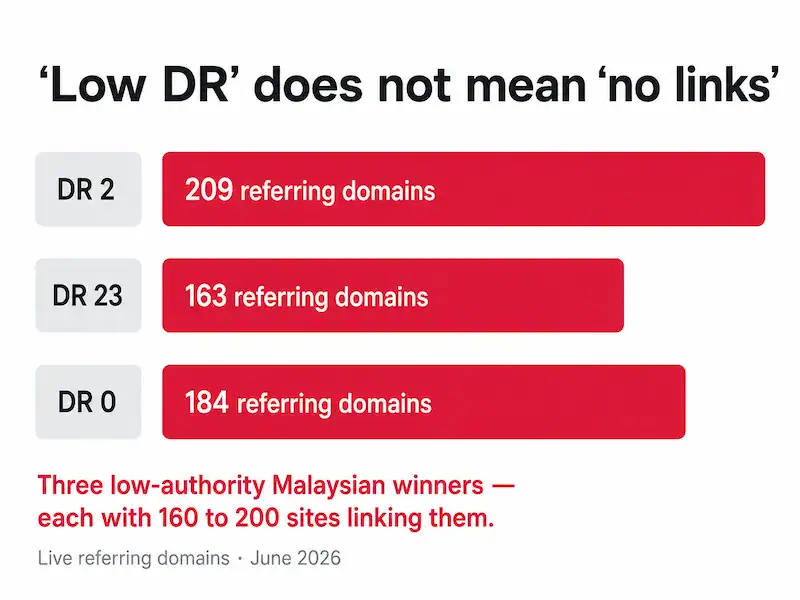
All three low-authority winners hold 163–209 referring domains. The DR-2 law firm has 209. The score is low because of link quality, not link count — and a small business clearing ~180 modest domains still out-resources the one-page competitor with five.
There are three repeatable ways a small Malaysian site wins, and we found one of each:
An earned backbone (the law firm), a local cluster (the aircond company), and relevance over links (the dental clinic).
The DR-2 law firm's real edge is a handful of niche-authoritative links:
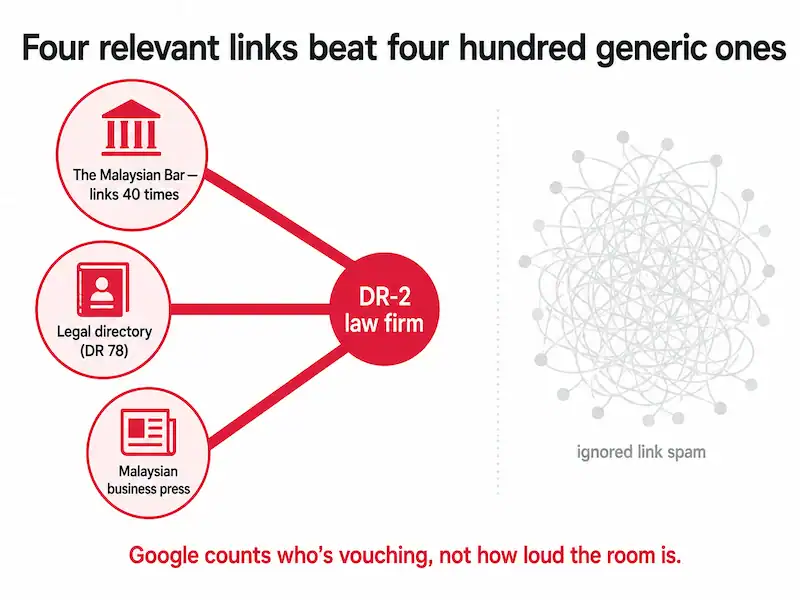
The Malaysian Bar's site (DR 72) links it 40 times, a global legal directory (DR 78) eight times, plus Malaysian business press. Four genuinely relevant links beat four hundred generic ones.
The aircond company ranks on a cluster of other small Malaysian trade sites
Electricians, event suppliers, local services linking each other. No authority giants; just dense, same-market relevance.
The dental clinic ranks almost in spite of its links
Its profile is dominated by automated spam — proving that in low-competition local searches, on-page relevance and intent can carry a site even with a weak link profile.
Every site we examined — including the clean winner — is being hit with automated link spam
(buybacklinks.agency, backlinker.shop, Telegram-link anchors, fake testimonials). It demonstrably isn't what's ranking any of them. The link packages sold to Malaysian SMEs are the one ingredient the data rules out.
Methodology
Three Malaysian websites, each documented in our earlier studies as a low-authority site outranking stronger competitors:
- A divorce law firm
Domain Rating 2
Ranking on page one for “divorce lawyer malaysia” above firms with far bigger sites.
- An aircond service company
Domain Rating 23
Holding top positions for “aircond service” against national players.
- A dental clinic
Domain Rating 0
On page one for “klinik gigi.”
Domain Rating (DR) is Ahrefs’ 0–100 score of a site’s backlink authority, and it’s logarithmic — the gap from 2 to 50 is enormous, which is exactly why these sites “shouldn’t” be winning. For each, we pulled the full backlink picture: total referring domains and links, the highest-authority domains pointing at them, and the anchor text (the clickable words other sites use to link them, which tells Google what a page is about). We classified every signal link as earned, local, or spam.
- We're naming the sites' profiles, not shaming the sites — they're public ranking data and, in two of three cases, examples to learn from. Where we discuss link spam, note carefully: automated spam attaches itself to almost any ranking site without the owner's involvement,
so its presence is not evidence anyone bought it. We’ll show why it doesn’t matter either way. All data pulled live 13 June 2026 via Ahrefs. The dataset and analysis script are available on request — reach out and we’ll send the pack.
Finding 1
“Low DR” Is The Most Misread Number In SEO
Here’s the reveal that reframes everything. The three “low-authority” winners, by the numbers:
| The site | Domain Rating | Referring Domains | Live Backlinks |
|---|---|---|---|
| Divorce law firm | 2 | 209 | 754 |
| Aircond company | 23 | 163 | 336 |
| Dental clinic | 0 | 184 | 235 |
Read that again. A “DR 2” site has 209 different websites linking to it. A “DR 0” site has 184. These are not link-less sites that somehow tricked Google. They have substantial link counts — what they lack is link authority, because DR weights the strength of who links you, and most of their links come from modest or junk sources.
This is the misreading that costs Malaysian businesses real money in both directions. The owner who sees a competitor’s “DR 2” and thinks I can beat that with five links is wrong — the competitor has two hundred. And the owner who sees their own “DR 4” as a death sentence is also wrong — they’re often a dozen relevant links away from competing, because the bar in their actual SERP is lower than the scary logarithmic number suggests.
DR is a measure of a site’s backlink authority on a brutal curve. It is not a measure of how hard a specific page is to outrank, and it is not the number that decides your search fate.
- The sites in this study prove you can win a Malaysian SERP from the bottom of the DR scale — but not from the bottom of the effort scale. They did work. It was just different work than buying authority.
What work? That’s the next three findings — one per winner, because they each won a different way.
- The competitor you can't believe is beating you didn't skip the queue. They stood in a shorter one you didn't know existed.
Finding 2
The Earned Backbone (How The DR-2 Law Firm Actually Wins)
The divorce firm is the most instructive winner, because once you strip away the noise, its real link profile is a masterclass a one-person practice could copy.
Underneath the automated spam that hits every site (we’ll get to it), the DR-2 firm’s genuine, signal-carrying links look like this:
-
Malaysianbar.org.my (DR 72)
— linking 40 times
The Malaysian Bar’s own website, the single most topically relevant domain that could point at a Malaysian law firm, pointing at this one repeatedly.
-
iclg.com (DR 78)
— 8 links
A global legal directory — exactly the kind of industry-specific listing that signals “this is a real law firm” to Google.
- vulcanpost.com (DR 75), jobstreet.com.my (DR 72)
Malaysian business press and the country’s biggest jobs platform. Real, local, contextually sensible.
That’s the backbone. Not four hundred links — a handful of links from places that are unmistakably about law, business, and Malaysia. And the anchor text confirms the mechanism:
the firm’s most common real anchors are its own brand (“Shang & Co.”, its domain name) and one topical phrase
- Stamp Duty Calculator in Malaysia.
That last one is the tell: somebody linked them for a genuinely useful tool, in words that tell Google precisely what they’re expert in.
This is the whole game in miniature. Google’s question isn’t “how many links?” — it’s “do the right people vouch for you, about the right thing?” One link from the Bar Council answers that question more loudly than a thousand links from link farms, because relevance and trust travel together.
- The firm didn't out-link its bigger competitors. It out-relevanced them — and it did so with a link profile small enough that any focused Malaysian business could assemble its equivalent in a few months. Forty links from the Bar Council beat four thousand from nowhere. Google counts who's vouching, not how loud the room is.
Finding 3
The Local Cluster (How The DR-23 Aircond Company Wins)
The air conditioning company won in a completely different way — and it’s the model most local service businesses in Malaysia should study, because none of it requires national press or industry bodies.
Its signal links come from other small Malaysian trade and local sites:
-
wiringrumah.my (DR 28)
— 9 links
An electrical-wiring site. Adjacent trade, same customers, same country.
-
marqueetent.my (DR 26)
— 9 links
- Event-tent rental. Another local service business.
- oksigen.my (DR 25), utopiacoliving.com (DR 24)
More small Malaysian sites in the same broad neighbourhood of local services and property.
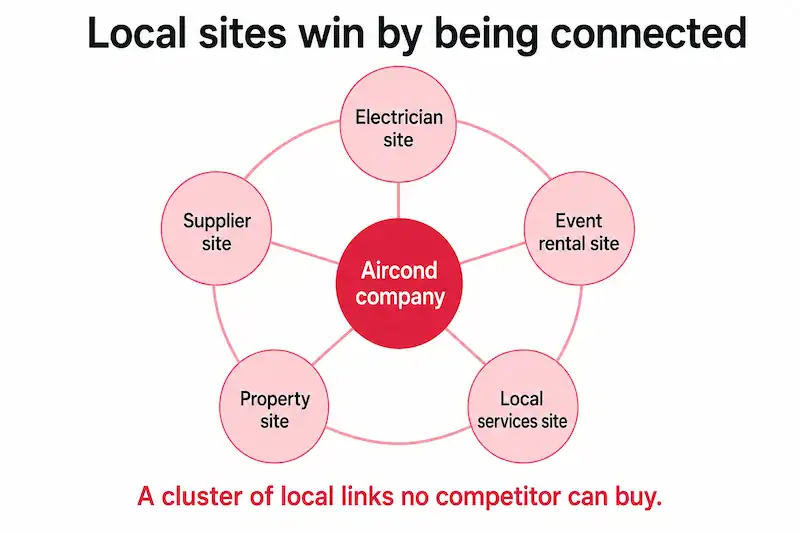
Not one of these is a powerhouse. There’s no Bar Council equivalent here. What there is instead is density of local, same-market relevance — a web of modest Malaysian sites that, taken together, tell Google
- this aircond company is a real, embedded part of the Malaysian local-services ecosystem.
Tradesmen linking tradesmen; local businesses cross-referencing local businesses.
This is profoundly replicable, and almost nobody does it deliberately. Every local service business in Malaysia knows other local service businesses — suppliers, complementary trades, the contractor they sub to, the supplier they buy from, the property manager who recommends them. Each of those relationships is a potential link, and the data says a cluster of them, from genuinely related local sites, is enough to win a local SERP.
- The air conditioning company's "authority" is really just belonging — and belonging is something you can build a link at a time from people you already work with. Big sites win by being famous. Local sites win by being connected — and connection is a thing you can build from your existing contact list.
Finding 4
Relevance Over Links (How The DR-0 Dental Clinic Wins)
The dental clinic is the cautionary specimen, and the most important one for keeping you honest about what this study does and doesn’t claim.
Its backlink profile is, frankly, dominated by automated spam — the recurring link-seller domains we’ll dissect next. There’s no Bar Council here, no clean local cluster. By the logic of Findings 2 and 3, it has no business ranking.
And yet it sits on page one for “klinik gigi.” Why?
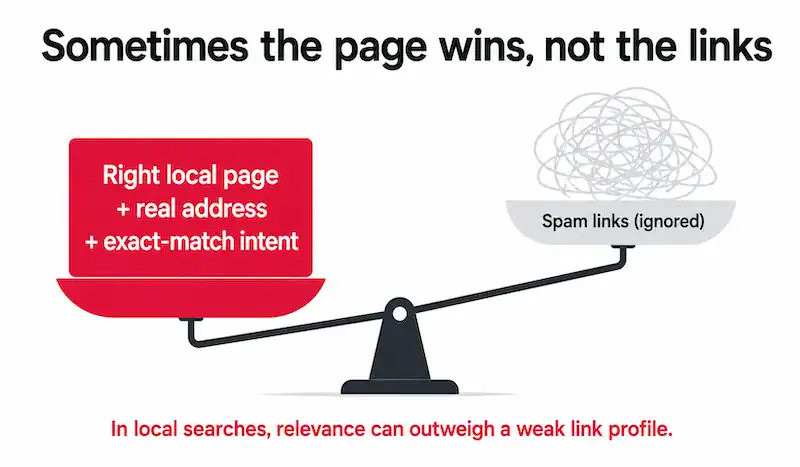
Because in a local, lower-competition SERP, the other ranking factors can carry a page across the line without a strong link profile: a clear, relevant page about exactly the service searched; a real local business with a real address Google can place on a map; the on-page relevance and structure our other studies keep showing matter; and genuine local intent match. “Klinik gigi” near a real clinic is a search Google wants to answer with that clinic — and when the competition is also low-authority, links stop being the deciding vote.
The honest lesson cuts both ways.
- It is not "spam works"
The spam isn’t ranking this clinic; relevance is, and the spam is a liability that could age into a penalty. It is that in the right conditions — local intent, modest competition, a genuinely relevant page — a small business can rank while its link profile is still weak, buying time to build the real thing. The clinic is winning on the foundation (relevance, locality, a fit page), not on its links. For most Malaysian local businesses, that foundation is the cheapest and fastest lever, and it’s the one to pull first.
Sometimes the small site wins not because of its links, but because it answered the exact local question better than anyone bigger bothered to.
Finding 5
The Spam Autopsy — What’s Sold vs What’s Working
Now the uncomfortable part, and the most valuable warning in this study.
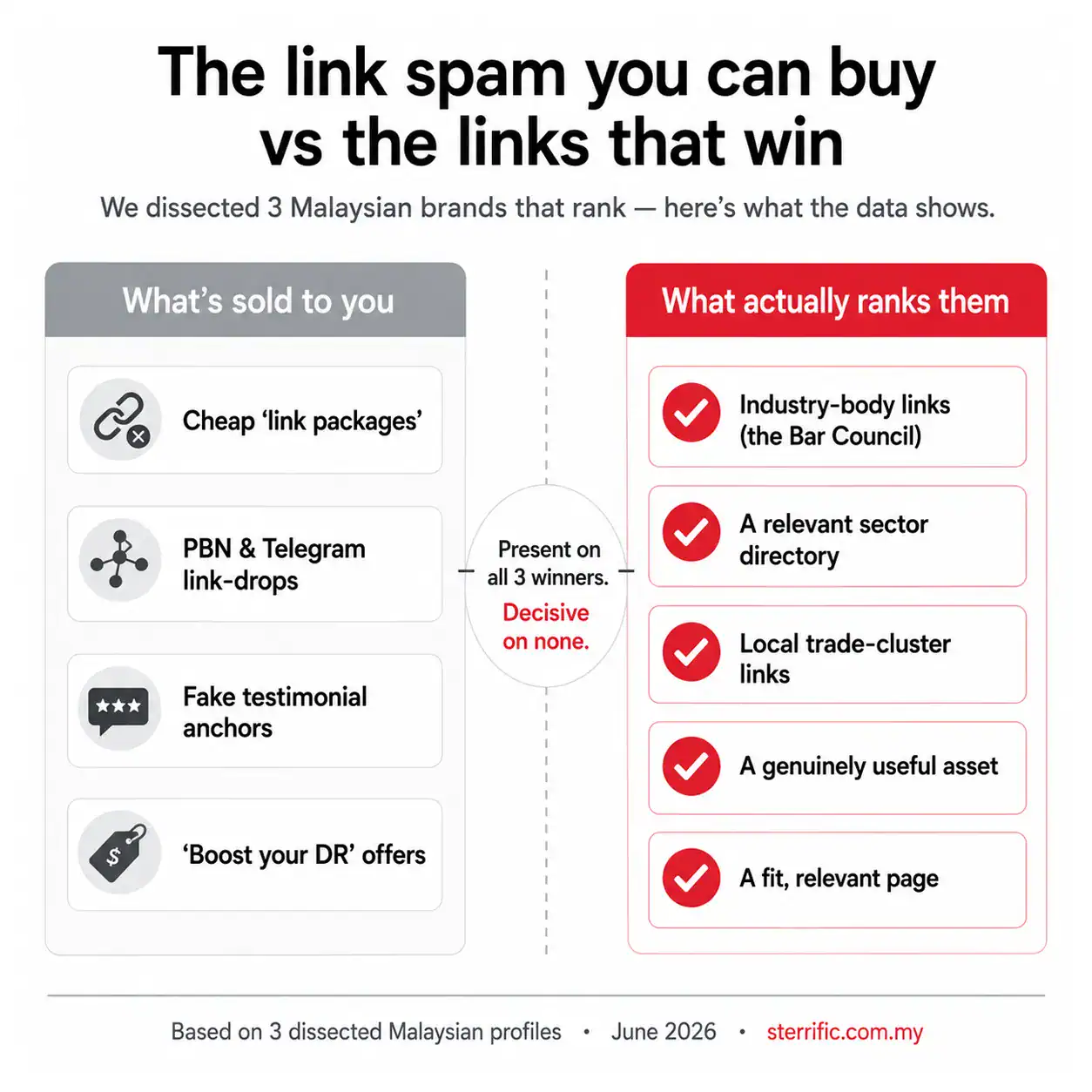
Every single site we examined — including the cleanly-winning law firm — is carrying a load of automated link spam.
The same cast of junk domains appears across all three profiles: rankyour.website, buybacklinks.agency, backlinker.shop, authoritybacklinks.shop, rank-top.click, and nakedly fake anchor texts — Telegram-channel link-drops (“JOIN OUR TELEGRAM darksidelinks”) and an entire fake testimonial (“after engaging with [an SEO service] for just six weeks, my site gained +300% keyword visibility…”) sitting in the anchor data of a law firm.
2 facts about this spam matter enormously

- Its presence is not proof that anyone bought it
Automated link-building tools scrape and spam millions of domains indiscriminately; spam links attach themselves to ranking sites the way barnacles attach to any hull in the water. A site appearing in these junk databases often had nothing to do with it. So this is not an accusation against any business in this study.

-
This is the point,
it isn't working
Look at what the data actually shows: the spam did not rank the dental clinic (relevance did). It is not the backbone of the law firm (the Bar Council and the legal directory are). It’s present everywhere and decisive nowhere. Google has spent fifteen years learning to discount exactly this pattern, and the evidence in front of us is that it has: three ranking sites, the same spam on all of them, and in every case, the real explanation for the ranking is something else entirely.
This is the warning to carry out of the article. The Malaysian SEO market is full of cheap “link packages” and “we’ll boost your DR” offers, and they produce precisely the profile we’re looking at — high link counts, junk domains, fake anchors, a DR number that may even tick up briefly. What they do not produce is the thing that actually ranks these three sites: relevant links, local connection, and a genuinely fit page.
You can buy the spam. You cannot buy the win — and increasingly, the spam is a risk that sits on your profile waiting to become a penalty.
- The link packages sold to Malaysian businesses build the exact profile our data shows doesn't rank anyone. You'd be paying for the barnacles and skipping the boat.
What This Data Does NOT Say
It does not say links don't matter
The opposite: two of three winners are explained by their links — just relevant ones. Links remain a primary ranking force; this study is about which links, not whether links.
It does not say spam "works."
Spam was present on all three and decisive on none. Where a site won, something else won it. Treat the spam as a liability to disavow and avoid, not a tactic.
It does not say DR is useless
DR is a fine comparative signal of authority. The error is reading it as "how hard is this page to beat" or "how many links does this site have" — it answers neither.
It does not say you'll rank without effort
Every winner did real work — earning relevant links, building local connections, or building a genuinely fit page. The point is that this work is achievable by a small business, not that it's unnecessary.
Three sites is an illustrative dissection, not a census
The mechanisms generalise; the exact profiles are specific to these three. Read the limitations.
The Strategy: The Small-Site Link Playbook
A dissection without a method is just gossip about other people’s websites. Here’s the repeatable playbook the three winners hand you — what to build, in what order, and what to refuse.
- Step 1 — Build the foundation first (it's the cheapest lever)
The dental clinic proves relevance can rank a page before its links are strong — so before chasing a single link, make the page genuinely deserve to win: a clear page about exactly the service searched (per our website-structure study, one page per service, not a combined page), a real local presence Google can verify (Google Business Profile, consistent name-address-phone, a real map pin), and content that actually answers the searcher. For many local Malaysian SERPs, this foundation alone gets you competing. It is the fastest, cheapest move, and it makes every link you earn later count for more.
- Step 2 — Earn your "backbone" links (the law-firm model)
You need only a handful — but they must be relevant. The targets, in order of value:
- Your industry's bodies and association
The Bar Council ranked a law firm; your equivalent exists — the trade association, professional body, licensing registry, or chamber for your field. A listing or membership link from it is the highest-relevance link you can get.
- Industry-specific directories
Not generic “submit your site” farms — the directory for your sector (a legal directory, a medical listing, a verified-contractor registry). One relevant directory beats fifty generic ones.
- Local business press and platforms
Malaysian business media, sector roundups, the major local platforms (the law firm got Vulcan Post and JobStreet). A single genuine mention in the local press is both a link and a trust signal.
Five to ten of these, earned over a few months, are a competitive backbone in most Malaysian SERPs. That’s the whole quantity the DR-2 firm needed.
To make this concrete, here’s the backbone hit-list a Malaysian dental clinic would build, mirroring what ranked the law firm:
Malaysian Dental Association
Member directory listing — the Bar-Council equivalent
One verified medical/clinic directory
The sector listing, not a generic submit-your-site farm
Local-press health angle
What to know before braces" explainer pitched to a Malaysian lifestyle outlet
Dental-supply or equipment partners
Whose "where to find our treatments" pages can link stockists
That’s four targets, each genuinely relevant, each achievable with a single well-written email or a membership form — and it’s a stronger backbone than any clinic competitor buying a hundred forum links will ever have. Swap “dental” for your field, and the four slots stay identical: professional body, sector directory, local press angle, relevant partners.
- Step 3 — Build your local cluster (the aircond model)
This is the most under-used tactic in Malaysian local SEO, and you already have the relationships:
- Suppliers and partners
The people you buy from and sub to. A “our trusted partners” link is natural and easy to ask for.
- Complementary local trades
The aircond company linked with electricians and event suppliers; who serves your customers around the thing you do? Cross-referrals become cross-links.
- Local organisations
The chamber of commerce, the business association, the community group, the supplier you sponsor.
Each is one email to someone you already know — and the ask is easier than owners fear, because it’s mutual. The script is three sentences:
We list our trusted partners on our site, and we'd like to add you — here's the link to yours. If it fits, a link back to us on your suppliers/partners page would be great. Happy to do the same for anyone you'd recommend.
That’s a value exchange, not a favour, and complementary local businesses say yes to it routinely because it helps them too. A dozen of these, from genuinely related Malaysian sites, build the “belonging” signal that ranks the aircond company — and no competitor can buy your relationships.
The relevance test (how to tell a real target from a junk one)
Before you pursue any link, run it through one question the whole study reduces to: would this link make sense to a human who knew my business? The Bar Council linking a law firm makes sense; a generic “business directory” in another country linking the same firm does not. Three quick filters separate the two:
- Relevance
Is the linking site about your field, your city, or your customers?
- Data
Is it a site real people actually visit, or a husk that exists only to sell links (no real traffic, no real content, a name like “authoritybacklinks.shop”)?
- Reason
Is there a genuine reason for the link to exist (membership, partnership, a useful resource, a real mention)?
A target that passes all three is worth real effort; one that fails any is the barnacle from Finding 5 wearing a nicer label. This single test, applied honestly, would stop most of the wasted link spend in the Malaysian market.
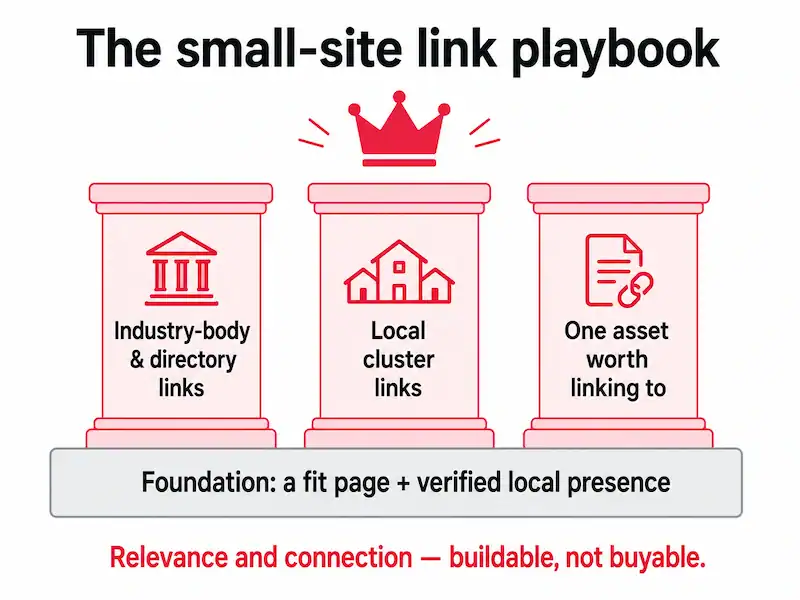
- Step 4 — Build one thing worth linking to (the asset method)
Notice the law firm’s standout topical link was for a “Stamp Duty Calculator.” That’s not an accident of outreach — it’s an asset people link to without being asked, the same pattern our page-one anatomy study found (the calculator that out-earned entire practice-area pages). Build one genuinely useful thing for your field — a calculator, a checklist, a price guide, a template, a local data resource — and it earns relevant links on autopilot, in topical anchors, for years. One good asset does the work of a hundred outreach emails.
- Step 5 — Refuse the thing that doesn't work
The discipline that makes the rest pay off is this: do not buy link packages. Everything Finding 5 documented — the cheap “boost your DR,” the “100 backlinks for RMxxx,” the PBN and Telegram link-drops — builds the profile our data shows ranking nobody, and increasingly carries penalty risk. Every ringgit and hour spent there is taken from the four steps above that actually work. If you’ve already accumulated spam (or it accumulated on you), Google’s disavow tool exists; clean profiles age better than padded ones.
The money the market wants you to spend on links is best spent earning the three kinds that count.
The realistic 90-day version
Month 1: foundation
The fit page(s), the verified local presence.
Month 2: the backbone
Identify and approach your industry body, the one relevant directory, one local-press angle; ship one linkable asset.
Month 3: the cluster
Work your existing supplier, partner, and complementary-trade relationships into a dozen genuine links.
That sequence, not a single ringgit of bought links, is what the three winners in this study actually did — and it’s within reach of a business run by one busy person.
The Final Take: You’re Not Outgunned. You’re Out-Connected — For Now.
The verdict, plainly:
The low-authority site beating you isn't winning on volume, money, or a trick — it's winning on relevance and connection, both of which you can build and neither of which you can buy.
“DR 2” never meant “no links”; it meant a profile assembled from the right modest sources instead of the wrong impressive-sounding ones. The work is real, but it’s the kind of work a small Malaysian business is uniquely well-placed to do — because it runs on relationships and local belonging you already have.
If you’re a business owner
Stop reading competitors' DR as destiny
Pull the actual referring domains (Run-It-Yourself below). You'll usually find the "scary" competitor has modest links you can match — or junk links that aren't helping them.
Fix the foundation before chasing links
The fit page, the verified local presence. It's free, and it's often enough.
Earn five to ten relevant links, not five hundred generic ones
Your industry body, one sector directory, local press. Quality and relevance, every time.
Mine your own relationships
For the local cluster — suppliers, partners, complementary trades. The links no competitor can buy are the ones you already have access to.
Refuse the link packages
They build the profile that ranks nobody and risks a penalty. Spend that budget on an asset worth linking to.
If you’re a specialist or marketer
The opportunity is in saying no to what clients ask for (“boost my DR”) and yes to what works. Audit a prospect’s profile live; show them the junk that isn’t helping and the three relevant links that would; position relevance-building — outreach to industry bodies, local-cluster development, one linkable asset — as the deliverable. It’s harder to sell than “100 links,” and it’s the only version that survives a Google update.
The one-sentence version
The unknown site beating you didn't buy its way up — it earned a handful of relevant links, built a cluster of local connections, and put up a page that actually answered the question, and every one of those moves is available to you, and none of them is for sale.
Run This Yourself
The three dissected profiles and the analysis script are available on request — reach out and we’ll send the pack.
To diagnose the competitor that’s been beating you: put their domain into any backlink tool and look at referring domains (not the DR number). Sort by authority and read the top twenty. Ask three questions —
- Are the good links relevant to their industry?
That’s their backbone, and your target list too.
- Are they local?
That’s a cluster you can match.
- Is most of it junk?
Then they’re winning on something else — check their pages, their local presence, their relevance, and beat them there.
Twenty minutes tells you whether you’re facing a real link advantage or an illusion with a scary number on it.
Limitations (Read These Before Quoting)
Three sites are an illustrative dissection, not a statistical sample.
They were selected as documented low-DR winners to explain the mechanism; the three profiles (earned/cluster/relevance) recur across our work but aren't claimed as fixed proportions.
Backlink data is Ahrefs' index
Comprehensive but not omniscient; some links are missed, some lag, and spam-domain DRs are themselves inflated by the same junk networks. Figures are a 13 June 2026 snapshot.
"Spam wasn't decisive" is an inference from the pattern
Not a controlled experiment — we cannot prove a counterfactual, only show that the spam is constant across winners while the real explanation varies, which is strong but not laboratory evidence.
Relevance and on-page factors are described, not measured here
This study isolates the link profile; the foundation claims lean on our separate structure and anatomy studies.
DR is logarithmic and competitive
It shifts as the whole web's link graph shifts, independent of a site's own changes.
FAQ
So should I just ignore Domain Rating completely?
No — it’s a useful comparative authority signal. Just stop using it for two things it can’t do: telling you how hard a specific page is to outrank, and estimating how many links a site has. Read the referring domains for those.
A competitor has DR 40, and I'm DR 5. Is it hopeless?
Check what their DR is made of first. If it’s built on relevant, earned links, you’ve got real work ahead — start the playbook. If it’s padded with the junk from Finding 5, their “40” is softer than it looks, and a fit page plus a few relevant links can compete in the actual SERP regardless of the headline gap.
Is buying backlinks ever worth it for a small Malaysian business?
The data in this study says the cheap packages build the profile that ranked nobody and carry penalty risk — so no. “Buying” a link in the legitimate sense (sponsoring a real local event for a real mention, paying for a genuine industry-directory listing) is different and fine. The test is relevance and reality, not whether money changed hands.
How many links do I actually need?
Far fewer than the DR scores suggest — the winners here won their SERPs with a backbone of roughly five to ten relevant links plus a local cluster. In lower-competition local searches, even fewer, if the foundation is strong. Relevance compounds; volume doesn’t.
We already paid for a link package. What now?
Don’t panic, and don’t buy more. Audit the profile, consider Google’s disavow tool for the obvious junk, and redirect future budget to the playbook — the foundation, the relevant backbone links, the local cluster, one linkable asset. Clean profiles age better than padded ones, and Google is far more forgiving of “ignored spam” than of ongoing manipulation.
Research and data by the team at Sterrific, a digital marketing agency in Petaling Jaya, Malaysia. The websites analysed are referenced as anonymised, publicly observable ranking examples; nothing here implies any business engaged in or endorsed link manipulation. Charts and figures may be republished with attribution and a link to this study.

Sterrific Agency
We’re a digital marketing agency based in Malaysia, specialising in SEO, local SEO, and technical SEO. We work with business owners who want their search visibility built on foundations they can actually trust — and own. If you’ve been through something similar to the story above, we’d genuinely like to hear about it.