You picked the name. You said it out loud in the car. Your cousin liked it. You even made a logo in Canva at 1am.
And you skipped three of the four checks that decide whether you’re actually allowed to use it.
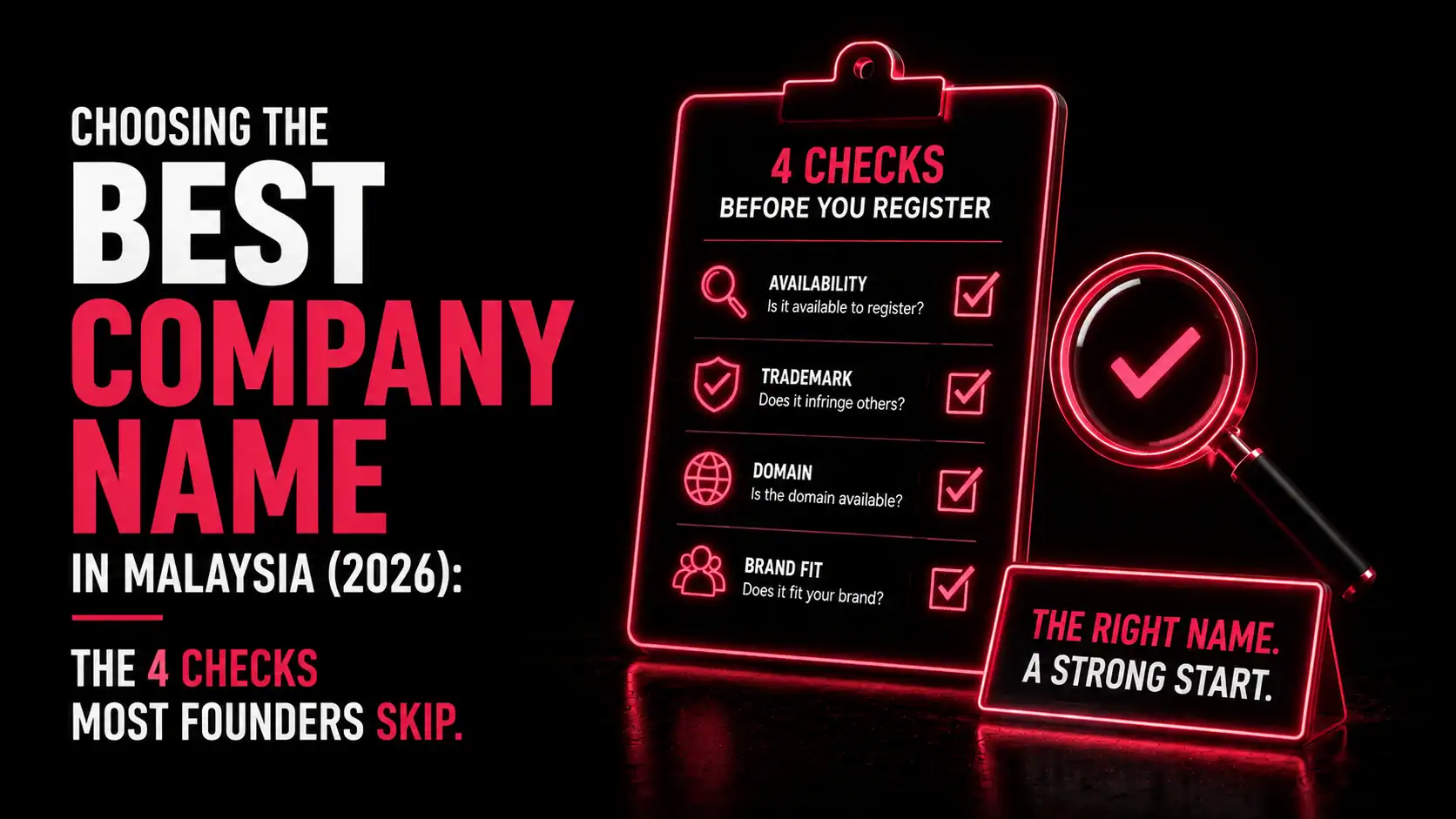
Here’s the thing almost nobody tells new Malaysian founders: a business name in this country has to survive four separate gates, run by four different systems, and passing the first one tells you almost nothing about the other three. SSM can approve your name today, and MyIPO can still hand it to a competitor as a registered trademark tomorrow. The name can be legally yours and still be un-Googleable, un-spellable, and already gone as a <>.com</>.
This guide is the checklist we wish every founder had before they filed. It’s built for people at the exact moment of registering a business in Malaysia — sole prop, enterprise, or Sdn Bhd — who want to pick a name once and never have to change it (rebrands are expensive; more on that later).
We’ll go gate by gate, with the real 2026 fees, the real forms, and the real reasons SSM sends people home. If you register a company for a living, or you’re doing it for the first time this month, this is for you.
Key findings (the TL;DR)
- A Malaysian business name must pass four checks, not one: (1) SSM name approval, (2) MyIPO trademark clearance, (3) domain + social handle availability, (4) findability/brandability. Most founders only run check one.
- SSM approval is not brand ownership. SSM checks its own company register under the Companies Act 2016; it does not check the trademark register. You can be fully SSM-approved and still infringe someone’s registered trademark. [EDITOR — verify + link]
- Reserving a name is cheap; the trademark is where the real money and time live. An SSM name reservation is roughly RM50 per 30 days. A MyIPO trademark is roughly RM950 per class and takes ~12–18 months. [EDITOR — verify + link]
- The <
>.com</By the time a name clears SSM, the matching <> is often the first domino to fall.>.com</> or Instagram handle may be long gone — and that shapes your name more than any government rule. - Names that can’t be spelled or said across BM, English and Chinese quietly cost you customers in a market where your audience searches, types and refers you in three languages.
- Real quote from the trenches (Lowyat): one sole proprietor had a unique two-word trade name rejected by SSM as “too general” while stranger, longer names sat happily in the register. Approval is partly discretionary — plan for a “no.” (forum.lowyat.net/topic/4205516)
One line to tattoo on the inside of your eyelids: your name isn’t yours until all four gates say yes.
Why a company name is four checks, not one
Most people treat naming as a creative problem. You brainstorm, you vibe, you pick. In Malaysia it’s really a clearance problem — four independent yes/no gates, each run by a body that doesn’t talk to the others.
Gate one is SSM (Suruhanjaya Syarikat Malaysia, the Companies Commission of Malaysia). It decides whether you can register the name as a business or company. Its authority comes from the Companies Act 2016 (for companies) and the Registration of Businesses Act 1956 (for enterprises/sole props). [EDITOR — verify + link]
Gate two is MyIPO (the Intellectual Property Corporation of Malaysia). It decides who owns the brand — the exclusive right to use a name or mark for particular goods and services. Its authority comes from the Trademarks Act 2019. [EDITOR — verify + link]
Gate three is the internet — specifically MYNIC (the national <>.my</> registry) and the global domain and social-media namespace. It decides whether customers can find you at a clean web address and a matching handle.
Gate four is the human brain and Google’s index — whether your name is memorable, pronounceable across Malaysia’s main languages, and searchable. No form to fill; the market grades this one for you.
Here’s why the “four gates” framing matters. Each gate has its own definition of “taken.” SSM’s register, MyIPO’s register, the <>.com</> WHOIS, and Google’s results are four different databases. A name can be free in one and occupied in the others. Founders who only check SSM are effectively checking one of four locks and declaring the door open.
Clear the wrong lock and you don’t have a business name — you have a lawsuit waiting for a return address.
The four gates, side by side
It helps to see the whole board before you play it. Here’s what each gate costs, who runs it, and what “pass” actually means:
| Gate | Run by | Governs | Rough cost | Rough time | What a “yes” gets you |
|---|---|---|---|---|---|
| 1. SSM name | SSM | Companies/business register | ~RM30–RM60/yr (enterprise) or ~RM50/name (Sdn Bhd) | 1–3 working days | The right to register the name |
| 2. Trademark | MyIPO | Brand ownership per class | ~RM950/class + ~RM250 search | ~12–18 months | The exclusive right to use the name as a brand |
| 3. Domain/handle | MYNIC + registrars/platforms | Web + social presence | ~RM60–RM80/yr (.com.my) | Minutes | An address customers can find and type |
| 4. Findability | Google + your market | Memory + search | Free | Ongoing | People can actually remember and search you |
[EDITOR — verify all figures + link before publish.]
Read that table and the strategy writes itself: the cheap, fast gates (3 and 4) should filter your list first, and the slow, expensive gate (trademark) should only ever see your finalists. Founders who do it backwards — reserve at SSM, print the cards, then discover the trademark clash — pay for that ordering mistake in rebrand costs.
Let’s walk each gate.
Check 1 — SSM name approval (the gate everyone thinks is the whole game)
This is the gate people mean when they say “I checked if the name is available.” It’s necessary. It’s just not sufficient.
What SSM is actually deciding
Under Section 26 of the Companies Act 2016, a name is available only if it is not undesirable, not unacceptable, not identical to an existing company/corporation/business, not identical to a name already reserved, and not a name the Minister has directed the Registrar to refuse. Section 27 is the mechanism: you apply to the Registrar to confirm availability, and if satisfied, the Registrar confirms and reserves it. [EDITOR — verify + link]
Two words in there do a lot of quiet work: undesirable and identical. The Registrar has discretion to decide both — which is exactly why two founders with equally “clean” names can get different answers.
The route depends on your entity
Sole proprietor / partnership (enterprise) → ezBIZ. SSM’s ezBIZ Online portal (<>ezbiz.ssm.com.my</>) handles new registration, changes, renewal and termination, 24/7. [EDITOR — verify + link] You choose between:
- Personal name — your name exactly as on your NRIC (e.g. “Ali bin Abu”). Fee about RM30/year. No name approval needed, so it’s fast — often approved within 1–2 working days. [EDITOR — verify + link]
- Trade name — a made-up business name (e.g. “Ali Global Catering”). Fee about RM60/year, and it requires prior name approval, so expect a few extra days. [EDITOR — verify + link]
Add roughly RM5/year per branch and RM10 for a Business Information printout. [EDITOR — verify + link]
Sdn Bhd (private limited company) → MyCoID. You file Form 13A (Application for Availability of Name) through the MyCoID portal (<>mycoid2016.ssm.com.my</>) with your proposed name(s) and a short description of the business. [EDITOR — verify + link] Each name submission costs about RM50, so three candidate names is about RM150. Approval typically lands in 1–3 working days. [EDITOR — verify + link]
Reservation: you’re renting the name, not buying it
An SSM-approved name is reserved for 30 days, extendable up to a maximum of 180 days, at roughly RM50 for each 30-day block. [EDITOR — verify + link] During that window nobody else can grab it — but the clock is real. Reserve too early, dawdle on incorporation, and you can watch the reservation lapse.
If you want the deeper mechanics of registering the entity itself, we’ve written the long-form walkthroughs: SSM registration and how to register a company in Malaysia.
Controlled, gazetted and prohibited words
Some words don’t just need approval — they need a third party’s consent. If a proposed name is gazetted, controlled, or requires a certificate of eligibility, you must attach a letter of consent or the certificate from the relevant authority. [EDITOR — verify + link] The usual suspects:
- “Bank”, “insurance”, “finance”-type words — expect regulator involvement.
- “Royal”, “diraja”, crown/state references — restricted.
- “Government”, “national”, “ASEAN”-type words — restricted.
- Religious or racially sensitive terms — flagged.
- Anything implying “Bhd”/“Sdn Bhd” status you don’t have (SSM is strict on enterprise names that dress up as companies). [EDITOR — verify + link]
Refer to SSM’s official Guidelines on Company Names for the controlled-word tables before you submit — matching against that list is the single cheapest way to raise your approval odds. [EDITOR — verify + link]
A practical read on this: a controlled word doesn’t necessarily kill your name, it slows it. If “Bank Digital Xyz” needs a letter from the relevant regulator, that’s not a five-minute request — it’s a separate approval track that can add weeks and paperwork. For most founders, the smarter move is to sidestep controlled words entirely unless the word is genuinely core to what you do. Every controlled word you avoid is one fewer external approval standing between you and a live business.
The other quiet trap is the “looks like an Sdn Bhd” problem for enterprises. SSM is strict about a sole prop or partnership adopting a name that borrows the trappings of a company — using “Sdn”, “Bhd”, “Corporation”, “Holdings” or similar in a way that implies a status you don’t hold. If you’re registering an enterprise but want it to sound like a big company, that instinct works against you at the counter. [EDITOR — verify + link]
Why names get rejected
The greatest hits, per SSM and Malaysian company-secretary practices: [EDITOR — verify + link]
- Too similar to an existing (or former) registered name — likely to confuse the public.
- Prohibited / controlled words without consent.
- Too general or generic — the classic frustration point.
- Misleading as to activity, size or status.
That third one bites hardest, because “too general” is a judgment call. Which brings us to a real Malaysian founder’s experience.
Real voices: “rejected as too general”
On the Lowyat forum, a sole proprietor described submitting a unique two-word trade name — their own coinage, in the spirit of a “Pizza Hut” — only to have it rejected by SSM as too “general.” Over two days of back-and-forth, they say the officer wouldn’t approve it, citing an internal SOP of approving trade names that include a personal name. Their sharpest point: stranger, longer names like “Rice & Pasta Nutrition Depot City Teleshop” were already sitting in the register while theirs got bounced. (forum.lowyat.net/topic/4205516)
Take the lesson, not the outrage: name approval has a discretionary edge, so always file more than one candidate and don’t fall in love before the letter arrives.
Check 2 — Trademark clearance (why an SSM “yes” can still be illegal)
This is the gate that turns a happy launch into a cease-and-desist letter eighteen months later.
SSM ≠ trademark. Two registers, two questions.
SSM answers: “Is this name already taken on the companies/business register?” MyIPO answers a completely different question: “Does someone already own the exclusive right to use this name as a brand for these goods or services?” [EDITOR — verify + link]
Because they’re separate systems, you can incorporate a company with SSM and still be infringing another party’s registered trademark. SSM will not warn you — checking the trademark register isn’t its job. [EDITOR — verify + link]
An SSM certificate proves you exist. A trademark proves the name is yours. They are not the same document, and only one of them wins in court.
What Malaysian case law shows
You don’t have to imagine the risk — Malaysian courts have ruled on it:
- QSR Brands v Ayamas Kitchen. Ayamas Kitchen began trading as “Kedai Ayam Asli” with a logo resembling QSR’s “Kedai Ayamas.” QSR sued for infringement and passing off; in 2017 the Court of Appeal found infringement, ordered damages, and ordered Ayamas Kitchen to stop using the name and logo. [EDITOR — verify + link]
- Malaysia Airlines v AirAsia Com Travel (2023). The High Court found the operator of the “AirAsia SuperApp” liable for displaying marks identical to Malaysia Airlines’ registered trademarks when selling the plaintiffs’ flight services. [EDITOR — verify + link]
Different facts, same moral: registering something with the government is not a defence to using someone else’s brand.
How to clear a trademark before you commit
- Search MyIPO first. Use MyIPO’s trademark search (<
>iponline2u.myipo.gov.my</>) to check existing and pending marks in your class(es). For a professional read, MyIPO also offers a Preliminary Advice and Search (PSA) from about RM250. [EDITOR — verify + link] - Understand classes. Trademarks are registered per Nice class of goods/services. A name can be free in your class and taken in another — and vice versa. You register (and pay) per class.
- Budget the application. MyIPO application fees run about RM950 per class if you use the pre-approved list of goods/services (fee
TMA2A) or about RM1,100 per class if you don’t (TMA2B), plus roughly RM50 per extra mark in a series (TMA2C). [EDITOR — verify + link] - Watch for temporary discounts. MyIPO ran a fee-reduction package from 1 Sept to 31 Dec 2025, cutting the fee by RM300 to RM650 for applicants with annual sales turnover under RM500,000. [EDITOR — verify whether this has ended or been extended; do NOT present as current without checking.]
- Plan for the wait. Malaysian trademark registration typically takes ~12–18 months: examination ~6–12 months, an 8-week opposition window after publication in MyIPO’s journal, then the certificate ~1–3 months after that. A registration lasts 10 years and is renewable. [EDITOR — verify + link]
A worked example: what a trademark actually costs
Numbers in a list feel abstract, so make it concrete. Say you run a small F&B brand and want to protect the name for both your restaurant services (one class) and your packaged sauces (another class). Rough, pre-verification math: [EDITOR — verify + link]
- Preliminary search (PSA) to check both classes: from ~RM250.
- Application, class 1 (using the pre-approved goods/services list): ~RM950.
- Application, class 2 (also pre-approved list): ~RM950.
- Rough total before any professional/agent fees: ~RM2,150, spread over a ~12–18 month registration timeline.
Two things fall out of that. First, class discipline matters — every class is another ~RM950, so register where you actually trade and plan to trade, not everywhere imaginable. Second, this is precisely why you don’t want to run the trademark gate on a shortlist of eight names. You run it on the one or two survivors that already cleared domains, handles and the SSM search. The trademark is the expensive, slow final lock — treat it that way.
Registered vs unregistered: what protection you actually have
Even without a registered trademark, Malaysian common law offers a passing off remedy if you’ve built genuine goodwill in a name — that’s the doctrine behind cases like the “Kedai Ayamas” dispute. But passing off is harder, slower and costlier to prove than infringement of a registered mark, because you have to establish reputation, misrepresentation and damage from scratch. A registered trademark under the Trademarks Act 2019 hands you a far cleaner, stronger position. [EDITOR — verify + link]
Translation for a founder on a budget: you’re not defenceless without a trademark, but you’re fighting uphill. Register the mark once the brand is worth defending, and you swap an uphill battle for a document that does the arguing for you.
The practical sequence that saves grief: search MyIPO before you reserve at SSM, not after. A name that’s clean on both registers is worth a hundred that only cleared one.
Check 3 — Domain and social handle availability
Your name lives online before it lives on a signboard. If customers can’t find a clean address, the legally-perfect name still leaks trust.
The <>.com.my</> / <>.my</> landscape via MYNIC
> / <>.my</> landscape via MYNICMYNIC is the national registry for <>.my</> and its family — <>.com.my</>, <>.biz.my</>, <>.org.my</>, <>.net.my</>, <>.edu.my</> and more. You buy through MYNIC-accredited registrars (Exabytes, Shinjiru, and others). Rough 2026 pricing: [EDITOR — verify + link]
- <
>.com.my</— about RM80/year at the standard rate, but ~RM60/year for a newly SSM-registered business under a MYNIC × SSM initiative.> - <
>.com</— roughly RM45–RM70/year.> - <
>.my</— promo pricing from as low as RM9.90 first year at some registrars.> - All exclude 8% SST, and first-year promos are usually not the renewal price — check what you’ll pay in year two. [EDITOR — verify + link]
<>.com.my</> signals a registered Malaysian business (registrars typically require your SSM document), which can build local trust. <>.com</> is the default customers still type by reflex. Many Malaysian brands buy both and redirect one.
The handle test
Run your shortlisted name through, in one sitting:
- Domains: <
>.com</>, <>.com.my</>, <>.my</>. - Instagram, TikTok, Facebook, LinkedIn handles.
- The “close cousin” check: is there an existing brand one letter or space away that customers will confuse you with?
If the exact match is gone everywhere, that’s a signal — not necessarily a veto, but a cost. A <>.com</> you have to buy from a squatter, or a handle with three underscores, is friction on every business card and every ad forever.
A name your customer can’t type is a name your customer can’t buy from.
The renewal-price trap
One more thing that catches first-timers: the price you see is almost never the price you keep paying. Promotional <>.my</> domains from RM9.90 and cut-price <>.com</> first years look great — until year two, when the domain renews at its standard rate. Before you commit a name to a domain, check the renewal price at your registrar, not the sign-up price, and remember to add 8% SST on top. [EDITOR — verify + link] A domain is a recurring cost for the life of the brand, so budget it like rent, not like a one-off.
If you’re raising money to get started, factor these small recurring costs into the plan early — our guide on startup funding in Malaysia covers where that runway comes from.
Thinking about where you’ll actually sell? Our guides on online business opportunities in Malaysia and e-commerce in Malaysia pair naturally with this step.
Check 4 — Findability and brandability (SEO, memory, and three languages)
This is the gate with no application form — the market grades it. And in Malaysia the market reads, types and refers in Bahasa Malaysia, English and Chinese.
Say it in three languages
Your customer might discover you in English, save your number under a BM spelling, and recommend you to their auntie in Chinese. A great Malaysian name survives all three:
- Pronounceable across BM and English without a coaching session.
- Not accidentally awkward in any of the main languages (a name can be neutral in English and unfortunate in BM or a Chinese dialect — test with real speakers).
- Spellable after hearing it once. If people have to ask “how do you spell that,” you’re losing word-of-mouth.
Findable on Google
- Distinctiveness beats description for search. Ultra-generic names (“Best Digital Marketing”) are hard to rank and hard to trademark — the same generic-ness SSM dislikes also buries you on Google.
- Avoid clashes with a bigger brand’s search footprint. If page one is already someone else’s, you’ll spend years fighting for your own name.
- Short, one clear spelling, no gimmick punctuation. Every extra character is a chance to mistype.
Brandable for the long run
- Room to grow (don’t box yourself in with a hyper-narrow name if you plan to expand beyond one product or one city).
- Clean as a logo and a handle, not just as a legal string.
Five naming approaches (and their Malaysian trade-offs)
There’s no single right type of name, but knowing the family a candidate belongs to tells you its risks up front:
- Descriptive (“KL Halal Catering”). Instantly clear, decent for local SEO in a narrow niche — but weak to trademark (hard to own generic words) and easy for competitors to sit beside. This is also the family SSM most often calls “too general.”
- Suggestive (“Grab” for transport, evoking convenience). Hints at the benefit without spelling it out. Usually the sweet spot: distinctive enough to protect, meaningful enough to remember.
- Coined/invented (“Petronas”, a portmanteau). Maximum distinctiveness and the easiest to trademark and to own the <
>.com</> for — but you carry the full cost of teaching the market what it means. - Founder/personal name (“Ali Global Catering”). Fast to approve at SSM as an enterprise, personal, trustworthy — but harder to sell the business later and awkward if the founder exits.
- Cultural/local (a BM or Chinese word with meaning). Strong local resonance and memorability — just run the three-language check hard, because a word that sings in one language can stumble in another.
Pick the family deliberately, not by accident. A coined name asks more of your marketing budget; a descriptive one asks more of your legal position. Both are fine — as long as you chose the trade-off.
A name is a marketing asset first and a legal formality second — pick one that Google, and a stranger, can find on the first try.
The name-vetting workflow (do it in this order)
Order matters. Cheap, fast checks first; expensive, slow ones last — so you fail early and cheap, not late and expensive.
- Brainstorm 5–8 candidates. More than one, always — SSM’s discretion means you will lose some.
- Kill the obvious losers. Drop anything hard to spell, hard to say in BM/English/Chinese, or generic. (Check 4, first pass — free.)
- Domain + handle sweep. Check <
>.com</>, <>.com.my</>, <>.my</> and the main social handles for your survivors. (Check 3 — free/minutes.) - MyIPO trademark search in your intended class(es). Consider a PSA (~RM250) for the final one or two. (Check 2 — this is the make-or-break search.) [EDITOR — verify + link]
- SSM name search via ezBIZ (enterprise) or Form 13A on MyCoID (Sdn Bhd). File a couple of candidates. (Check 1 — RM30–RM60/yr enterprise, ~RM50/name Sdn Bhd.) [EDITOR — verify + link]
- Reserve the winner at SSM and register the domains + grab the handles the same day. (Reservation ~RM50/30 days.) [EDITOR — verify + link]
- File the trademark once you’re committed, per class. (~RM950/class; ~12–18 months.) [EDITOR — verify + link]
- Lock the brand: logo, site, and the SEO basics so the name is findable from launch.
The one-page checklist
- 5–8 candidate names generated
- Each is spellable + sayable in BM / English / Chinese
- <
>.com</> available (or a clean plan B) - <
>.com.my</> / <>.my</> available - Instagram / TikTok / Facebook / LinkedIn handles free
- No confusing “close cousin” brand
- MyIPO search clear in my class(es)
- Not on SSM’s controlled/prohibited list
- SSM name search passed
- Name reserved at SSM
- Domains registered + handles claimed
- Trademark application filed
Common naming mistakes Malaysian founders make
1. Treating SSM approval as brand protection. The single most expensive mistake. SSM approves; MyIPO owns. Skipping the trademark search is how you build a brand on land you don’t own. [EDITOR — verify + link]
2. Falling in love before the letter arrives. Because SSM has discretion (see the Lowyat “too general” case), betting everything on one name means starting over when it bounces. Always file more than one.
3. Picking a name nobody can spell or find. Clever spellings, silent letters, mixed-language puns — they die on the phone and in the search bar. If your mum can’t spell it after hearing it, neither can your customer.
4. Ignoring the <>.com</ Discovering post-registration that the domain is taken (or squatted at a painful price) forces an ugly choice: awkward domain, or rename after you’ve printed everything.> reality.
5. A name that’s awkward in BM or Chinese. In a trilingual market, a name that only works in English is a name that only works for part of your audience.
6. Generic to the point of invisible. “Too general” gets you rejected at SSM, refused at MyIPO, and buried on Google — a rare triple failure from one root cause.
7. Rebranding later because you rushed. Every one of the above ends the same way: a rename. New signage, new stationery, new domain, lost search equity, confused customers. Twenty minutes of checking beats a rebrand every time.
What a forced rebrand actually costs you
Founders underestimate this because most of the cost is invisible until it lands. A rename triggered by a missed trademark or a taken domain isn’t one bill — it’s a cascade:
- Re-registration and legal: amending the name at SSM, a fresh trademark filing on the new name (another ~RM950/class), possibly settling or defending the original dispute. [EDITOR — verify + link]
- Design and print: new logo, packaging, signage, uniforms, business cards, vehicle decals — everything with the old name on it, thrown away.
- Digital: a new domain, redirects, updating every social handle and directory listing, and rebuilding the site’s branding.
- The silent killer — lost search equity. Any Google ranking, reviews and backlinks tied to the old name largely reset. Months of SEO groundwork evaporate, and your customers Google the old name and find nothing.
None of that appears on the day you skip the MyIPO search. All of it appears eighteen months later, usually right when the business is finally gaining traction. The cheapest rebrand is the one you never have to do — and it costs about twenty minutes of checking today.
Once your name is settled, the next job is getting it in front of people — which is where channels like Facebook marketing in Malaysia come in. But that only pays off if the name underneath it is one you’ll never have to change.
What this does NOT mean
Let’s keep it balanced, because a checklist can tip into paranoia.
- It doesn’t mean you need a trademark before you can trade. Plenty of Malaysian businesses operate for years on SSM registration alone. The point is to search MyIPO so you don’t build on someone else’s mark — and to file once the brand matters enough to protect.
- It doesn’t mean a taken <
>.com</It’s a cost and a signal, not always a veto. Strong brands live happily on <> kills a name.>.com.my</> or a modified domain. - It doesn’t mean generic is always wrong. Descriptive names can work for local SEO in narrow niches — just know you’re trading distinctiveness (and trademark strength) for it, on purpose.
- It doesn’t mean SSM discretion is arbitrary malice. The Registrar is applying broad statutory tests (undesirable/identical) to thousands of names. Filing multiple candidates is simply how you work with that reality. [EDITOR — verify + link]
- None of this is legal advice. Fees, forms and rules change, and edge cases (controlled words, cross-class trademark conflicts) genuinely need a qualified professional. Verify current figures on the official SSM and MyIPO portals before you rely on them.
The goal isn’t fear. It’s picking a name once. Run the four gates in order, keep two or three candidates alive until the last possible moment, and treat the trademark search as the decision point it really is. Do that and you skip the single most common — and most expensive — mistake in Malaysian business naming: discovering, far too late, that the name you loved was never actually yours to use.
FAQ
1. Does SSM approving my name mean it’s protected? No. SSM checks its own company/business register under the Companies Act 2016; it does not check the trademark register. Someone can hold a registered trademark on the same name and you could be infringing it despite full SSM approval. Search MyIPO separately. [EDITOR — verify + link]
2. How much does an SSM name reservation cost and how long does it last? For a Sdn Bhd, roughly RM50 per name submission via Form 13A on MyCoID, reserved for 30 days and extendable to a maximum of 180 days at about RM50 per 30-day block. [EDITOR — verify + link]
3. What’s the difference between a personal name and a trade name for an enterprise? On ezBIZ, a personal name (your NRIC name) costs about RM30/year and needs no name approval (fast, ~1–2 working days). A trade name (a made-up business name) costs about RM60/year and requires prior name approval, so it takes a little longer. [EDITOR — verify + link]
4. How long does SSM take to approve a name? Typically 1–3 working days; a personal-name enterprise can be approved in 1–2 working days since no name check is needed. [EDITOR — verify + link]
5. Why was my name rejected as “too general”? SSM can refuse names that are too generic, misleading, or likely to confuse the public — and there’s genuine officer discretion involved. A real Lowyat account describes exactly this. The fix is to file multiple candidates and add distinctiveness. (forum.lowyat.net/topic/4205516)
6. How much is a trademark in Malaysia and how long does it take? Roughly RM950 per class (pre-approved goods/services list, TMA2A) or RM1,100 per class otherwise (TMA2B), with a preliminary search (PSA) from about RM250. Registration usually takes ~12–18 months and lasts 10 years, renewable. A temporary reduction to RM650 ran Sep–Dec 2025 for small turnovers — check whether it’s still live. [EDITOR — verify + link]
7. Should I get a <>.com</ Ideally both. <> or a <>.com.my</>?>.com.my</> (~RM80/yr, or ~RM60/yr for newly SSM-registered businesses) signals a registered Malaysian business; <>.com</> (~RM45–RM70/yr) is what customers type by default. Prices exclude 8% SST and promo years aren’t renewal prices. [EDITOR — verify + link]
8. Does my name really need to work in BM and Chinese too? In practice, yes. Malaysians discover, save and refer businesses across BM, English and Chinese. A name that’s hard to say or spell in one of them quietly loses you word-of-mouth and local search.
Before you file, lock the brand
A name that clears all four gates is a fantastic start — but a name on a certificate isn’t a business yet. It still needs a brand people recognise, a website people trust, and the SEO groundwork so people actually find it when they search.
That’s the part we live in. Sterrific helps Malaysian founders turn a cleared name into a real presence — branding, web design, and SEO built for how Malaysians actually search and buy. If you’ve done the hard work of choosing well, let’s make the name earn its keep: talk to Sterrific.
Choose once. Choose across all four gates. Then go build.
Related reading: SSM registration · how to register a company in Malaysia · online business opportunities in Malaysia · e-commerce in Malaysia · Facebook marketing in Malaysia · startup funding in Malaysia