Instagram Marketing in Malaysia (2026): What Still Works Now That TikTok Ate the Feed
Instagram Marketing in Malaysia (2026): What Still Works Now That TikTok Ate the Feed
TL;DR
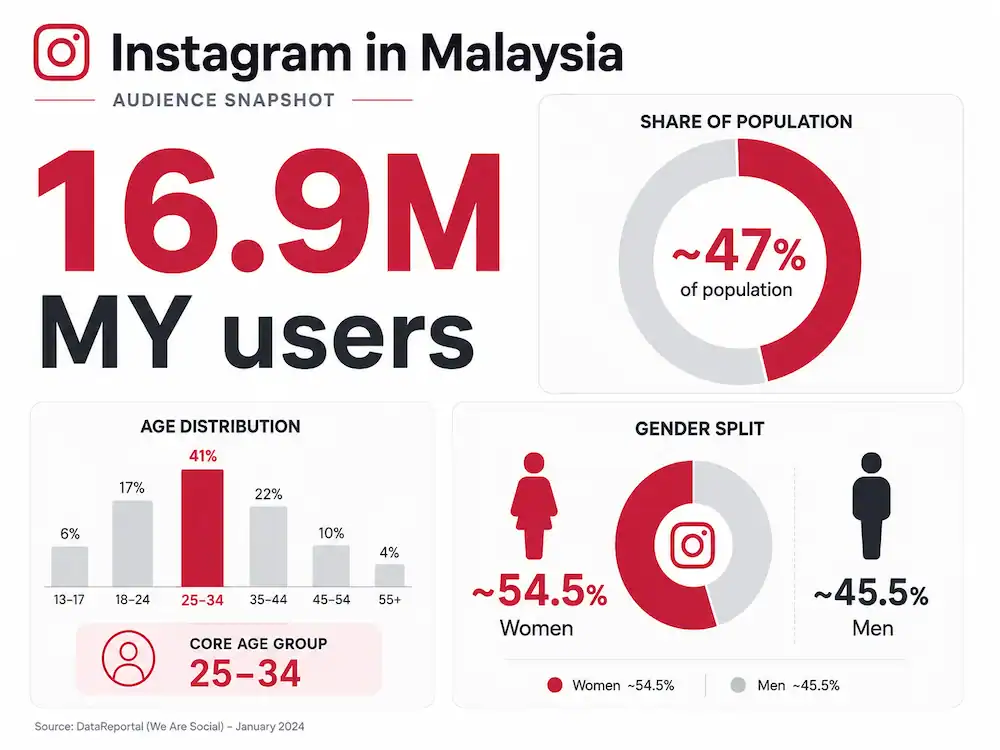
Instagram is still huge in Malaysia — about 16.9 million users, roughly 47% of the population — but its job has changed. TikTok now owns the impulse buy; Instagram owns brand, trust and higher-value sales.
Stop running Instagram like a night-market stall. The 2019 advice (post daily, spam hashtags, hope) is now actively wrong. Reels drive reach, carousels build authority, and most Malaysian sales still close in the DMs.
Match the platform to how people buy. Impulse and demo-able goods lean TikTok; search-and-compare leans Shopee; brand-led, higher-value, considered purchases lean Instagram.
Inside: the real 2026 playbook, honest RM budgets for content, ads and creators, the mistakes that quietly kill accounts, and a 90-day plan you can start tomorrow.
If you read a guide on using Instagram to promote your business written a few years ago — including, honestly, the older version of this very article — most of its advice is now wrong. Back then Instagram was where Malaysians discovered products, and the playbook was simple: post consistently, pile on hashtags, and engagement would follow. Then TikTok arrived, ate the discovery feed, and rewired how Malaysians shop online.
So this is not another “10 ways to use Instagram” listicle. It’s a strategic reset for Malaysian businesses in 2026: what Instagram is genuinely for now, what it’s no longer good at, and exactly how to use it alongside — not against — TikTok, Shopee and WhatsApp. Backed by the numbers, not vibes.
Now the number that reframes everything. In 2024, Malaysians spent RM12.07 billion on TikTok Shop — the sixth-highest in the world, up 104% in a single year. That is where impulse buying migrated. Instagram didn’t lose its audience; it lost the impulse-purchase job to TikTok’s algorithm and live selling. Understanding that one shift is the difference between wasting effort on Instagram and making it pay.
What Instagram is actually for now (vs TikTok and Shopee)
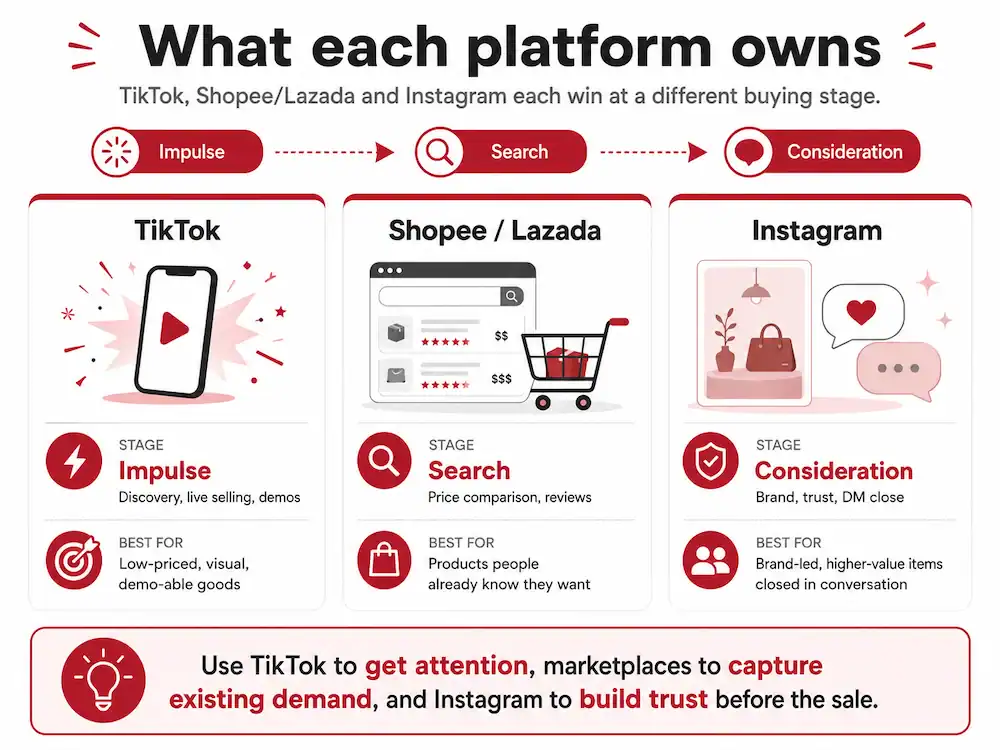
The single most useful question in Malaysian social commerce in 2026 is not “which platform is best?” It’s “how do people buy my product?” The answer tells you where to lead.
Platform
The buying behaviour it owns
Best for
TikTok
Impulse — discovery, live selling, demos
Low-priced, visual, demo-able goods
Shopee / Lazada
Search — price comparison, reviews
Products people already know they want
Instagram
Consideration — brand, trust, DM close
Brand-led, higher-value items closed in conversation
Read the Instagram row carefully, because it’s the whole strategy. Instagram in 2026 is your showroom and your relationship channel. It’s where a Malaysian customer checks whether you’re legit before they spend real money — scrolling your grid, reading your reviews, seeing your work, then sliding into your DMs to ask “berapa harga?” It rewards businesses selling considered purchases: interior design, dental, property, premium F&B, bespoke fashion, coaching, professional services. If that’s you, Instagram isn’t optional — it’s where the sale is won or lost.
Go deeper: for the full cross-platform picture — where to put your ringgit across search, social and ads — see our Social Media Marketing in Malaysia guide.
The analogy that fits. TikTok is the pasar malam stall — high foot traffic, impulse buys, shout the price and move volume. Instagram is your showroom — considered, brand-led, where someone decides to trust you before they commit to a bigger purchase. The mistake most Malaysian businesses make is running their showroom like a night-market stall: blasting “PM for price” posts into a void and wondering why nobody buys. Different room, different job.
The 2026 Instagram playbook for Malaysian businesses
Here is how to actually use Instagram now — the “10 ways,” rebuilt for how the platform and Malaysian buyers behave today.
1. Set up a real business account (and treat the bio as a shopfront)
Switch to a free Business or Creator account for insights and contact buttons, and never mix it with your personal one. Your bio is prime real estate: say clearly what you sell and where (KL? nationwide shipping?), add a call/WhatsApp button, and put one clean link in bio — ideally a link hub or a WhatsApp deep-link, since that’s where Malaysian sales close.
2. Make Reels your reach engine — not hashtags
In 2019, hashtags were how you got discovered. In 2026, Reels are. Instagram pushes short video to non-followers the way TikTok does, so Reels are now your single best shot at reaching new Malaysians. Film simple, useful, native-feeling clips — a before/after, a quick how-to, a behind-the-scenes — and post them consistently. Hashtags still help categorise, but a handful of relevant ones is plenty; the video does the work.
Go deeper: short video is now the centre of gravity for Malaysian attention — the costs and what converts are in our Video Marketing in Malaysia guide.
3. Use carousels to build authority (and earn saves)
Where Reels win reach, carousels win trust. A well-made multi-slide post — a checklist, a price breakdown, a myth-buster — gets saved, and saves are a strong signal to both the algorithm and the buyer. For considered purchases, carousels are how you prove expertise before anyone asks.
4. Use Stories daily for the human, trust-building stuff
Stories are where relationships are maintained: behind-the-scenes, customer messages, polls, quick Q&As, today’s work. They don’t need to be polished — they need to be real. For a Malaysian SME, Stories are the low-effort, high-trust habit that keeps you in mind between purchases.
5. Turn your grid into a catalogue with product tags — but expect to close in DMs
Set up Instagram Shopping and tag products so people can browse prices without asking. But be realistic about Malaysia: many buyers still want to confirm and pay via WhatsApp or bank transfer, not in-app checkout. So make the DM handover seamless — a saved reply with your catalogue, sizes, and a WhatsApp link. The tag starts the interest; the DM closes the sale.
Go deeper: the DM-to-sale handoff is a whole skill — our WhatsApp Marketing in Malaysia playbook covers how to close without being pushy.
6. Work with the right creators — nano and micro, not just mega
Malaysian influencer marketing has matured past chasing celebrity follower counts. Nano- and micro-creators (a few thousand to ~100k engaged followers in a tight niche) often convert far better and cost far less, because their audience actually trusts them. A local food creator with 20k engaged followers in Klang Valley can move more nasi ayam than a national celebrity. Brief them well, let them stay authentic, and prioritise engagement and relevance over reach.
7. Collaborate: Collabs, takeovers, and cross-promotion
Instagram’s Collab feature lets two accounts co-own a post, sharing it to both audiences. Partner with complementary (not competing) Malaysian businesses — a wedding photographer with a bridal boutique, a cafe with a local bakery — and you both borrow each other’s trust. It’s the cheapest audience growth there is.
8. Run Meta ads — but start small and target tightly
Instagram ads run through Meta’s Ads Manager (shared with Facebook). The advantage is precise targeting — location down to a KL suburb, age, interests. You can start from as little as RM20–50 a day, test which creative and audience actually produce enquiries, then scale what works. Boosting a post from the app is the beginner trap; the real control is in Ads Manager.
9. Make social proof impossible to miss
Malaysians check whether you’re legit before they buy. Turn happy-customer messages, reviews and results into Highlights and Story reshares. A “Reviews” or “Hasil” (results) Highlight does more selling than any caption, because it’s other people vouching for you — the most persuasive thing on the platform.
10. Read Instagram Insights — and track the metric that matters
Instagram’s free Insights tell you reach, saves, shares, profile visits and link taps. For a Malaysian business, the metric that actually matters isn’t likes — it’s profile visits and DMs started, because that’s the top of your sales conversation. Track what turns a scroll into a message, and do more of it.
What Instagram marketing actually costs in Malaysia
You can start for free, but here are realistic ringgit ranges once you invest, so you can budget honestly.
What you’re paying for
Typical Malaysian range
Doing it yourself (phone + time)
RM0 + your hours
A freelancer/agency to manage content
~RM800–RM2,500/mo
Meta (Instagram) ads
from ~RM20–50/day to start
A nano/micro-creator post (UGC)
~RM150–RM1,000 per video
The cheapest, most durable version for most SMEs: do the organic work yourself (Reels, Stories, DMs), and put a small, tightly targeted ad budget behind your best-performing content once you know what resonates. Spending on ads before you know your winning content is how budgets vanish.
What Malaysian sellers actually say
The strategic split we’re describing isn’t theory — it’s how experienced Malaysian sellers already talk. The consensus in local seller communities is that the platform should follow the product: TikTok Shop is the easiest start because its algorithm pushes content to new audiences regardless of follower count and wins the impulse buy; Instagram tends to suit sellers who already have a brand or audience and are selling something with enough margin to carry a premium, closed in the DMs. In other words — if your product sells on trust and consideration rather than a spontaneous scroll-and-tap, Instagram is where you lead. If it’s a cheap impulse item, don’t fight TikTok; join it.
The mistakes that quietly kill Malaysian Instagram accounts
Running it like a catalogue. Posting product photo after product photo with “PM for price” and nothing else. No story, no trust, no reason to follow.
Buying followers or engagement. It’s the social-media version of buying backlinks — a vanity number that fools nobody, tanks your real engagement rate, and can get the account restricted. Malaysian buyers can smell a fake following.
Ignoring the DMs. The sale happens in the messages. An unanswered DM for six hours is a lost customer who bought from a competitor who replied in six minutes.
Still leaning on hashtags for reach. That’s a 2019 strategy. Reels are the reach engine now.
Trying to out-TikTok TikTok. Chasing viral impulse content on a platform built for consideration. Play Instagram’s game, not TikTok’s.
Your 90-day Instagram plan
Don’t try to do all ten things at once. Here’s a realistic sequence for a Malaysian SME.
Days 1–30 — Foundation. Switch to a Business account, rewrite the bio with a clear offer and a WhatsApp button, and set up 3–4 Highlights (Reviews, Products/Services, About, FAQ). Set up Instagram Shopping if you sell products. Post 3 times a week — mix one Reel, one carousel, and Stories most days. Reply to every DM within the hour where you can.
Days 31–60 — Find what works. Check Insights weekly. Which Reels drove profile visits? Which carousels got saved? Do more of those. Line up one or two nano-creator collaborations in your niche. Start capturing every happy-customer message for social proof.
Days 61–90 — Amplify. Take your best-performing organic post and put a small, tightly targeted Meta ad behind it (start RM20–50/day). Formalise your DM-to-sale flow with saved replies and a WhatsApp handover. Review what’s actually generating enquiries — not likes — and build the next quarter around it.
What to actually post: content pillars by business type
“Post consistently” is useless advice if you don’t know what. The fix is content pillars — three or four recurring themes you rotate through so you never stare at a blank screen. A reliable ratio is roughly 4:1: four posts that help, teach or entertain for every one that directly sells. Here’s what that looks like for common Malaysian business types.
Business type
Content pillars that work
Cafe / F&B
The dish up close (Reels), behind-the-kitchen (Stories), happy-customer moments, weekly promos, “where to park” and location tips
Services (dental, salon, renovation, clinic)
Before/after (carousel or Reel), “how it works” education, the team and premises for trust, reviews, honest price/FAQ posts
Retail / fashion / beauty
Styling and how-to-use Reels, new arrivals, customer photos (UGC), restock alerts, size and care guides
Property / high-value
Project and unit tours (Reels), neighbourhood guides, financing explainers, client testimonials
Notice the pattern across all four: the selling is the minority of the content. People follow a business for what it gives them — a laugh, a tip, a bit of inspiration — and buy from it because that generosity earned their trust. Lead every week with value, and the sale becomes the easy part.
Consistency without burnout: batch it
You don’t need to create daily. The sustainable way is to batch: block two hours once a week, film four or five Reels and shoot a set of photos in one go, then schedule them out. A single afternoon at your cafe or on a job site can produce a fortnight of content. Consistency beats intensity, and batching is how busy Malaysian owners actually stay consistent.
The 2026 Instagram features worth using
Instagram has quietly added tools that suit Malaysian businesses well — most people just aren’t using them.
Broadcast Channels. A one-to-many messaging channel inside Instagram, a bit like a Telegram channel. Perfect for sending restock alerts, flash promos and “drop” announcements to your most engaged followers without fighting the feed algorithm.
DM tools and saved replies. Since Malaysian sales close in the DMs, speed matters. Set up saved replies for your most common questions (“harga?”, sizes, delivery) and, where it fits, light automation for after-hours FAQs — just keep a human on anything close to a sale.
Trial Reels. Test a Reel with non-followers first to see if it lands before showing it to your audience — a low-risk way to find what reaches new people.
Collabs, Notes and interactive stickers. Cheap, native ways to borrow reach and spark replies. Interaction is the fuel; these are the matches.
A word of caution on automation: it should support the human relationship, never replace it. The businesses that win on Malaysian Instagram are the ones that feel like a real person is on the other end — because someone is.
When Instagram should NOT be your priority
Because we’d rather be useful than flattering: Instagram is not for every business, and pouring effort into it out of FOMO is its own kind of waste. Deprioritise it if:
You sell a pure price-driven commodity. If people buy purely on lowest price with no brand consideration, your energy is better spent on Shopee search and reviews than on building an Instagram brand.
You’re strictly B2B or industrial. Your buyers may live on LinkedIn, in trade networks, or in Google search — not scrolling Reels.
Your customers simply aren’t there. If your market skews older or offline, meet them where they are rather than forcing a channel.
For many of those businesses, the higher-return channel is search — being there the moment a customer types what they want into Google. If that’s you, put the effort into SEO instead, and make sure whoever runs it is building real authority rather than buying spam links.
Instagram is not where Malaysians impulse-buy anymore — that ship sailed to TikTok, and RM12 billion of GMV sailed with it. But 16.9 million Malaysians are still on Instagram, and it has quietly become something arguably more valuable for the right business: the place people go to decide whether to trust you before they spend real money. Treat it as your showroom, not your night-market stall. Lead with Reels for reach, carousels for authority, Stories for trust, and DMs for the close — and stop measuring the wrong things. Do that, and Instagram earns its place in your 2026 marketing, no matter what TikTok is doing next door.
Want Instagram to actually bring in enquiries?
We help Malaysian businesses turn social feeds into a real sales channel — content, ads and the strategy behind them. No fluff, no vanity metrics.
Is Instagram still worth it for businesses in Malaysia in 2026?
Yes — about 16.9 million Malaysians use it, nearly half the population, skewing female and concentrated in the 25–34 working-adult group. But its role has shifted from impulse discovery (now TikTok’s territory) to brand, trust and higher-value sales. It’s especially worth it for considered purchases: services, premium products, and anything sold on reputation.
Instagram or TikTok for my Malaysian business?
Match the platform to how people buy. Cheap, visual, impulse or demo-able products lean TikTok; brand-led, higher-value items closed in conversation lean Instagram; search-driven, price-compared purchases lean Shopee. Many businesses use two — discover on TikTok, build trust and close on Instagram and WhatsApp.
Do hashtags still work on Instagram?
They help categorise a post, but they’re no longer the reach engine they were in 2019. Reels are. A few relevant hashtags are fine; your effort should go into video content that Instagram can push to non-followers.
How much should a Malaysian SME spend on Instagram?
You can start at RM0 doing organic content yourself. If you outsource, content management typically runs RM800–RM2,500/month; Meta ads can start at RM20–50/day; and nano/micro-creator posts run roughly RM150–RM1,000 each. Start organic, then put small ad budgets behind your proven content.
Can I sell directly on Instagram in Malaysia?
You can tag products and let people browse, but many Malaysian buyers still prefer to confirm and pay via WhatsApp or bank transfer. So use product tags to spark interest, and make the handover to DMs and WhatsApp seamless — that’s where most sales actually close.
About this guide. Written by the Sterrific team. User and demographic figures are from NapoleonCat and the DataReportal Digital 2026: Malaysia report (with Meltwater & We Are Social), 2026; TikTok Shop GMV from published 2024 figures. Budget ranges reflect typical Malaysian market rates and should be treated as planning guides, not quotes. Sterrific is a digital marketing agency in Petaling Jaya, Selangor.
Steve Chan is the Director of Sterrific with over a decade of experience in SEO and digital marketing. He leads data-driven digital strategies that help Malaysian businesses improve visibility, generate opportunities and achieve sustainable online growth. His work spans SEO, digital strategy, advertising and web development, with a strong focus on turning digital performance into measurable business results.
Make your brand stand out with Sterrific
Reach out today, request a Free Marketing Plan, and schedule your consultation with our experts.
“Since we started working with Sterrific back in May, their team has been a true strategic partner—helping us drive real impact and outstanding results. Just a few months into the partnership, in September, we hit a major milestone: our biggest online sales month ever. Compared to the year before, we saw an incredible 878% growth, which speaks volumes about how powerful this collaboration has been for us.”