Black Hat SEO In Malaysia (2026): We Audited 8 Google SERPs. Here’s What’s Actually Ranking [Data Study]
Black Hat SEO In Malaysia (2026): We Audited 8 Google SERPs. Here’s What’s Actually Ranking [Data Study]
TL;DR
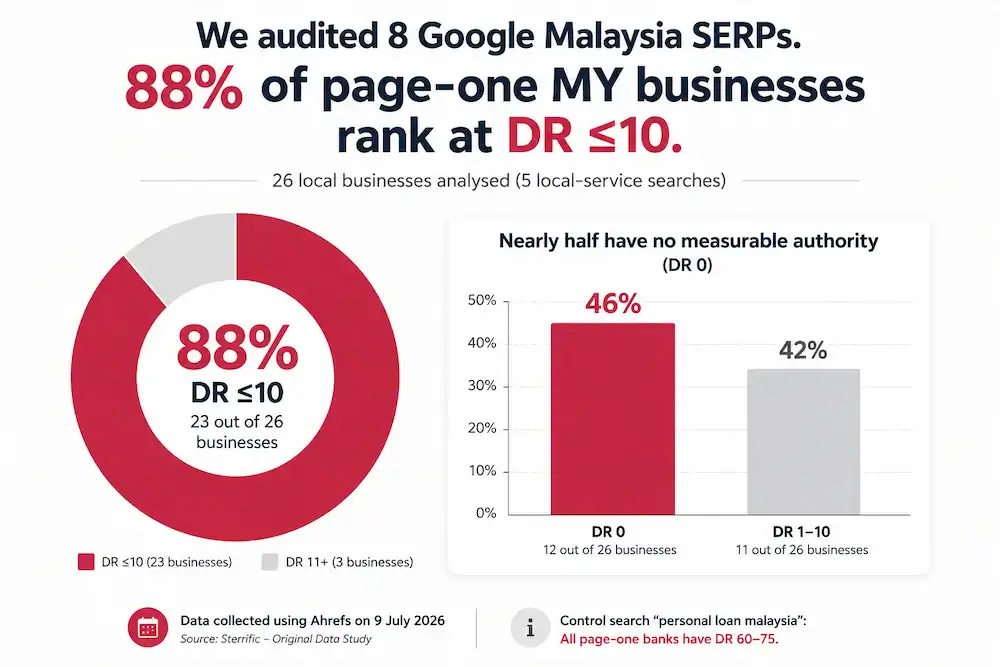
We audited the backlinks behind 8 live Google Malaysia SERPs in Ahrefs. Across 5 competitive local-service searches, 88% of the businesses on page one (23 of 26) have a Domain Rating of 10 or below, and 46% sit at DR 0 — propped up by bought links.
The economics explain it: you can buy 1,000 backlinks for ~RM50, while a real retainer runs RM1,500–9,000/month. A near-60× price gap is why the shortcut is everywhere.
We caught two live page-one sites whose anchor text literally advertises the seller — a “white-hat backlinks package” and a Telegram spam channel, “@SEO_LINKK”.
Google is explicit: buying links to manipulate rankings violates its spam policies and can trigger a manual action. The DR-0 sites winning today are renting their rankings on borrowed time.
Your game plan is inside: a 20-minute DIY audit, the 5 fingerprints, 6 questions for any agency, a recovery playbook, and what to build instead.
Most articles about black hat SEO are written by people who have never had to look it in the eye. They list the tactics — buy links, stuff keywords, cloak pages — and tell you not to do them. That is not useful to a Malaysian business owner. The question you actually have is sharper: is my SEO agency quietly doing this to my site right now, and is it about to cost me my rankings?
So instead of listing tactics, we ran a study. On 9 July 2026 we opened Ahrefs, pulled the live top 10 for eight ordinary Malaysian searches, and examined the backlink profile of every single website ranking on page one. We wanted receipts, not theory. We found them — and they are worse than we expected.
Here is exactly how we did it, so you can repeat it and check our work.
Method. We took eight commercial Malaysian searches and pulled the top 10 organic results for each in Ahrefs (Google Malaysia, 9 July 2026): one regulated money term, five competitive local-service terms where cheap SEO is rife, and the term SEO agencies use to sell themselves.
What we recorded. For every ranking site: Domain Rating (DR, the strength of a backlink profile on a 0–100 scale), referring domains, keywords ranked, estimated monthly traffic, and the actual anchor-text profile.
What we excluded, and why. Directories, social profiles and forums (Facebook, Reddit, Yelp, recommend.my). Their DR reflects the platform, not the business, so counting them would flatter the results. What’s left is the real contest: local companies competing for local customers.
A quick word on why Domain Rating matters here. DR is a logarithmic score of how strong a site’s backlink profile is relative to the rest of the web. Getting from DR 0 to DR 10 is easy; DR 10 to 30 is a year of real work; 30 to 60 is the territory of established brands. So when a commercial page ranks at DR 0, one of two things is true: either it just launched (and shouldn’t be ranking yet), or its links were manufactured. Our job was to tell which.
Finding 1: on page one of Google Malaysia, Domain Rating 0 is normal
Here is the study in one table — the count of genuine business websites ranking on page one of each search, and how many are running on near-zero authority.
Search (Google Malaysia)
Business sites on page 1
DR 10 or below
Lowest DR seen
plumber kuala lumpur
5
5
0
renovation contractor kuala lumpur
6
6
0
aircond service kuala lumpur
6
5
0
pest control kuala lumpur
4
4
0
kontraktor rumah
5
3
0
Total (local services)
26
23 (88%)
0
personal loan malaysia (control)
8
0
60
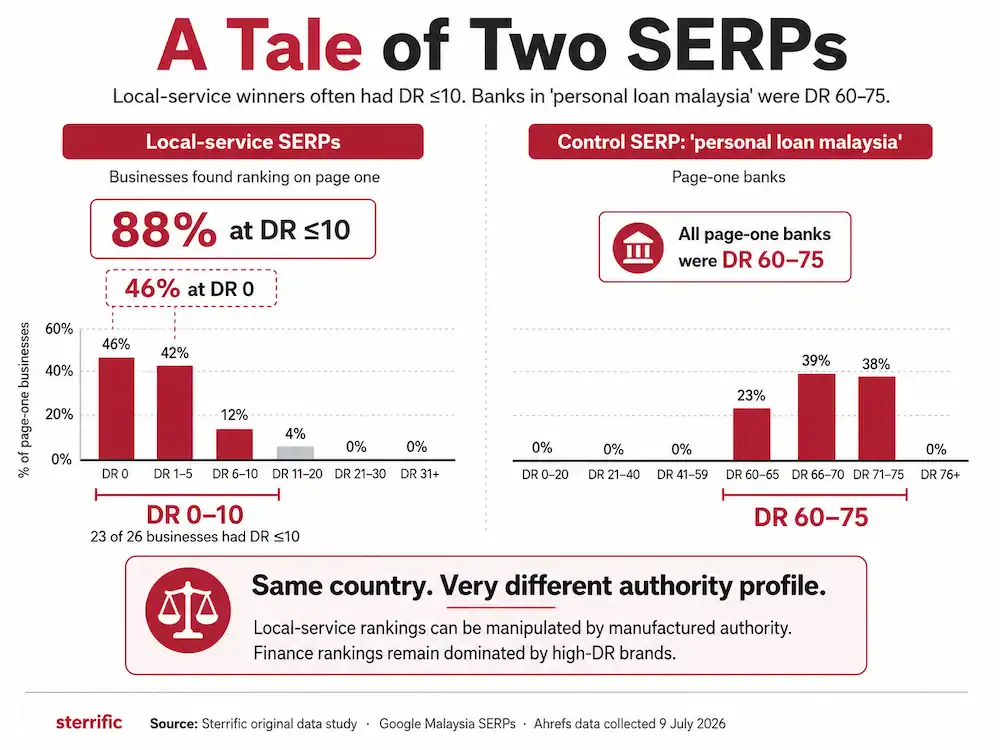
Read that bottom row against the rest. In banking, the weakest site on page one has a Domain Rating of 60. In plumbing, renovation, aircond and pest control, DR 0 is not the exception — it is the norm. Twelve of the 26 local businesses (46%) are sitting on a Domain Rating of exactly zero and ranking anyway. If you run a local service business in the Klang Valley, this table is your competitive landscape, and it is quietly rigged.
Finding 2: near-zero authority + hundreds of links = bought
A DR-0 site isn’t automatically guilty — a brand-new website is DR 0 too. What gives the game away is the mismatch: near-zero authority paired with a mountain of referring domains and almost no real content or traffic. Here are three live results from the “aircond service Kuala Lumpur” page one.
Position
Domain Rating
Referring domains
Keywords ranked
Monthly traffic
#2
0
196
74
531
#3
0
280
3
21
#10
7
302
34
342
Look at the No.3 site: 280 referring domains, but it ranks for just 3 keywords and gets 21 visits a month. That is 280 links aimed at a near-empty page. A healthy site earns links because it is useful, so links, keywords and traffic grow together. Here they have come apart completely — the tell-tale shape of a link package.
The plumber SERP was even more extreme: every one of the five business sites sat at DR 0 to 7 while carrying between 200 and 366 referring domains. Several showed an almost perfect one-link-per-domain ratio (for example, 200 backlinks from exactly 200 domains) — the fingerprint of a link farm, where a single link is dropped on hundreds of throwaway sites so the numbers look impressive at a glance.
Why it’s so cheap: the economics of a bought link in Malaysia
To understand why 88% of a page can be running on manufactured authority, follow the money. The price gap between fake links and real ones in Malaysia is enormous, and that gap is the entire market.
What you’re buying
Typical Malaysian price
What it actually is
“1,000 backlinks” gig
~RM50
Automated spam / link farm (the DR-0 footprint above)
Bulk “PBN” link
~RM5–RM50 each
A link on a private blog network Google is built to detect
A genuinely useful editorial link
~RM400–RM1,500 each
A real site choosing to reference you
A proper SEO retainer
RM1,500–RM9,000/mo
Content, technical work, and a handful of real links
Sit with that top and bottom row. A spam vendor will sell a thousand links for the price of two nasi lemak ayam and a teh tarik. A real retainer costs more than a thousand times as much per link, because it is buying something completely different: relevance, trust, and permanence. Reported Malaysian rates put the safe end of link-building at RM400–RM1,500 per quality link, against SME retainers averaging around RM3,000 a month. When a competitor is spending RM50 and outranking you, it is tempting to think you are the fool. You are not. They are the one holding a time bomb.
The analogy that fits. Buying links is like taking anabolic steroids to win a marathon. In the short term you will pass runners who trained for years. But you never built the heart and lungs to sustain the pace, and the moment you’re tested you’re disqualified — back to zero, with none of the base fitness the honest runners quietly banked. In SEO, the “drug test” is called a Google core update, and it runs several times a year.
What Google actually says (and does)
This is not our opinion; it is documented policy. Google’s Spam Policies for Google Web Search are blunt: “Buying or selling links for ranking purposes violates our spam policies. This includes exchanging money for links, or posts that contain links; exchanging goods or services for links; or sending someone a product in exchange for them writing about it and including a link.” Google is fine with paid links for advertising — as long as they are tagged rel=”sponsored” or rel=”nofollow” so they don’t pass ranking signal. The links in our study are neither.
Enforcement comes two ways. Google’s algorithms devalue manipulative links automatically — often the bought links simply stop working, and the site quietly slides. And where the violation is clear, a human reviewer can issue a manual action, which shows up as a notification in Google Search Console and can remove pages, or the whole site, from results. Recovery means removing or disavowing the links and filing a reconsideration request — a process that can mean auditing thousands of backlinks. It is slow, humbling, and entirely avoidable.
Our control search is the key to the whole study. Run the audit on “personal loan malaysia” and the picture flips completely:
Ranking brand
Domain Rating
Maybank
75
CIMB
71
RHB
69
Hong Leong Bank
68
UOB
60
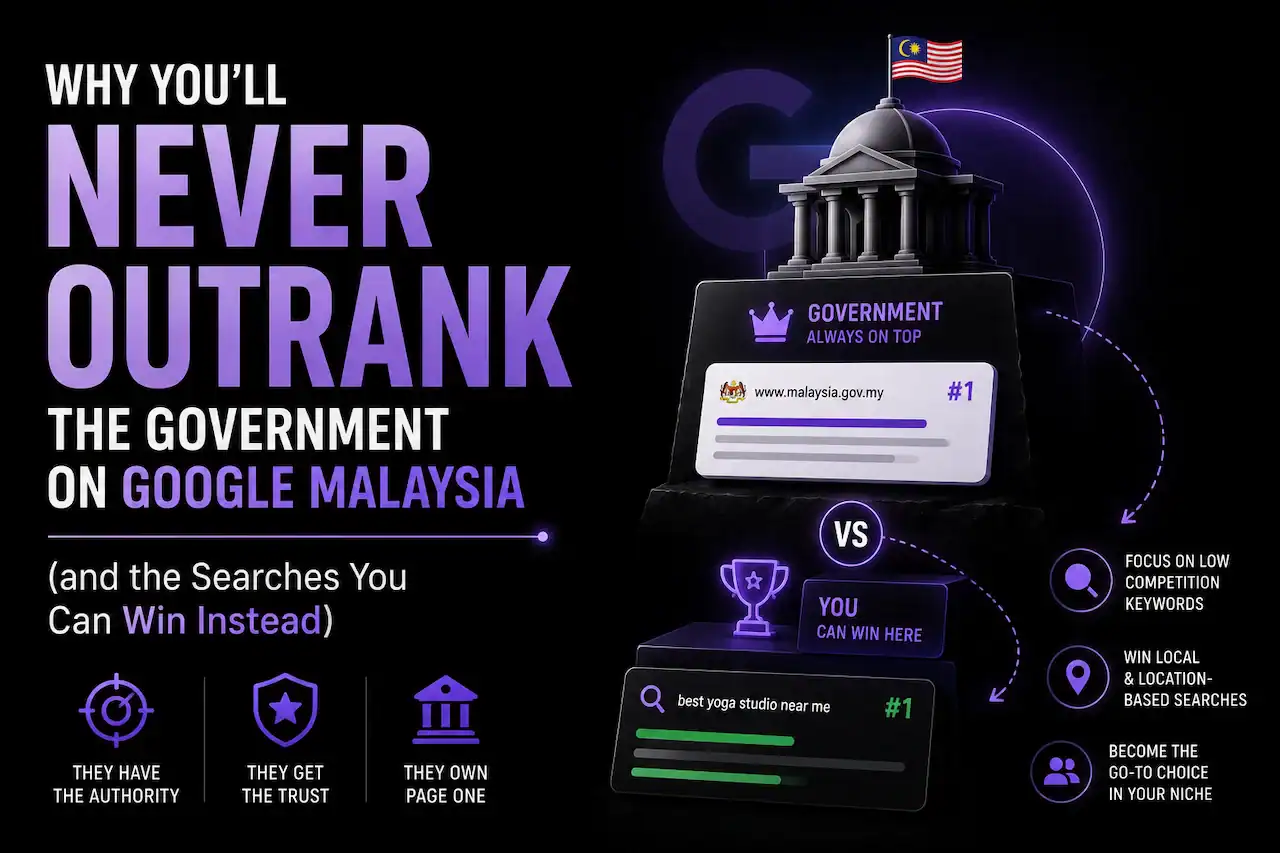
Every result is a real, regulated brand with a genuinely strong profile. There is no DR-0 site anywhere. Why the difference? Two reasons. First, banking is a Your-Money-or-Your-Life topic, where Google applies its strictest trust and quality thresholds. Second, the incumbents are simply too authoritative to dislodge with a RM50 gig. In “aircond service” and “kontraktor rumah”, neither guard is on duty — low trust thresholds and weak incumbents — so the cheap-SEO crowd walks straight in.
Malaysian operators have understood this for years. On a Lowyat.NET SEO thread, one member put it plainly:
“It’s hell lot easier to rank higher among local sites because there are very less competition. And that’s another reason why some of the SEO consultants out there are bull-sxxtting — because the price they charge [isn’t] worth what they’ve applied into the work.” — Lowyat.NET forum user
There is a knock-on effect for buyers, and you can watch it happen in real time. Because the ranked results in these niches are so untrustworthy, Malaysians increasingly skip Google’s organic list and ask other humans instead. Threads like “Aircon service woes — anyone you can reco, guys?” on r/KualaLumpur and “Reviews of renovation companies in KL” on r/malaysians exist precisely because the people at the top of the SERP bought their way there and can’t be trusted. Manipulated rankings don’t just harm the honest competitor — they degrade the whole channel.
Finding 3: the links literally advertise the seller
Bought links give themselves away in the anchor text — the clickable words in a link. A real link uses your brand name or the page topic. A cheap package blasts the same spun text across hundreds of junk domains, and sometimes that text is the vendor’s own sales pitch.
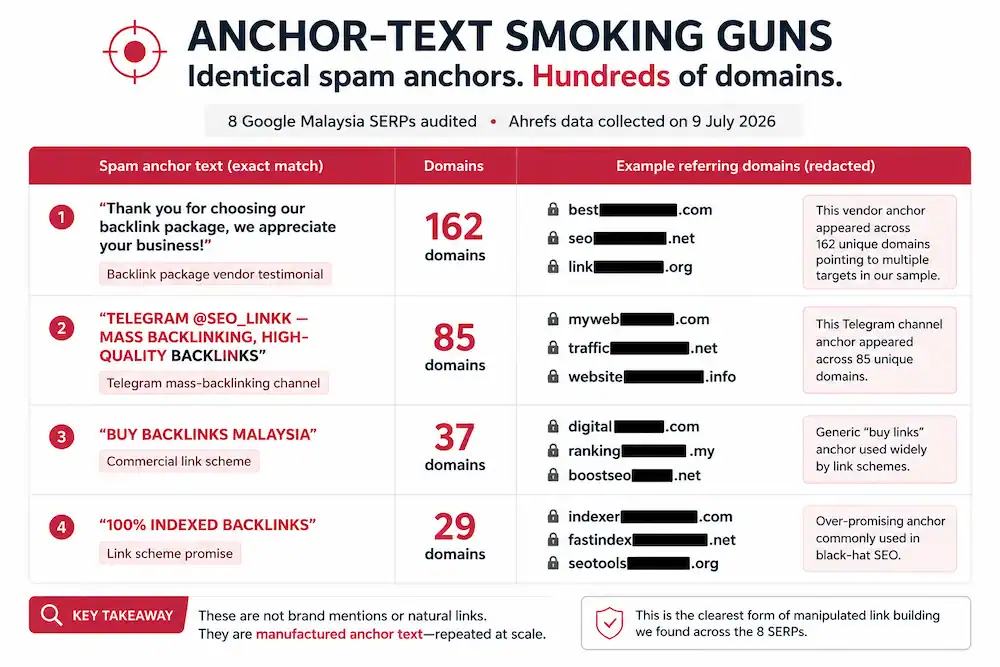
The single most common anchor pointing at that DR-0 No.2 aircond site — found across 162 separate referring domains, every one flagged as spam by Ahrefs — reads (verbatim):
“When starting [the site], every dollar mattered and wasting money on ineffective SEO agencies left me wary… Then came along SEOExpress.org — a refreshing approach where they actually cared about results! In under three months with their white-hat backlinks package, sales doubled…”
The site’s backlink profile is stuffed with 162 copies of a fake testimonial advertising the very vendor that built the links. “White-hat” is the punchline — there is nothing white-hat about 162 spam domains carrying the same spun paragraph.
On the “kontraktor rumah” page one, one ranking site is carrying 85 referring domains whose anchor text is, word for word:
“TELEGRAM @SEO_LINKK — MASS BACKLINKING, HIGH-QUALITY BACKLINKS”
The seller didn’t even hide. Their Telegram sales handle is sitting inside the backlink profile of a business currently ranking on page one of Google Malaysia. The same site shows tens of thousands of backlinks from only a few hundred domains — the signature of sitewide footer spam, one link copied across every page of a network. And the irony award goes to “seo services malaysia”, where one page-one result is an SEO company itself ranking on 259 links from 259 different domains at DR 15 — the exact footprint it would warn a client about. Some agencies sell the poison and drink it too.
The 88% headline hides how differently each SERP is rigged. Here is the real data, search by search.
Plumber KL — the most brazen. All five business sites on page one sit between DR 0 and DR 7. The No.2 result: DR 0, 247 referring domains, ranking for 21 keywords and 119 visits a month. The No.10 result: DR 0 with exactly 200 backlinks from 200 domains, ranking for 3 keywords and pulling 18 visits — a flawless one-link-per-domain link farm. A third sits at DR 7 carrying 366 referring domains but ranking for just 7 keywords. Not one earned its place.
Renovation contractor KL — 6 of 6 under DR 10. Every business site is DR 0 to 8. One at DR 3 carries 274 referring domains; another at DR 1 carries 303. A “top 10 renovation contractors” listicle ranking on the page sits at DR 0 with no referring domains recorded at all — thin enough that even the spam skipped it.
Pest control KL — the RM50 crowd against one real brand. Rentokil (DR 74) anchors the page as the lone established brand. Directly beneath it: a DR 1 site with 261 referring domains and a DR 0 site with 264. The distance between the incumbent and the challengers isn’t quality — it’s a link invoice.
Kontraktor rumah — the sitewide-spam extreme. One page-one site shows roughly 77,000 backlinks from only about 444 domains — the footer-link pattern, where a single link is stamped across every page of a whole network so a few hundred sites masquerade as tens of thousands of endorsements. Another ranks at DR 0 with 93 links from 93 domains.
Aircond service KL — where we started. Two DR-0 sites in the top three, one of them ranking on 280 referring domains while showing up for a grand total of 3 keywords.
The pattern across all five is identical: authority scores near zero, referring-domain counts in the hundreds, and organic footprints so small the sites barely exist outside their bought links. This is not a coincidence of five niches. It is one playbook, sold at one price, applied five times.
How these link packages actually work
The reason the fingerprints are so consistent is that the product is. A typical cheap package runs on a private blog network (PBN) — a stable of expired domains and auto-generated sites that exist only to link out. The vendor drops your URL into a spun template and blasts it across the network, which is why the same paragraph of text shows up as the anchor on 162 different domains, and why tools like Ahrefs flag the entire cluster as spam at once. Because the domains are junk, their Domain Rating is near zero; because the links are template-stamped sitewide, the link-to-domain ratio breaks; and because nothing on the page is genuinely useful, the traffic never arrives. Every fingerprint traces back to the same assembly line.
Seasoned Malaysian operators know to be wary of the “too good to be true” end of this market. As one Lowyat.NET member warned about the free and near-free SEO offers that feed it: “the SEO free submission, please don’t use it, they going sell your email to 3rd party. The world where got such always-free one?” The instinct is right. When the price is a rounding error, you are not the customer — your rankings are the product being gambled with.
What happens the day the update lands
Picture the sequence, because it is not hypothetical — it plays out after most core updates. Google refines how it weighs links and, effectively overnight, the network propping up a DR-0 site is devalued. The site gets no warning; it simply isn’t on page one anymore. There is no content to fall back on, because content was never the plan, so it doesn’t drift to page two — it vanishes. The owner, who was told SEO was “handled,” watches the enquiries dry up and often never connects it to an algorithm change weeks earlier. Meanwhile the vendor has moved on to the next client, and rebuilding from a disavow file and an empty website takes far longer than doing it properly would have in the first place. The RM50 was never the real price. The real price is the year you now spend climbing back — and every honest competitor who used that year to build something is now above you, for good.
The 5 fingerprints of a bought-link profile
You don’t need paid tools for most of this — Google Search Console’s free Links report shows you the essentials. Here is what manipulation looks like in the data, and how to check each one.
Domain Rating near zero, but ranking anyway. Real authority builds slowly. A DR 0–5 site at #2 for a commercial term didn’t earn it. Check: a free DR checker or Ahrefs’ free tools.
Referring domains that dwarf the content. Hundreds of linking domains but only a handful of keywords and near-zero traffic means links aimed at an empty shell. Check: compare your referring-domain count to the number of pages and keywords you actually have.
A broken link-to-domain ratio. Exactly one link per domain across hundreds of random sites (link farm), or tens of thousands of links from a few domains (sitewide footer spam). Healthy profiles sit in between. Check: Search Console > Links > Top linking sites.
Junk in the anchor text. Scan your anchors. Your brand and page topics are normal. Vendor ad copy — “backlinks package”, “@SEO_LINKK”, “buy backlinks cheap” — or foreign-language spam (casino, loan, adult) means someone bought them. Check: Search Console > Links > Top linking text.
A sudden spike. Hundreds of new links in a single month, then silence, is a purchase, not a campaign. Check: Ahrefs referring-domains graph, or the trend of your Links report over time.
Your 20-minute DIY backlink audit
Before you accuse anyone — or panic — run this. It costs nothing and takes about 20 minutes.
Open Google Search Console (free). Go to Links > External links > Top linking sites. Note roughly how many domains link to you.
Open Top linking text. Read your most common anchors out loud. If you see your brand, your service, and your city — good. If you see vendor names, “cheap backlinks”, or foreign casino/loan words, that’s a purchase.
Grab a free Domain Rating from Ahrefs’ free tools. Now compare: is your DR wildly out of step with how you rank? Suspiciously high with nothing behind it is as telling as suspiciously low.
Sort your linking sites by name. Strings of gibberish domains, obvious foreign spam, or hundreds of near-identical subdomains are link-farm tells.
Write down anything that fails. That list is either your disavow file (see below) or the question you take to your agency tomorrow morning.
6 questions to ask before you pay an SEO agency
The single best defence is a good question at the start. Ask these, and watch how they answer as closely as what they answer.
“Show me exactly where my links will come from.” A real answer names sites and reasons. “Our private network” is a red flag.
“How many links per month, and how?” A promise of “100 backlinks a month” is a promise to spam. Real links are slow.
“Can I see the anchor text you’ll use?” If they can’t say, the vendor is choosing it, not them.
“Do you buy links or build them?” Watch for the flinch.
“What happens if Google issues a manual action?” A real agency has a plan. A link seller has already moved on to the next client.
“Will you show me the work inside my own Search Console and Analytics?” Transparency is the whole game. Your data should live in your accounts, not theirs.
Treat any guaranteed “#1 on Google” promise as the tell it is. Nobody controls Google’s rankings; anyone who guarantees them is either naive or planning to cheat.
Already been burned? The recovery playbook
If your audit turned up spam, don’t spiral — work the steps in order.
Document everything. Export your backlinks from Ahrefs or Search Console and flag every domain that fails the five fingerprints.
Try removal first. Where you can, ask the linking site to take the link down. Realistically, spam networks won’t respond — which is what the next step is for.
Disavow the rest. Compile the junk domains into a disavow file and submit it in Google’s Disavow Tool. This tells Google to ignore those links when assessing your site.
Stop the source. If an agency is still building these, end that engagement today. Disavowing while the tap is still running is bailing a boat without plugging the hole.
File for reconsideration — only if you have a manual action. Check Search Console’s Manual Actions report. If there’s a penalty, submit a reconsideration request documenting your cleanup. If there’s no manual action, you don’t need this — just clean up and rebuild.
Check it isn’t sabotage. Not every toxic link is self-inflicted — sometimes a competitor or ex-agency points spam at you on purpose (negative SEO). We documented a real Malaysian case in how an SEO agency sabotaged our client.
What to build instead (the durable game plan)
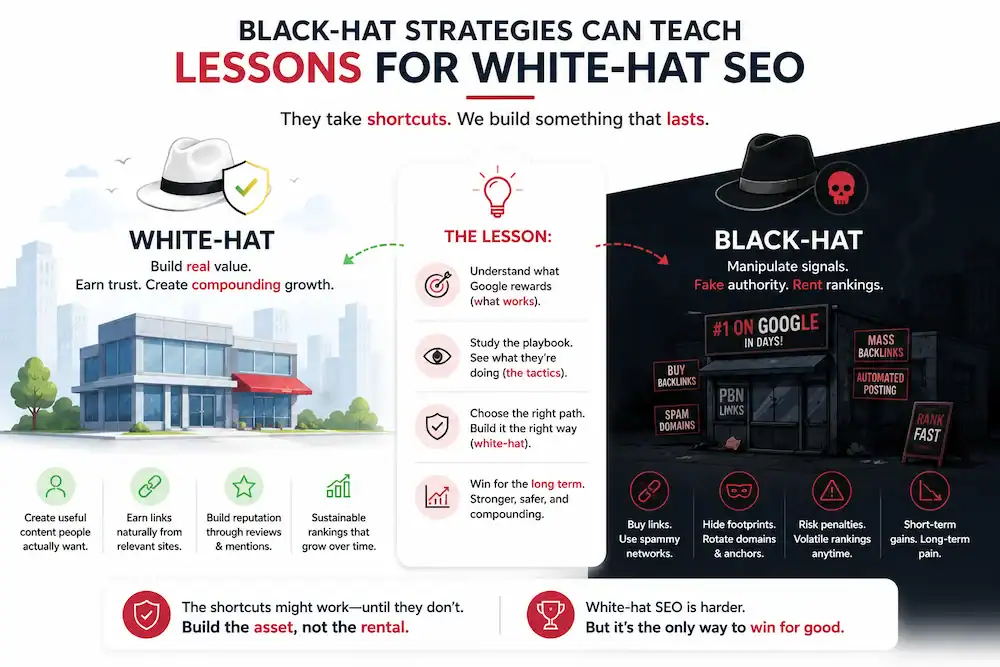
Here is the twist, and the reason this isn’t just a hit piece. Every black-hat shortcut is a fake of something that genuinely works — which is exactly why they bother faking it. Study the fakes and you get a map of what to build for real.
The black-hat shortcut
The real signal it’s faking — build this
Buying 200 spam links
A handful of real links: local press, suppliers, associations, genuine directories
Exact-match anchor spam
People naturally describing what you do, in their words
Keyword-stuffed doorway pages
Content that actually answers the searcher’s question
Fake testimonials
Real Google reviews and a real reputation
For a Malaysian local-service business, the durable plan is unglamorous and it works: (1) a fast, well-structured website with a real page for each service and each area you cover; (2) genuinely helpful content — honest pricing guides, “how to choose” explainers, real project photos — that earns links because it deserves them; (3) a rock-solid Google Business Profile with a steady flow of real reviews; and (4) a small number of legitimate local links from suppliers, associations, and Malaysian press. It is slower than a RM50 gig. It is also still standing after the update that wipes out the link farms.
And there is a quiet advantage hiding in our data. If 88% of your page-one competitors are built on links that Google is getting better at ignoring every year, then the first honest operator in the niche — the one with real content and real reviews — inherits the top of the SERP when the house of cards folds. In these niches, patience is a moat.
Go deeper: still deciding whether to invest in SEO or just run ads? Our SEO vs PPC guide for Malaysia lays out the real ringgit trade-offs.
The Final Take
Black hat SEO is not dead in Malaysia. Our data shows it actively ranking on page one for the searches your customers use every day — 88% of local businesses in these SERPs are running on near-zero, largely bought authority. But it is a rental, not an asset. The DR-0 site above you today carries a backlink profile that literally advertises the Telegram channel that built it, and it will not survive the next serious update. You can rent the same shortcut and live one algorithm change away from zero, or build the thing the shortcut is faking — real content, real links, a real reputation — and never look over your shoulder. The honest path is slower for about a year. Then it’s slower for your competitors, forever.
Not sure what your SEO is actually doing?
We’ll pull your backlink profile and tell you honestly what’s holding you up — and whether it’s built to last. No jargon, no hard sell.
Tactics that try to manipulate Google’s rankings against its guidelines — buying links, keyword stuffing, cloaking, doorway pages, fake reviews — for fast gains that risk penalties. White hat means earning rankings through genuinely useful content and links people give you willingly.
Is black hat SEO illegal in Malaysia?
It is not a crime, but it violates Google’s spam policies. The penalty isn’t legal — it is your site losing rankings, or getting a manual action, when Google detects the footprint. Our data suggests it eventually does.
How do I know if my SEO agency is buying links?
Run the 20-minute audit above. Check your backlink profile for the five fingerprints: a Domain Rating out of step with your rankings, referring domains that dwarf your traffic, broken link-to-domain ratios, junk anchor text, and sudden link spikes. Then ask the agency to show you their link sources inside your own Search Console.
Can buying backlinks get my site penalised?
Yes. Google’s link-spam systems devalue manipulative links, and a human reviewer can issue a manual action that removes a site from results until the links are disavowed and cleaned up. The sites in this study are exposed to exactly that.
How much do backlinks cost in Malaysia?
Spam is cheap — around RM50 for a thousand automated links, or a few ringgit each for private-blog-network links. Genuinely useful editorial links typically run RM400–RM1,500 each, and full SEO retainers for SMEs sit around RM1,500–RM9,000 a month. The price gap is the whole story: cheap links and real links are different products.
Does black hat SEO still work in 2026?
Short-term, and in low-competition unregulated niches, yes — as our Malaysian SERP data shows. Long-term, or in any niche Google treats as high-trust such as finance or health, no. It is a shrinking window on borrowed time.
What should I do instead?
Build a fast, well-structured site with a real page per service and area; publish genuinely helpful content that earns links; maintain a strong Google Business Profile with real reviews; and pursue a small number of legitimate local links. Slower to start, far more durable, and it compounds.
About this study. Produced by the Sterrific team using live Ahrefs data for Google Malaysia, pulled 9 July 2026 across eight commercial SERPs (five local-service terms, one regulated control, one industry term). Domain Rating, referring domains, keywords, traffic and anchor-text profiles were recorded per ranking site; directories, social and forum results were excluded. Pricing figures reflect reported Malaysian market rates; policy statements are drawn from Google’s published Search documentation. Ranking businesses are anonymised by position; link-spam vendors are named as they appear in the backlink data. Sterrific is a digital marketing agency in Petaling Jaya, Selangor.
Steve Chan is the Director of Sterrific with over a decade of experience in SEO and digital marketing. He leads data-driven digital strategies that help Malaysian businesses improve visibility, generate opportunities and achieve sustainable online growth. His work spans SEO, digital strategy, advertising and web development, with a strong focus on turning digital performance into measurable business results.
Make your brand stand out with Sterrific
Reach out today, request a Free Marketing Plan, and schedule your consultation with our experts.
“Since we started working with Sterrific back in May, their team has been a true strategic partner—helping us drive real impact and outstanding results. Just a few months into the partnership, in September, we hit a major milestone: our biggest online sales month ever. Compared to the year before, we saw an incredible 878% growth, which speaks volumes about how powerful this collaboration has been for us.”