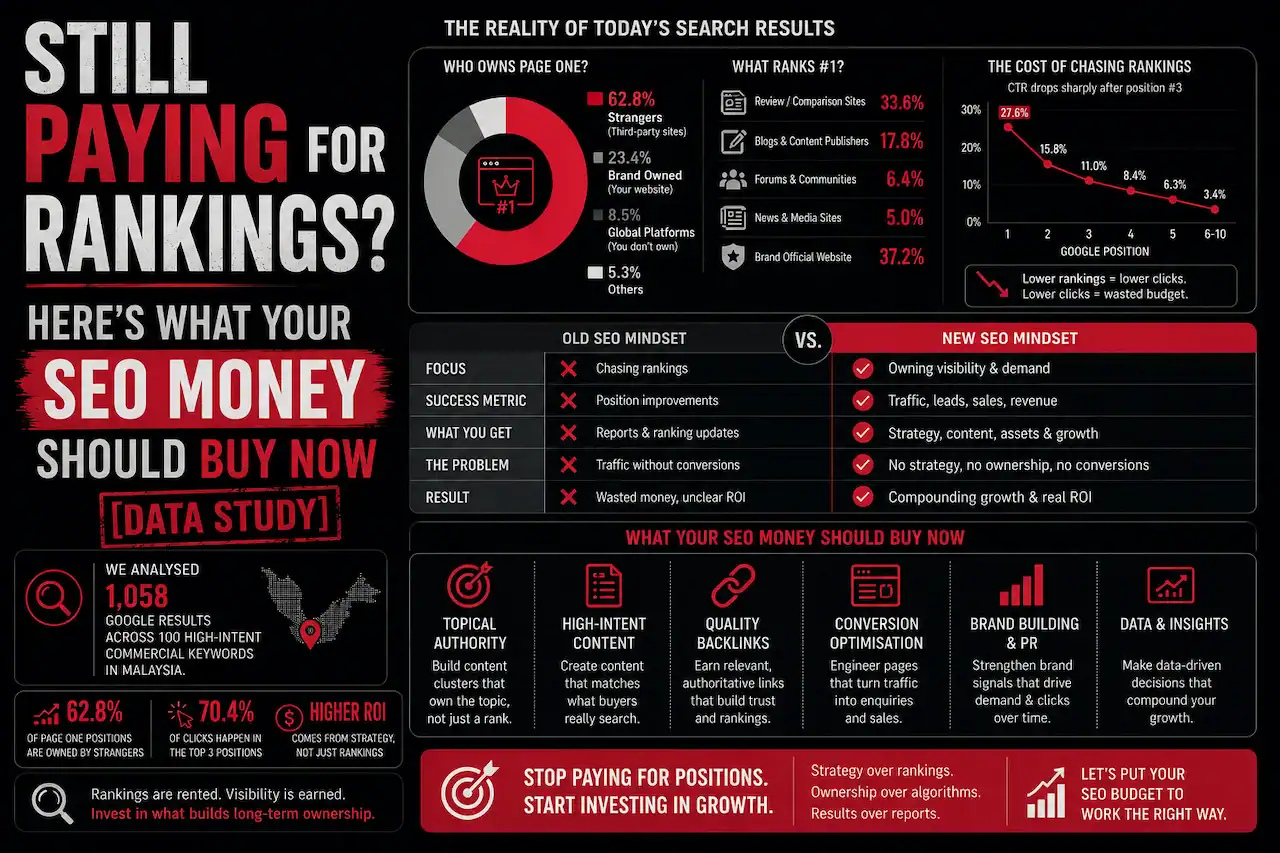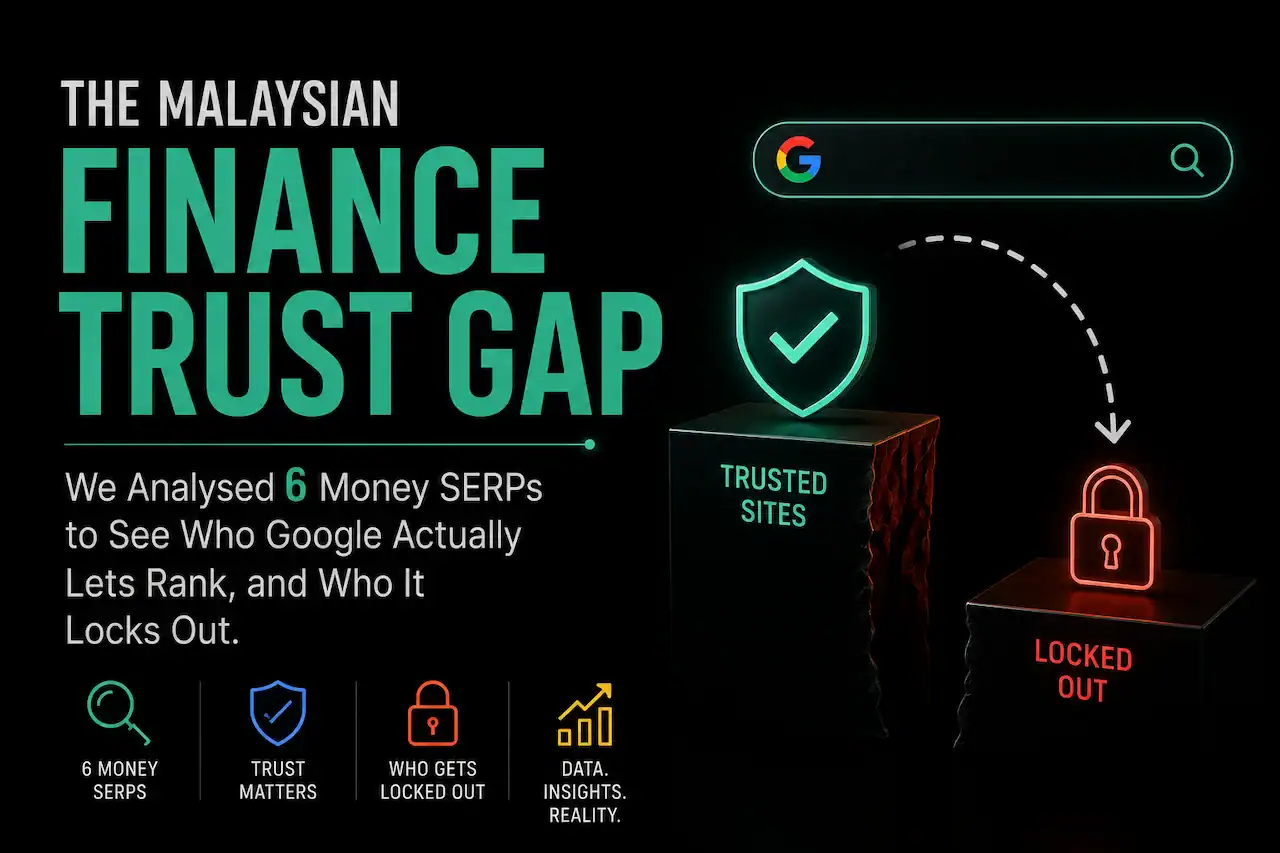
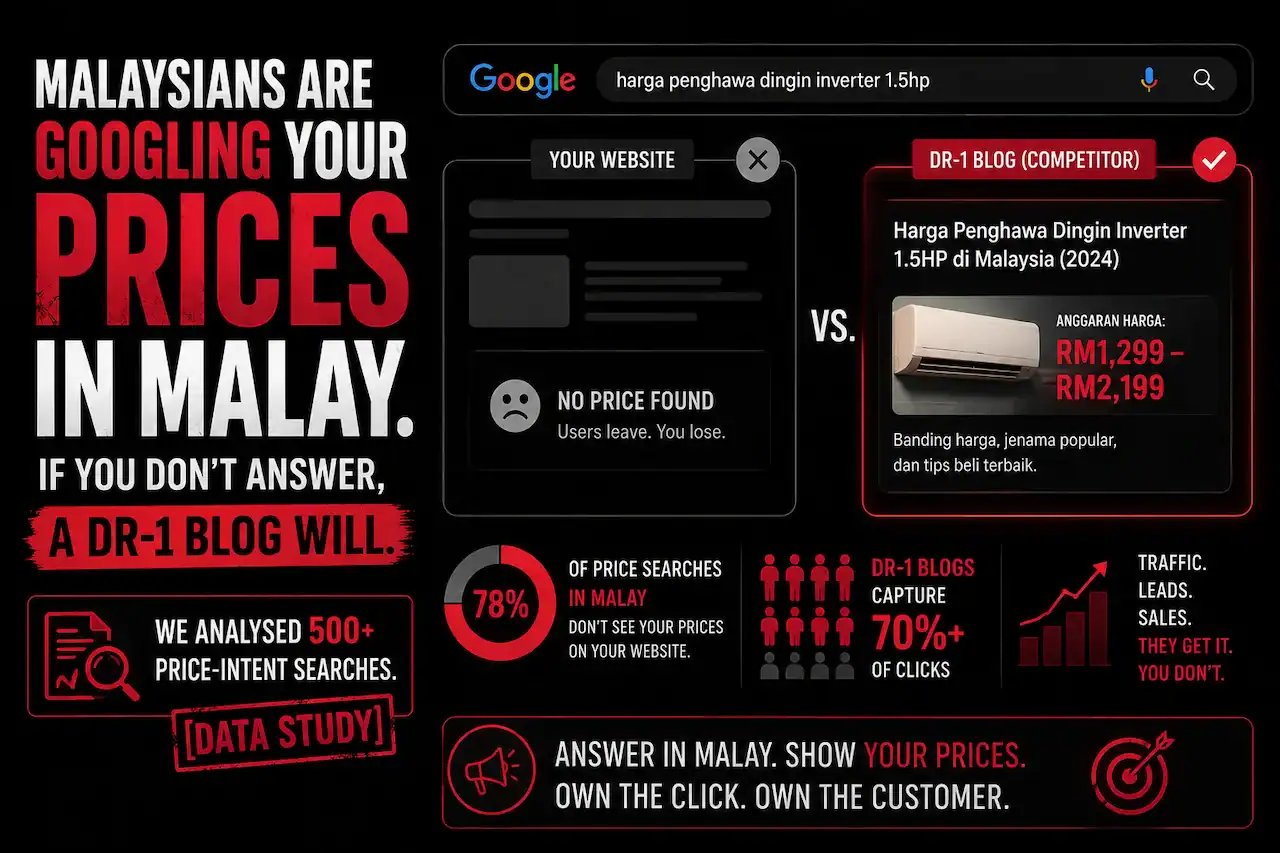
A Malaysian with money to spend is on their phone. They type one word in front of it: harga.
harga aircond
harga braces
harga renovation rumah
harga kereta secondhand
harga invisalign
In the next three seconds, Google hands them an answer. Is that answer coming from you — or from someone else who was willing to say the number you weren’t?
- harga aircond
For most Malaysian businesses, it’s someone else. The businesses that publish a number own the search. The businesses that say “WhatsApp us for a quote” are invisible.
study scope stat card
- What we pulled for this study
what this article covers (the four promises)
- What this article shows you — and why the order matters
The scale of price-search demand
33 keywords, seven verticals, and what the numbers say about where Malaysian commercial intent actually lives.
he language pattern that decides which keywords are real
why BM price queries and English ones are near-separate markets, and why translation workflows miss the biggest terms.
Who actually wins when businesses stay silent
Exactly what the data says to do about it
the pricing page framework, the disclosure thresholds, and what to publish when you genuinely can't quote a fixed price.
Price secrecy doesn't protect your margin. It just hands the most commercial search in your category to whoever was braver.
Key Findings (TL;DR)
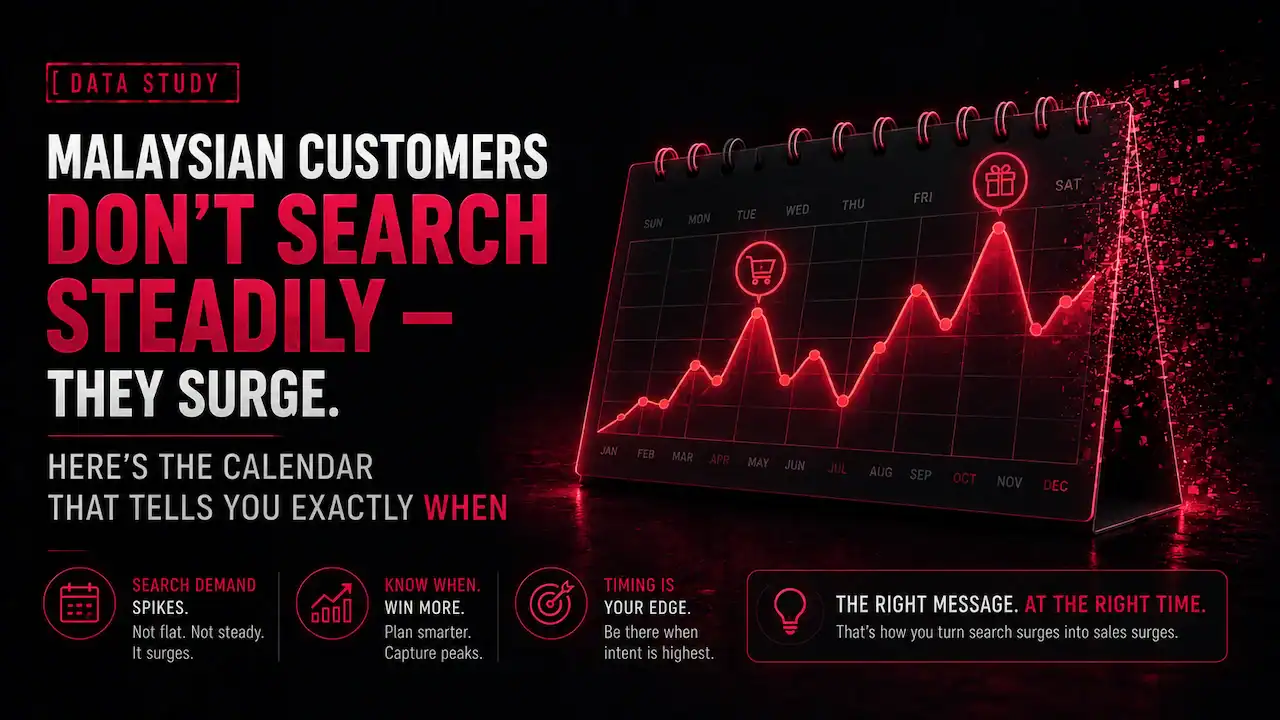
Malaysians search "harga" at massive scale
Our 33-keyword basket totals ~169,000 searches a month, and that's before counting the long tail. "Harga emas hari ini" (today's gold price) alone runs 136,000/month; "harga iphone 16" 5,600; "proton x50 price" 10,000; "harga aircond" 1,700.
Price-search is Malay-first — the mirror image of "near me."
Our geo-intent study found Malaysians search locations in English; here, they search for prices in Malay. "Harga aircond" (1,700) beats "aircond price malaysia" (250) 6.8 to 1; "harga iphone 16" beats its English form 18.7 to 1. Across the basket, BM "harga" terms outweigh English "price" terms roughly 14 to 1.
The page that shows a number wins. Full stop.
Across three dissected price SERPs, 89% of ranking organic pages display an actual price. The pages hiding behind "contact us for a quote" do not appear.
Domain authority barely matters here — transparency does.
On "harga braces," five of seven ranking pages sit at DR 8 or below — DR-1 clinic price-lists, DR-3 "harga braces" blog posts — outranking prestigious clinics that hide their fees. A DR-1 calculator ranks for "harga aircond" beside Daikin and Senheng.
Google's AI now answers the price itself.
On two of the three SERPs we pulled, an AI Overview states the price range directly at the top of the page — assembled from whoever published real numbers. Stay silent, and you're not just losing the click; you're absent from the answer Google now writes for you.
When businesses won't say the price, intermediaries take the search
price calculators, niche "harga" blogs, Facebook sellers' price-list photos, marketplace tags, and automotive editorial. Someone always answers. It's rarely the business itself.
Methodology
One question: how do Malaysians search for price, how much of it is there, and who wins when businesses hide their numbers?
- Three SERPs dissected in full
“harga aircond,” “harga braces,” and “harga proton saga” — classifying every ranking result by domain authority, by whether the page actually shows a price, and by SERP-feature type (organic, AI Overview, image, marketplace).
- 33 price-intent keywords
Pulled for Malaysian volume, Keyword Difficulty, and cost-per-click on 13 June 2026 (Ahrefs, Malaysia database), spanning big-ticket (cars, property, renovation, procedures), services (aircond, dental, legal), consumer goods (phones, laptops), and B2B.
- Both languages matched
For three products (aircond, braces, iPhone) we pulled the BM “harga [thing]” form and the English “[thing] price malaysia” form side by side, to measure which language carries price-search demand.
Two honest scope notes. First, “shows a price” is our classification of whether a ranking page displays actual figures (a number, a range, a price list) versus gating them behind a form — a judgement call, applied consistently, and the dataset ships so you can check it. Second, this is a snapshot of demand and current rankings, not a causal experiment; we measure what wins, and the pattern is strong, but correlation caveats apply throughout.
The dataset and analysis script are available on request — reach out and we’ll send the pack.
Finding 1
The “Harga” Economy Is Enormous
Start with the raw appetite for price, because it dwarfs what most businesses assume.

33-keyword basket · total monthly search volume
7 verticals: automotive · medical · home & renovation · electronics · finance · travel · services
outlier callout (harga emas)
136K
- harga emas hari ini
Malaysians check the gold price the way they check the weather. The outlier that anchors the basket — but the commercial story is in what follows it.
top commercial keywords grid (excluding outlier)
proton x50 price
10,000 / mo
harga iphone 16
5,600 / mo
harga minyak
3,900 / mo
harga tiket flight
2,000 / mo
harga aircond
1,700 / mo
harga honda city
1,400 / mo
harga braces
1,100 / mo
harga insurans kereta
800 / mo
A price search is the most commercially loaded query a person can make — they've already decided they want the thing; the only remaining question is what it costs and whether they can afford it. Someone searching "harga braces" is not researching orthodontics as a hobby. They are costing out a decision they intend to make, and they will transact with whoever answers them most convincingly.
The single most common piece of pricing “strategy” in Malaysian SME marketing is to withhold the price. The data says the opposite happens: the customer doesn’t call. They hit back, and they click the result that shows them a number. The price search is a hand raised to buy — and most businesses respond by leaving the room.
category breakdown (every vertical, full content)
Automotive
proton x50 price · 10K harga honda city · 1.4K harga proton saga · 1.1K · harga perodua myvi · harga servis kereta · harga tukar tayar
Medical
harga braces · 1.1Kharga gigi palsu · 300harga lasikharga implant gigiharga ivf malaysia
Home & Renovation
harga aircond · 1.7K · harga cat rumah · 800 · harga tiles · harga awning · harga renovation rumah
Electronics
harga iphone 16 · 5.6K · harga laptop · harga samsung s24
Finance
harga insurans kereta · 800 · harga saham maybank · harga minyak · 3.9K
Travel
harga tiket flight · 2K
169,000 times a month, a Malaysian asks what something costs. The business that answers gets the customer. The business that says "enquire within" gets forgotten before the kettle boils.
Finding 2
Malaysians Shop For Price In Malay — The Mirror Of “Near Me”
This is the finding that should reshape how Malaysian pricing content gets written, and it’s the exact inverse of what we found about location search.
Our “near me” study established that Malaysians search for “klinik near me” in English —”klinik berdekatan” beats “klinik berdekatan” 285 to 1. Price flips it completely. Malaysians search for how much in Malay:
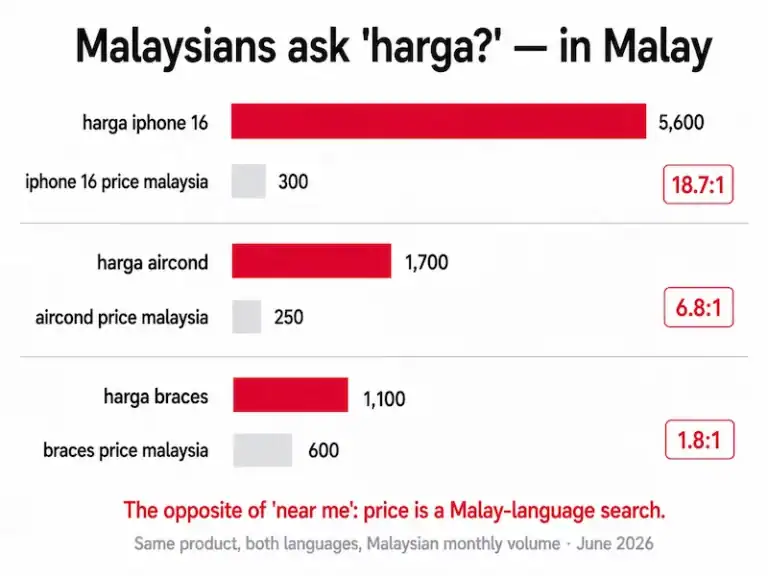
Product | BM “harga” | English “price” | BM leads |
iPhone 16 | harga iphone 16 — 5,600 | iphone 16 price malaysia — 300 | 18.7: 1 |
Aircond | harga aircond — 1,700 | aircond price malaysia — 250 | 6.8: 1 |
Braces | harga braces — 1,100 | braces price malaysia — 600 | 1.8: 1 |
Across the whole basket, BM “harga” terms outweigh English “price” terms roughly 14 to 1. “Harga” is, simply, the word Malaysians use to ask what something costs — across ethnicities, across product categories, across price points. Even for an imported, English-branded product like an iPhone, the price question is asked in Malay by an overwhelming margin.
Why the split from location search? Likely because “harga” is deep, everyday spoken Malaysian vocabulary with no friction — it’s the word you’d say at a market stall — whereas “near me” is a phrase the smartphone interface trained into people in English. Price is older, more visceral, more rooted in how Malaysians actually talk about money. Whatever the cause, the strategic consequence is fixed and specific: your pricing pages should lead in Malay, titled “harga [thing],” because that’s the search that exists. Build a beautiful English “[Product] Pricing” page and you’ve optimised for the 300, not the 5,600.
And — the lesson from our BM vs English study keeps holding true — you have to research this natively. You would never derive “harga aircond” by translating “aircond pricing”; the BM price-search behaviour only shows up when you look for it in Malay in the first place.
You wrote your pricing page in English to look professional. Your customers are asking “harga?” in Malay — and your professional English page is invisible to the question.
Finding 3
The Page That Shows A Number Wins — Authority Barely Matters
Here is where the study turns from demand to consequence, and the consequence is stark. We dissected who actually ranks for price searches, and the deciding factor isn’t authority, brand, or budget. It’s whether the page shows the price.
Google page 1 — “harga braces” (Malaysia)
| # | DR | Page | Price shown | Visits / mo |
|---|---|---|---|---|
| 1 | 16 | Dental clinic — “harga braces malaysia” Dedicated pricing post | Yes | 2,455 |
| 2 | 30 | Clinic — govt vs private braces comparison Price comparison page | Yes | — |
| 3 | 1 | Clinic — “braces-pricelist” page Direct price list URL | Yes | 512 |
| 4 | 3 | Clinic — “harga braces” landing page Pricing landing page | Yes | 308 |
| 5 | 1 | Dental blog Informational post with figures | Yes | 551 |
| 6 | 1 | Seremban clinic — “harga braces” breakdown Local clinic pricing page | Yes | — |
| 7 | 8 | Clinic — “harga braces for every budget” Budget-framed pricing guide | Yes | — |
| 5 of 7 ranking pages sit at DR 8 or below · 7 of 7 display an actual price | ||||
Five of the seven ranking pages sit at DR 8 or below — tiny clinic websites beating prestigious practices across the Klang Valley. Because they did the one thing the prestigious clinics won’t: they published the price. The famous clinic with the beautiful website and the “book a consultation” button is nowhere, because it answered a different question than the one being asked.
the relevance equation
- Relevant to "harga braces"
“RM 3,800 – RM 8,000”
- Not relevant to "harga braces"
“Contact us to learn more”
The pattern repeats on harga aircond and harga proton saga. Across all three SERPs, 89% of ranking pages display a price. In a price search, relevance is the number.
trust signal callout
The clinic that publishes "RM 3,800–8,000" answers the anxiety and earns trust in one move. The clinic that says "book a consultation to discuss pricing" confirms the fear — that the price is something to be managed, extracted in person. Silence reads as something to hide.
You don't need a stronger website to win the price search. You need the price on the page. Your DR-1 competitor figured that out.
Finding 4
Google’s AI Now Says The Price For You — Whether You Like It Or Not
The newest twist is the one that closes the escape route businesses have relied on.
On two of the three price SERPs we pulled — “harga aircond” and “harga braces” — Google now displays an AI Overview at the very top that states the price range directly. Before the searcher scrolls to a single website, Google has already told them roughly what the thing costs, in a tidy summary assembled from the pages that published real numbers.

the old logic, broken twice
A transparent competitor already showed them the number
further down the same page. The customer didn't need to call you. They clicked.
Google's AI Overview now shows them an estimate before they reach any website
drawn from your competitors' published figures. Not yours. Your silence doesn't create mystery. It removes you from a conversation happening without you.
who the AI quotes
- Gets the citation
The business that published “RM 3,800–8,000.” Gets the AI quote, the authority signal, and the click.
- Gets nothing
The business that said “contact us for a quote.” The information is freely available from five other sources. You withheld it only from yourself.
- Google AI Overview — "harga braces"
Being the source the AI quotes for price is now a deliverable. You cannot be quoted for a number you refuse to publish.
when no business answers, the intermediaries move in
| Who fills the slot | SERP | Why they exist | Cost to you |
|---|---|---|---|
| Price calculator DR 1 | harga aircond | Built because businesses won’t state a number, so someone estimated it for them. | Traffic lost |
| Facebook price-list photos | harga aircond | Image posts rank because established retailers hid behind “WhatsApp us”. | Enquiry lost |
| Lazada / marketplace listing | harga aircond | A product price tag ranks when no brand page will say a number. | Margin to platform |
| Editorial sites (Paultan, Carlist) | harga proton saga | Manufacturer was vague, so editorial sites published the RM-by-variant breakdown. | Authority lost |
| TikTok / Instagram price screenshots | harga braces | Clinics posting price screenshots fill the visual slots prestigious practices left empty. | Visual slot lost |
| Comparison blogs DR 1–8 | multiple | Aggregated everyone else’s published prices into one page and ranked for it. | Click lost |
| Every intermediary above exists because a business stayed quiet, and is now collecting the customer that business could have had. | |||
Every one of these is an intermediary capturing demand that a business abandoned. Price is the most commercial query of all — so the abdication is the most expensive. You’re not losing informational traffic. You’re losing the customer at the exact moment their wallet is open, to a third party that monetises your silence.
Every price you refuse to publish is a business model for someone else. The calculators, the price-list sellers, the comparison blogs — they exist because you stayed quiet, and they're collecting the customer you could have had.
What This Data Does NOT Say
It does not say every business must publish exact prices.
It does not say price is the only ranking factor.
It does not say hiding price never has a business rationale.
It does not measure conversion.
"Shows a price" is a judgement call

The Final Take
Publish The Number, Own The Search
The verdict, plainly: Malaysians search for price constantly and in Malay, the page that shows a number wins regardless of its authority. Google’s AI now states the price before anyone reaches your site, and price secrecy — far from protecting you — simply hands the most commercial search in your category to a braver, smaller competitor. The question was never “should we reveal our pricing.” The customer already knows the price; they’re reading it off someone else’s page right now. The only question is whether that page is yours.
If you run a business
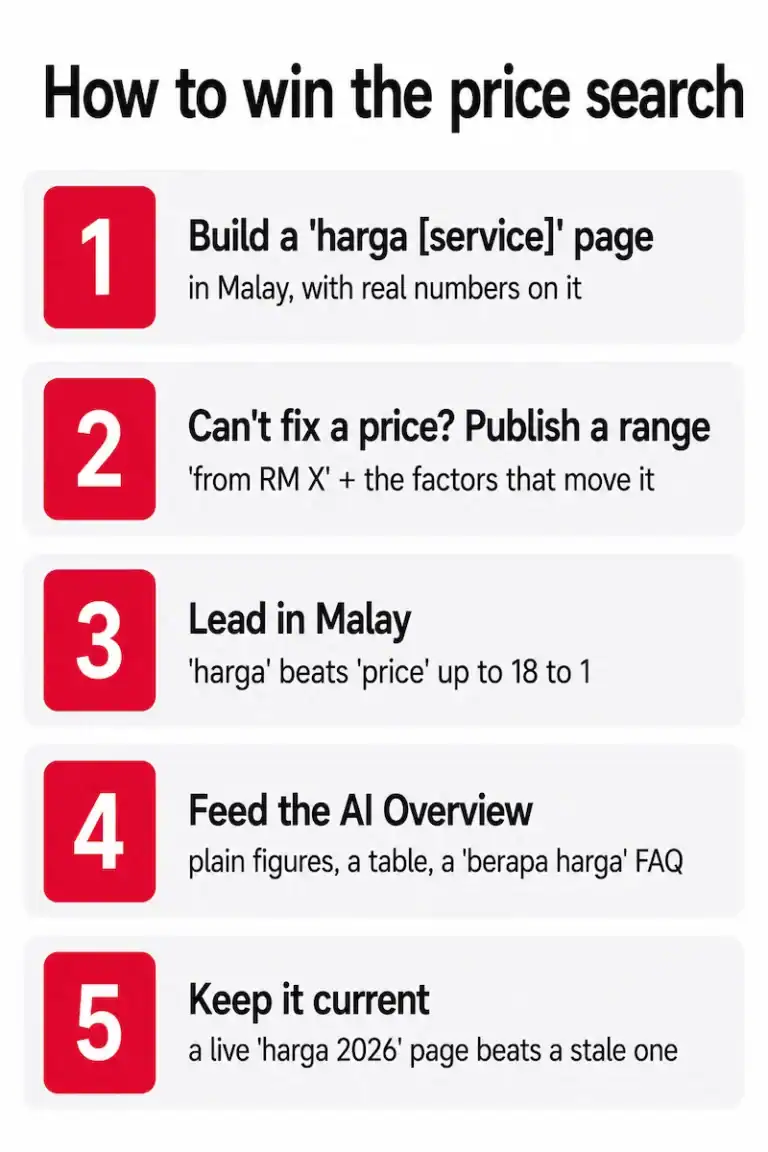
Build a "harga [your service]" page — in Malay, with real numbers on it.
This is the single highest-intent page you can publish. Title it the way Malaysians search ("harga braces," "harga renovation rumah"), and put actual figures on it. If you've resisted this for years, the data is your permission slip: your DR-1 competitor already did it and is taking your enquiries.
If you genuinely can't quote a fixed price, publish a range and the factors.
"From RM X," "most projects fall between RM X and RM Y," "here's what moves the price up or down," "here are three real past examples." A range ranks and earns trust; silence ranks nothing. Bespoke is not an excuse to show no number — it's a reason to show a considered one.
Lead in Malay for price content.
"Harga" is the search; your English pricing page is optimised for a fraction of the demand. Write the BM page first, the English one second — and research the terms natively, never by translation.
Structure the page to feed the AI Overview.
Clear figures, a simple table, the price stated in plain text near the top, an FAQ answering "berapa harga…" — the format Google's AI can lift. Being the quoted source for your category's price is the new prize.
Treat the price list as a living asset.
Update it as your rates change (the way the ranking calculator and price-list pages do). A current "harga 2026" page beats a stale one, and the freshness compounds.
If You’re a Marketer or Agency
The opportunity is enormous, and most clients are sitting on the wrong side of it.
Start with a price-transparency audit.
Show the client the “harga [their service]” SERP. Point out the DR-1 competitor already winning the search, then show them the AI Overview quoting competitors while their brand is absent.
The usual objection: “We don’t want to reveal our pricing.”
But the market is already doing it.
Your client is not revealing anything customers cannot already find elsewhere. The real decision is whether they want to appear in a high-intent search that is happening regardless.
Where the Opportunity Is
- High Intent
Users searching for prices are already close to making a decision.
- Low Competition
Many Bahasa Malaysia price keywords still have very low difficulty, sometimes KD 0.
- AI-Friendly
Clear pricing gives Google and AI search engines information they can easily extract and surface.
THE “HOME SOIL” STRATEGY
Own the organic price search. Let paid ads chase everything else.
The one-sentence version
Malaysians ask “harga?” hundreds of thousands of times a month in Malay. The page that gives them a number can win regardless of how small the brand is, and Google’s AI may surface that number before anyone even reaches the website.
- Publish your prices in BM, or keep sending your most ready-to-buy customers to the competitor who did.
Run This Yourself
The 33-keyword dataset, matched language pairs and analysis script are available on request.
Reach out and we’ll send you the full pack.
To test the same pattern in your own category, you can run this check in an afternoon.
The Afternoon Price Search Audit
01. Compare Search Demand
Pull the search volume for:
“harga [your product/service]”
and compare it with:
“[product/service] price Malaysia”
- In many categories, the BM search demand will significantly outweigh the English equivalent.
02. Check Who Ranks
Search “harga [your service]” on Google.
Look at the businesses ranking on page one and ask:
How many actually publish a price?
- Then check how authoritative those websites are. You may find surprisingly small domains competing successfully because they answer the pricing question directly.
03. Check the AI Overview
Search the same query and see whether an AI Overview appears.
Look specifically at:
Which businesses does Google quote when giving the price?
- This helps show who is feeding the AI layer with usable pricing information.
04. Check Your Own Website
Now run the most important test:
A customer searches for your price. Do they find a number or a contact form?
- That last question is often the entire diagnosis.
Limitations (Read These Before Quoting)
33 keywords and 3 dissected SERPs are an illustrative study, not a census
"Shows a price" is a consistent judgement call, not a Google signal
Correlational, not causal.
Demand is measured; conversion is not
Volumes and CPC are Ahrefs estimates
FAQ
We sell bespoke/custom work — we genuinely can't put a fixed price up. What do we do?
Publish a range and the logic behind it: “from RM X,” typical project bands, the factors that move the figure, and two or three real worked examples. The data penalises *silence*, not honesty about variability. A page that says “most clients spend RM X–Y, depending on these three things” ranks and builds trust; a contact form ranks nothing. Bespoke is a reason to show a thoughtful number, not no number.
Won't publishing prices let competitors undercut us?
Your competitors already know your pricing — they shop you, they hear it from lost clients, they can estimate it. Customers are the only ones your silence actually hides the number from, and they’re reading it off a transparent competitor’s page instead. You’re not protecting information; you’re protecting your own invisibility. And the data shows the transparent competitor is winning the customer, not the cheapest one — price content wins on being there, not on being lowest.
Should the price page be in Malay or English?
Malay first — “harga” is the dominant search (up to 18:1 over the English form). Publish the BM page as your primary, an English version as secondary, and research the terms natively rather than translating, because the BM price-search vocabulary doesn’t derive from English.
How do I get into the AI Overview for price?
Publish clear figures in plain text near the top of the page, use a simple price table, and add an FAQ answering “berapa harga…” directly. The AI Overview assembles from pages that state numbers plainly — you can’t be quoted for a price you don’t publish. (Our page-one anatomy study covers the broader “what the AI quotes” pattern.)
Isn't your 169,000 figure mostly just the gold price? Doesn't that inflate the finding?
Fair challenge, and worth answering plainly: yes, “harga emas hari ini” (136,000) is an outlier driven by daily gold-price checking, and we’ve kept it visible rather than buried it. But strip it out entirely, and the remaining 32 keywords still carry ~33,000 monthly searches across ordinary commercial categories — and the patterns that matter (BM leads English up to 18:1, transparency beats authority, the AI Overview answers the price) come from the non-gold SERPs we dissected: aircond, braces, proton. The gold number shows the intensity of Malaysian price-checking as a behaviour; the commercial keywords show it converts into the searches your business actually competes in. Neither needs the other to hold.
Is this just for consumer businesses, or B2B too?
Both, with adaptation. Consumer price searches (“harga aircond”) are higher-volume and reward exact figures. B2B price intent is lower-volume but extremely high-value (our zero-volume study found the B2B price tail is often unmeasured entirely) — and there, ranges and “starting from” pricing plus a clear scoping explanation win, because even B2B buyers are quietly searching the price before they ever contact a vendor.
Research and data by the team at Sterrific, a digital marketing agency in Petaling Jaya, Malaysia. Charts and figures may be republished with attribution and a link to this study.